They aren’t just different channels. They are opposite channels.
Some topics do well in social media. Others do better in search. A pro content strategist can predict this and knows how to align topics with channels.
The key to great content promotion is knowing the difference between social media and SEO. Because topic / channel fit makes all the difference. So today we’re taking a quick look at these side-by-side.
To make it easy to compare and contrast, we’ll line these two up side-by-side in one big infographic…
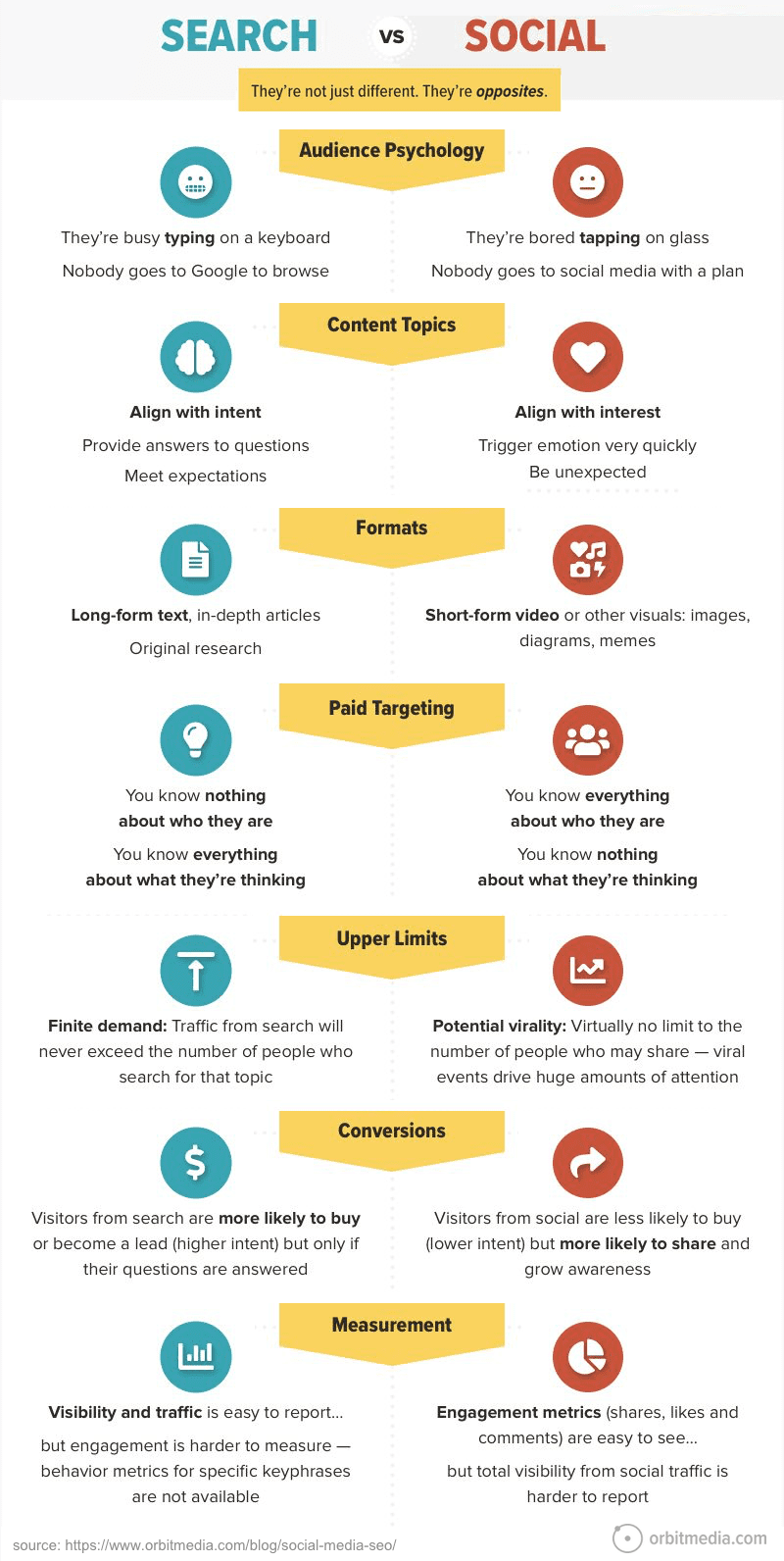
It’s a stark contrast, isn’t it? Look closely and you soon realize that social and search aren’t just different, they are polar opposites.
Let’s break it down:
1. Audience psychology
Different context. Different mindset. Different intent.
The reasons people go to a search engine and open up a social media app are completely opposite. This is a useful way to think about it.
- Search users are busy
Users of search engines have specific needs and they know it. They type it into a search bar with the specific expectation of getting answers or help. - Social users are bored
Users of social media have time, but no specific goals. They’re tapping, not typing.
In other words, no one goes to Google to browse. And no one goes to social media with a plan. With this in mind content strategists need to find the fit between our topics and our promotion channels.
Yes, some research shows that some social platforms are used to find answers. Some people go to TikTok or Instagram for lunch ideas. But that isn’t mostly how social media is used.
Social media is generally a terrible place to search for answers to questions. You can’t check tomorrow’s weather on Instagram. TikTok won’t tell you Tom Hanks’ age. Facebook isn’t the place to find out how much Tylenol a 6 year-old can take.
2. Topics for search vs. social
With the psychology of users in mind, we can quickly see why certain content, topics and headlines perform better in search. Other topics and headlines perform better in social media.
- Social media
Content that is unexpected, visual, collaborative or emotional often does well in social, especially emotions such as anxiety, anger and awe. Trending topics and strong opinion. - Search optimization
Content that meets expectations, especially research-based, detailed content that answers questions. Evergreen topics that don’t quickly go out of style often are perfect for SEO.
You can see the difference in your own GA4 account. Here’s how.
Go to the Page Path report and add a “secondary dimension” by clicking the blue plus sign above the first column. Select “Session source.” It’s also helpful to use a filter to show just your articles (Page path contains “blog”) and to remove direct traffic (Session source does not contain “direct”).
This is the report that shows the performance of all of your content in every channel:
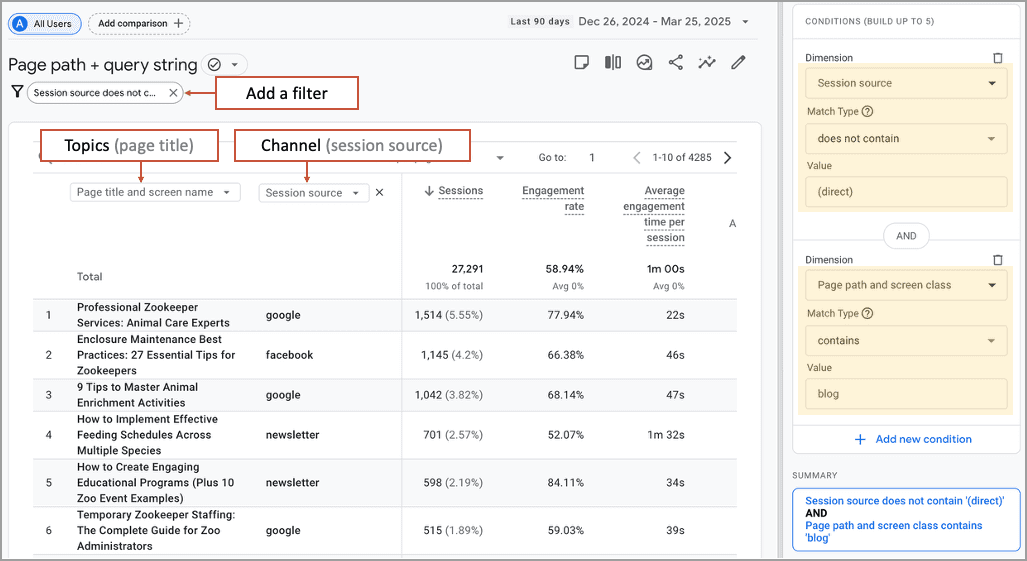
You’ll quickly see that some topics did very well in some social …but got zero traction in search. And vice versa.
It’s tricky to wade through all of that data. But AI can help. Export this GA4 report as a CSV file (click the share icon in the top right) and upload it to your favorite AI. Now you can talk to the data about the differences. You can even ask it to recommend new topics and align them with promotion channels.
Here’s the Topic / Channel Fit Prompt:
You are a Content Strategist and GA4 expert, skilled in using data to discover which topics perform well in which channels. I’m giving you a GA4 report showing the performance of content across various traffic sources. Using this data, suggest 10 new topics for articles aligning them with traffic sources in which they are likely to perform well. For each, suggest ways in which it could be promoted in that specific channel.
The analysis is interesting because it doesn’t rely on best practices. It’s based entirely on your data. It shows how your readers engage with your content in which channels.
3. Formats for search vs. social
Content formats are the types of media in which the content is published, including the lean-back-and-watch video and the lean-in-and-read article.
Some formats have natural advantages in search results, others in social streams.
- Search engines: Long-form text
Detailed articles perform best in search, at least in the traditional organic rankings. The average high-ranking is 1500-2500 words long (source). That’s big. Detail and relevance are key to SEO. There’s a good reason Google loves Wikipedia. Those articles are very very detailed. - Social media: Short videos
Short videos capture attention in fast-moving social streams. TikTok and Instagram are dominant and YouTube is catching up. Short-form video is the fastest growing format on the web.
Of course, Google also knows how compelling visuals can be. Search results are getting more visual all the time. 51% of Google search results include videos (source).
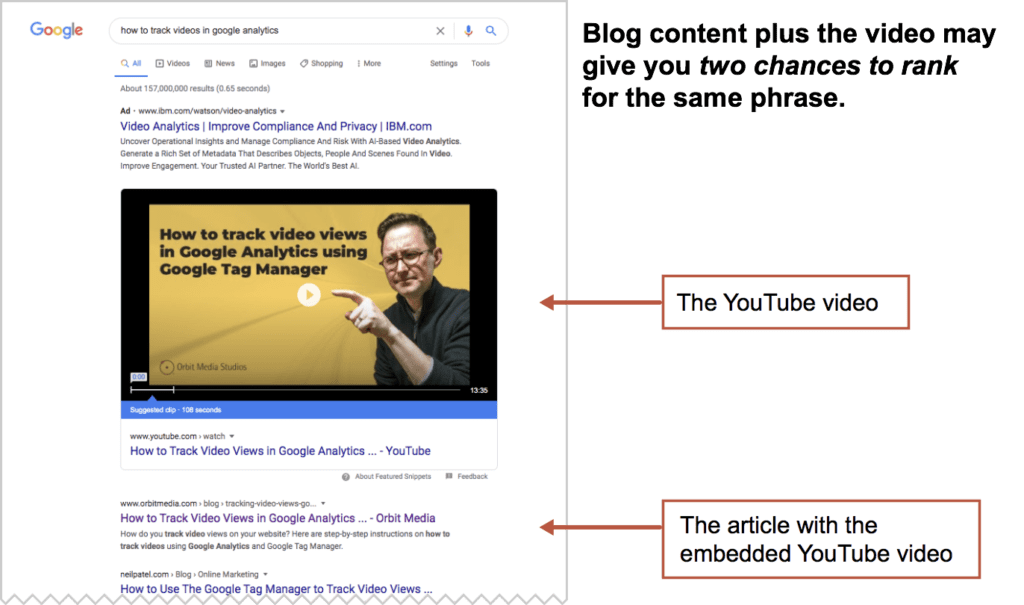
Source: Adding Video to Your Content Strategy
4. Paid targeting
We don’t usually talk about paid marketing in this newsletter but it’s so interesting, we can’t resist. It perfectly highlights the social vs. search differences.
In social, you target the audience based on their demographics and behavior. In search, you target the audience based on what they type into a little box.
- Paid search / PPC (pay per click)
You know everything about what they’re thinking, but you know nothing about who they are.
Good for: Pest exterminators. 🪳
If they need it, they search for it. They feel urgency. Bug problems are specific to a demographic. - Paid social
You know nothing about what they’re thinking but you know everything about who they are.
Good for: Cool sunglasses. 🕶️
They didn’t know they wanted them until they saw them. Now they have to have them.
Of course, paid social and paid search can work for all kinds of offers, topics and audiences. The examples above simply highlight the differences.
5. Influencer collaboration
Every piece of content is an opportunity to collaborate. Invite someone to cameo in your next video or contribute a quote for your next article, and the quality and the reach both improve. Better yet, use one of the intrinsically collaborative formats, such as roundups and interviews.
But different influencer collaborations have different advantages in different channels.
- Search engines: Subject matter experts
When the goal is to make the best page on the internet for an evergreen topic, you’re looking for quotes from subject matter experts that add insights and depth. It doesn’t really matter if they have a lot of Pinstagram followers. Examples: Research partners, journalists, authors - Social media: Social influencers
When the goal is to maximize reach and engagement, you’re looking to collaborate with people who have large and highly-engaged followings. It’s nice if they provide details and insights, but their ability to amplify is key. Examples: Strong/contrary perspectives, media personalities
Of course some potential collaborators are a mix of both, blending style with substance to create deep insights with wide social reach.
6. Upper limits
If everything goes well, what’s the upside? How much success is possible? Again, these two channels, social media and SEO, offer opposite opportunities.
- Search traffic: Topical maxima
There is a ceiling to the amount of traffic a page will get from a search engine. Traffic will never exceed the number of people who search for that topic each day. The total demand for the topic (the search volume) is the maximum amount of traffic the page will get from search engines. - Social media: Breathtaking virality
There is virtually no limit to the amount of traffic a page can get from social media. A huge number of people may share a piece of content. If you’ve ever seen the Analytics for content that has “gone viral,” you know just how far and how fast things can spread.
7. Conversions
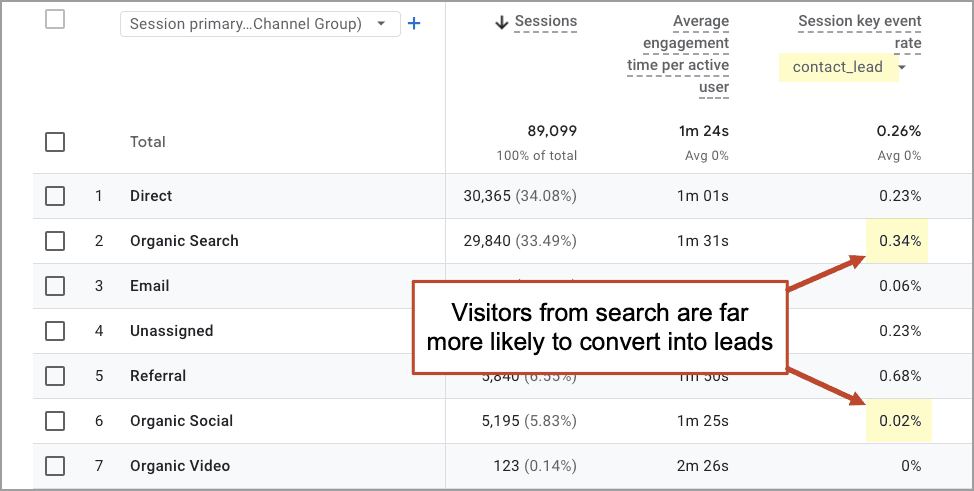
With different intent comes different conversion opportunities. Visitors who used a keyboard to get here are more likely to act than visitors who tapped on a piece of glass.
- Visitors from search are looking for something. They just searched for it. That’s why visitors from search are more likely to be ready to buy, but less likely to share and interact. These visitors enter with a specific purpose, need or question. They have strong intent.
- Visitors from social are just browsing around. They really have no specific intent. But if you capture their attention, they may drop by for a visit. They may also share and spread awareness, influencing other potential buyers.
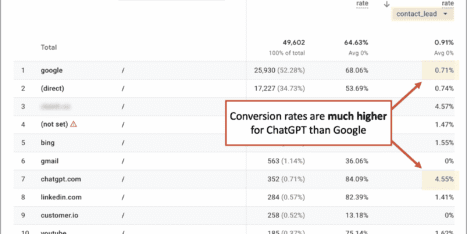
You can check the data for yourself. In GA4 check the Acquisition > Traffic acquisition report and scroll over to the “Session key event rate” metric. Here I’ve selected leads as the key event.
8. Measurement
Beyond conversion rates, different metrics are used for our two channels.
Search metrics are more accurate because search traffic comes mostly from one website. Social media traffic is hard to measure because social traffic comes to us from a wide range of websites and apps.
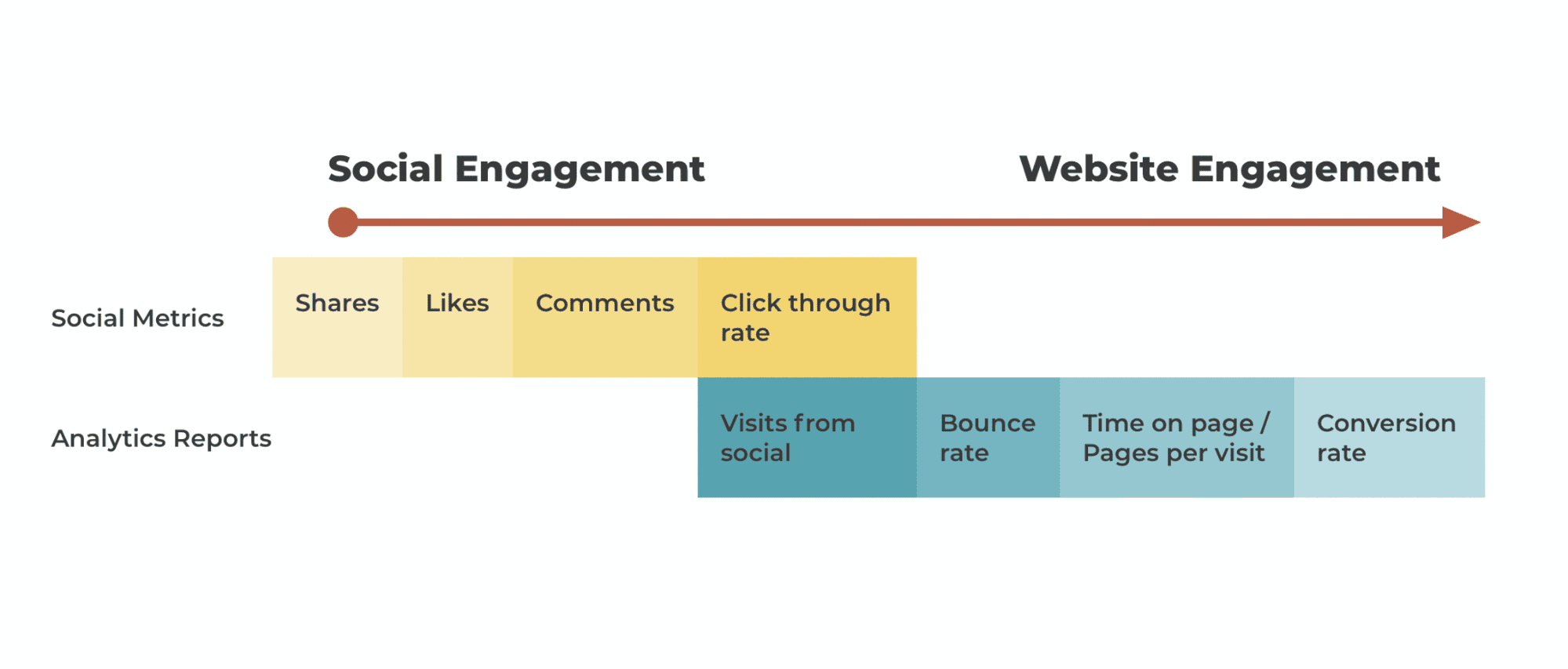
Social media is data rich because there are so many ways for users to engage. Compare:
- SEO metrics:
Paid SEO tools have lots of data: search volume, rankings for specific phrases. GA4 has some too: traffic, engagement and key events. Google search console shows impressions and clickthrough rates. - Social metrics:
Shares, likes and comments are all highly visible. But because GA4 misses a lot and often puts clicks from shares into “Direct.” You’ll need to use a URL builder to add campaign tracking codes if you want a more accurate picture. This helps a bit with the “dark social” problem. Once the campaign tracking codes are in place, you can track website engagement.
Here’s how they help each other
“You can’t do SEO without using social media.”
“You need to use search to do social media right.”
These might be overstatements, but there is truth there. Watch a social media pro at work, they’re doing research in Google.
The reverse is also true. SEOs dig through social media while researching topics and collaborators. These channels complement each other.
The final two bullets in our social media vs. SEO comparison show how the two channels work together.
- How SEO helps social media… Social profiles often rank in Google. Social posts do too (it’s the “What people are saying” box). And content that ranks in search may get shared and attract followers.
- How social media helps SEO… Relationships formed in social media often lead to the collaborations and links that drive rankings. It’s hard to network with editors without social media.