Every year we ask 1000+ content marketers 24 questions. The goal is to discover what marketers create, how often, how long it takes, how they promote it, and most recently, how they use AI.
The survey includes one final, simple question: Does your content deliver results?
For 12 years, the answer to that question mostly held steady. Year after year, between 20% and 30% of marketers told us their blog delivers “strong marketing results.” The number bounced around a little but always stayed within that range.
This year it dropped.
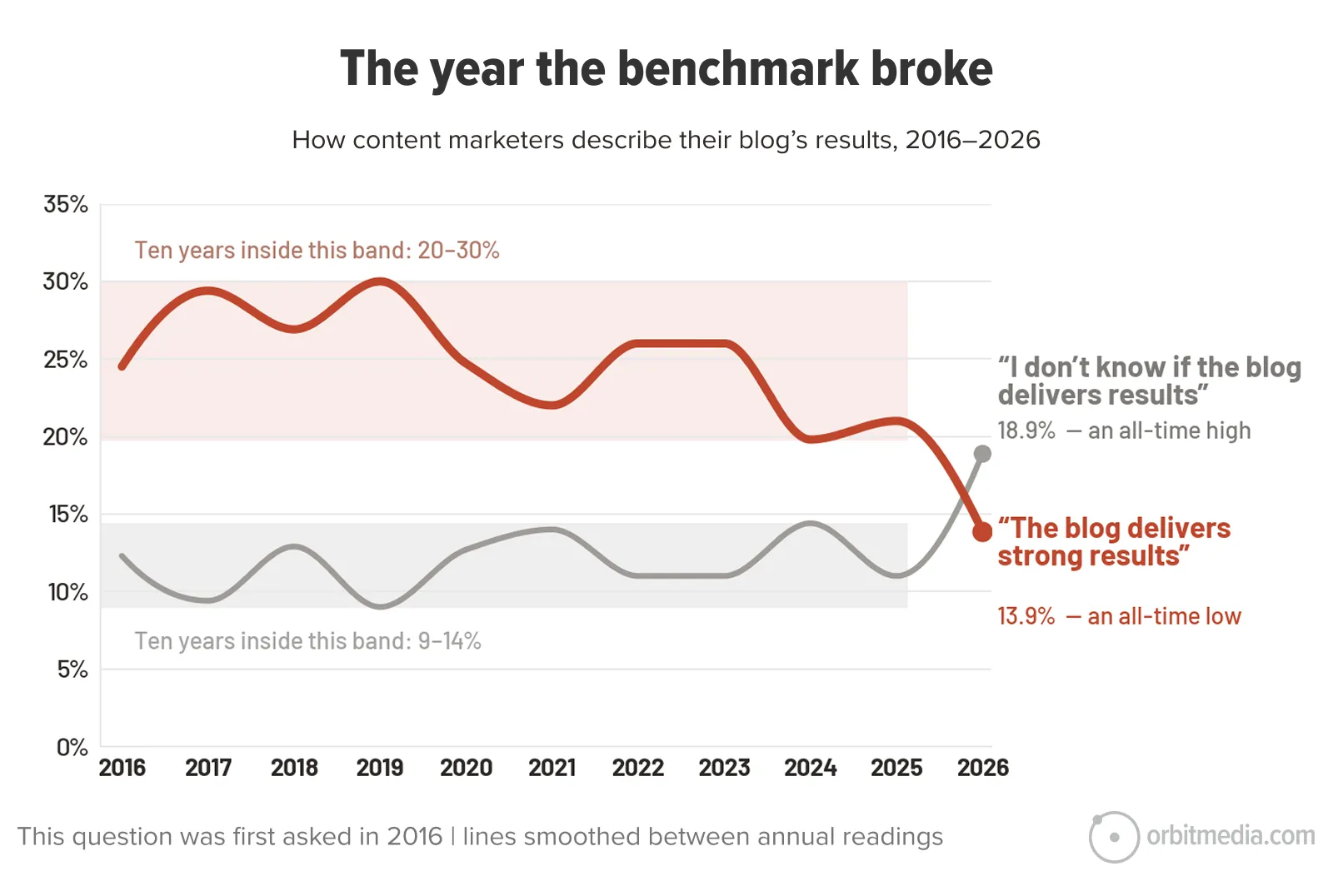
14% report “strong results.” That’s six points below the previous twelve-year low. That’s a huge dip.
At the same time, 18% report “I don’t know if the blog delivers results.” That’s a big jump. For a decade, that number always fell between 9% and 14%. Today, nearly one in five content marketers can no longer tell you whether the work they do is working.
Clearly, something happened.
But first, the 2026 numbers at a glance…
- 1,312 words – The average blog post, down from a peak of 1,427 in 2023
- 3 hours, 20 minutes – The average time to write one, down from a peak of 4:10 in 2022
- 13.9% say their blog delivers strong results, an all-time low
- 92.4% now use AI for blogging …and it correlates with nothing
How to cite this research… You are welcome to use any of these stats and charts in your content with attribution to Orbit Media. Just link back to this page. Questions? Need a custom cut of the data? Just drop us a line.
The four eras of content marketing
The data goes back far enough to give us a unique view into the evolution of content marketing. We can break it down across four specific eras. When we step back and look at it from a distance, we can see an entire industry change its mind several times.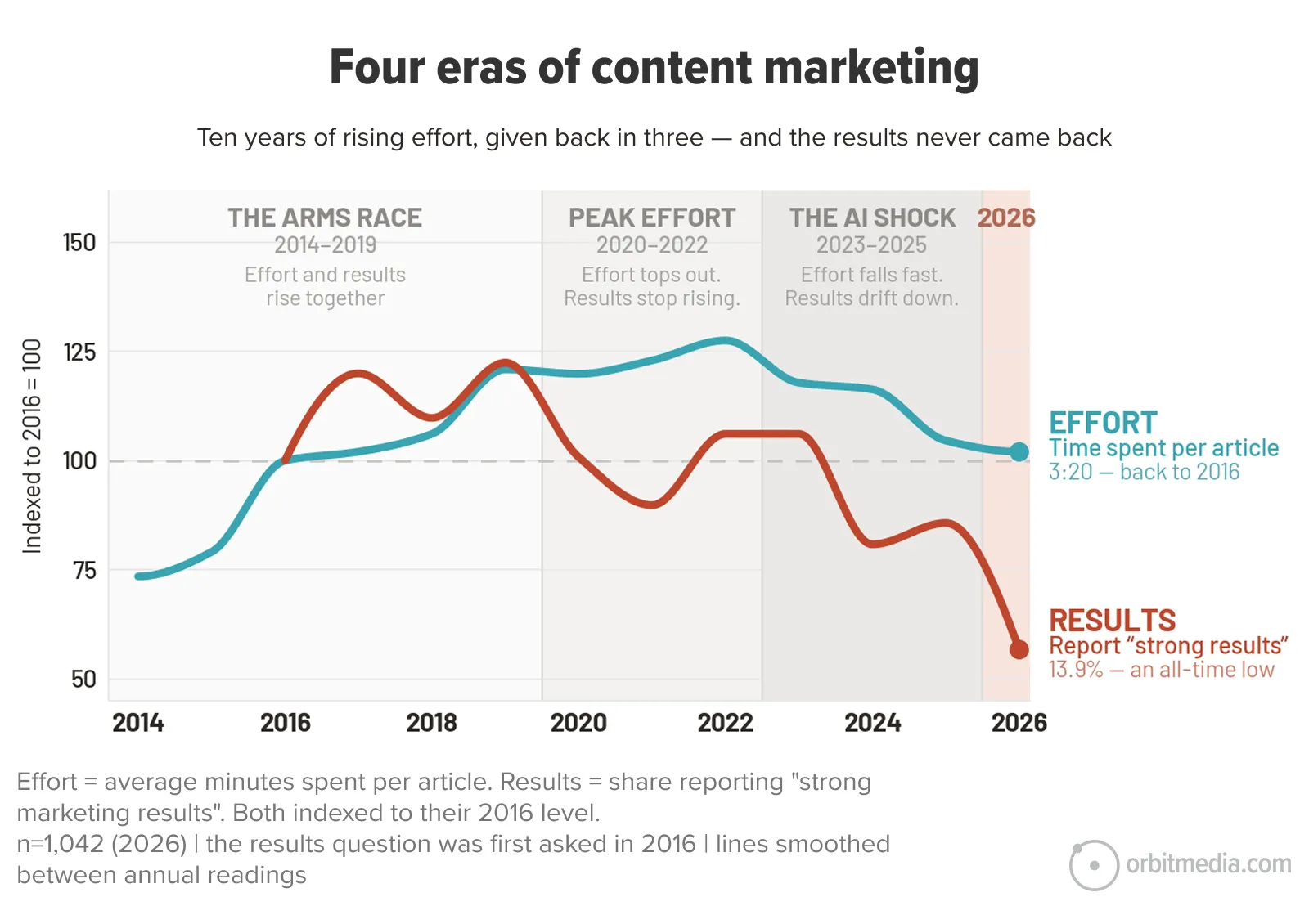
2014–2019: The arms race
In this era, everything went up together.
Time spent per post went up, climbing from two-and-a-half hours to almost four hours. Articles got much longer, rising from 800 words to more than 1,200 words. The use of email marketing nearly doubled. SEO promotion climbed eighteen percent.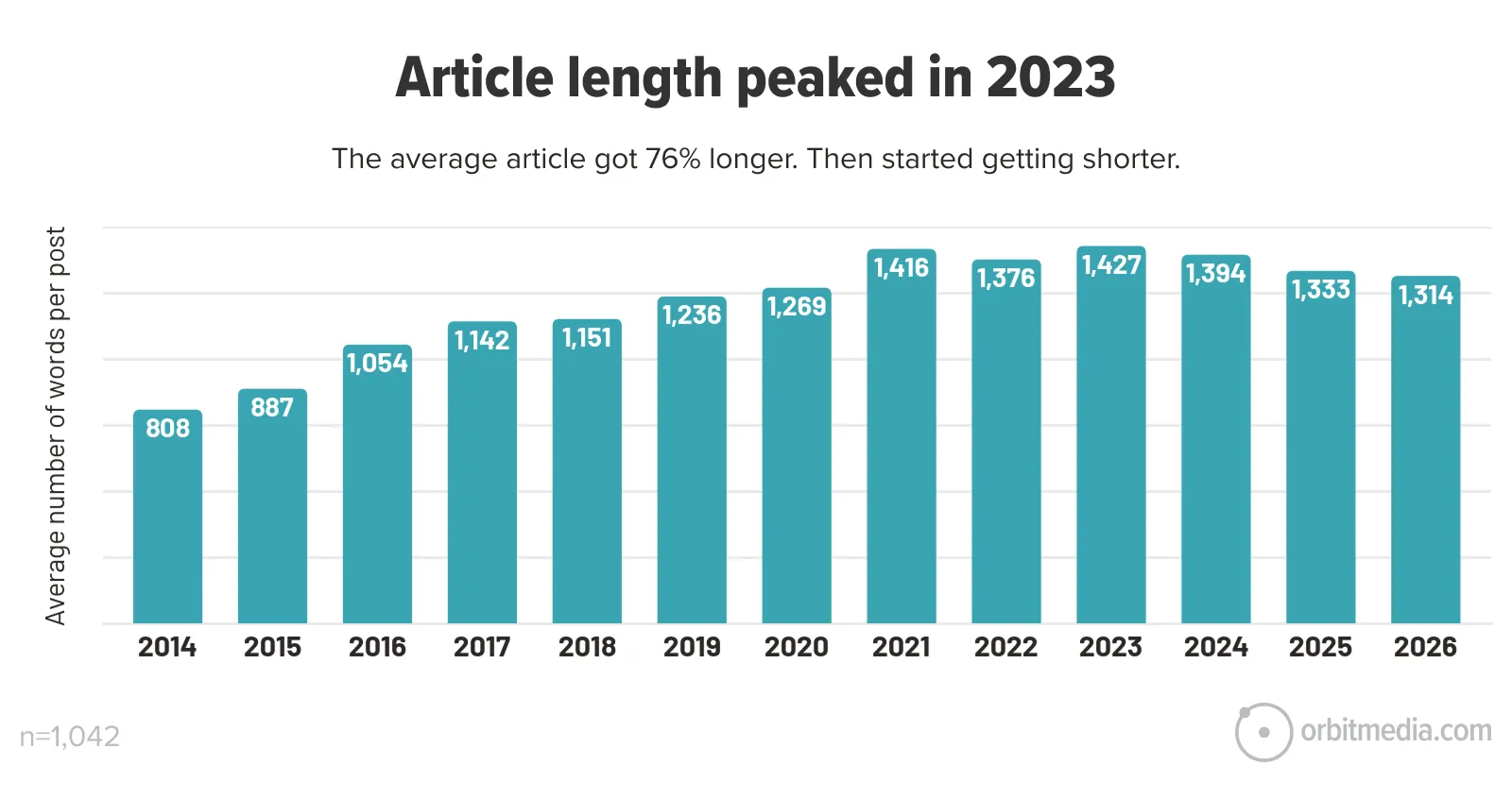
The idea was very simple: content marketing is a production contest, and whoever invests the most wins.
And that playbook actually worked. “Strong results” ran 25–30% through this whole stretch. Nearly every measure of effort correlated with better outcomes. The winners were those who published longer articles, more frequent articles and spent more time on each.
2020–2022: Peak effort
Then the arms race topped out.
Time spent writing per article peaked back in 2022. Length peaked in 2023. Updating older articles hit a high of 73%. Content marketers were maxing out on effort and one in four reported strong results.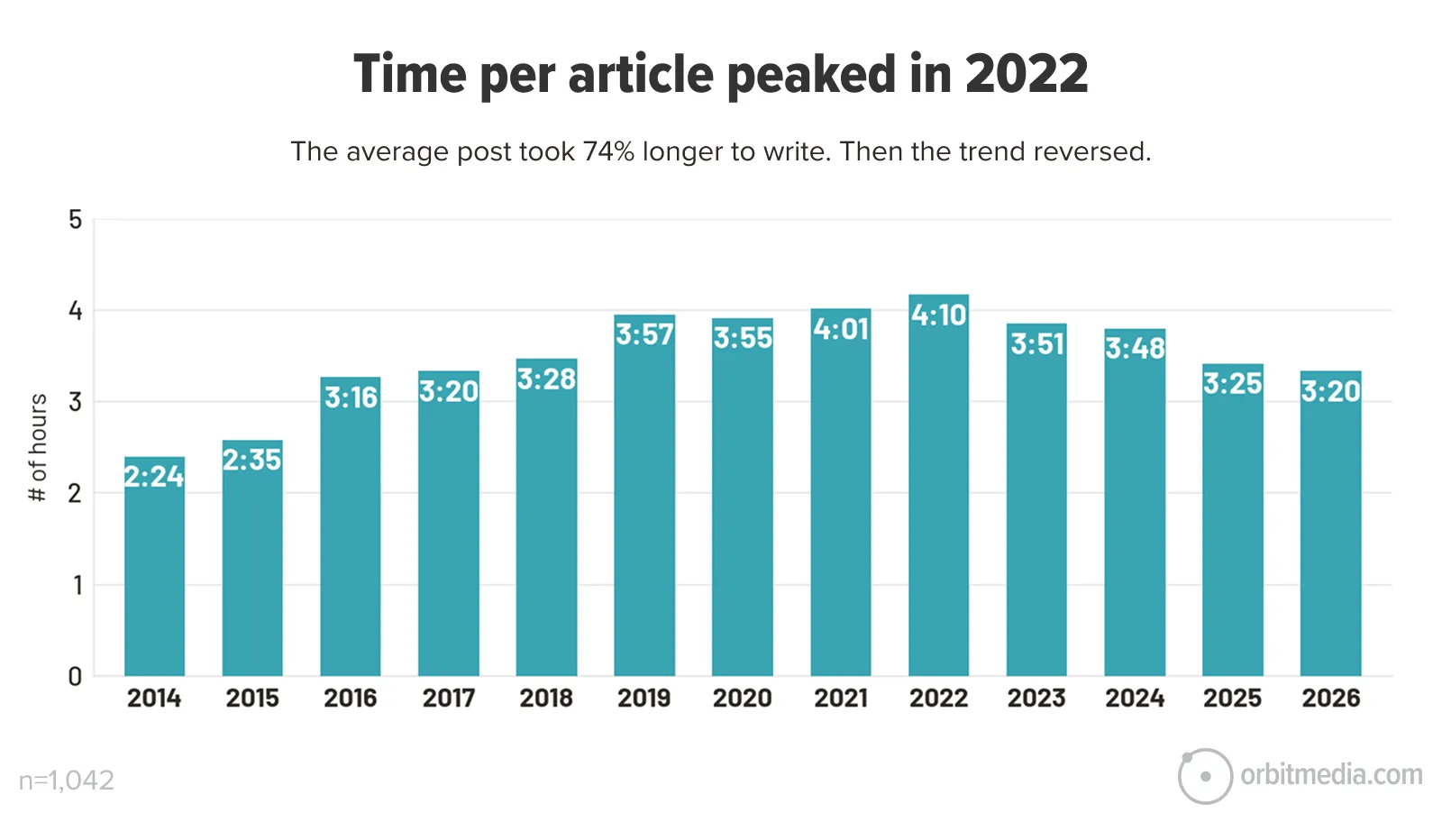
Publishing frequency changed. Marketers publishing 2–6 times per week fell from 28% in 2014 all the way down to 12% by 2022. Monthly publishing doubled. The focus was on quality, not quantity.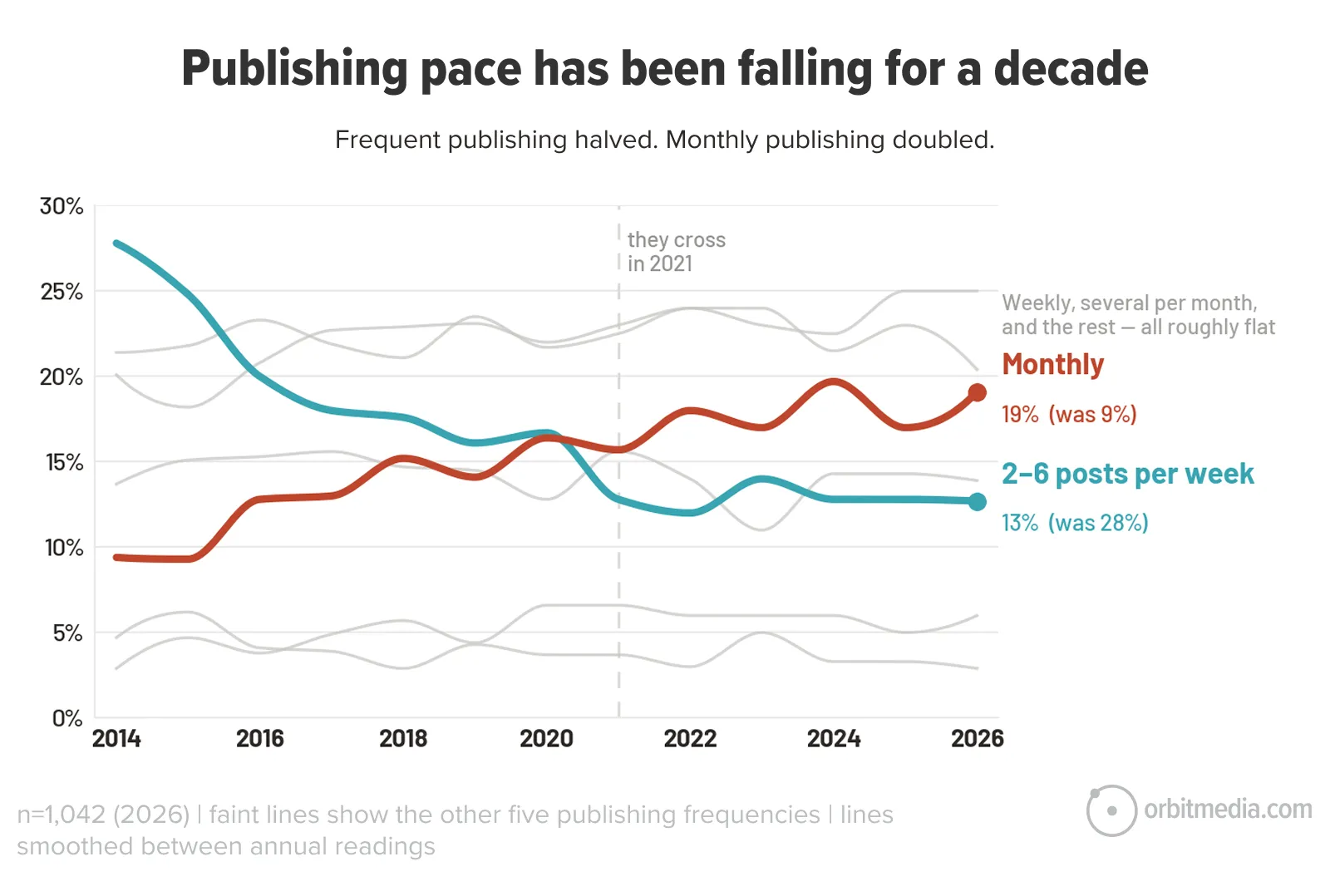
The industry converged on a common strategy: fewer, bigger, better. And it worked. Our own correlation charts from past surveys kept showing that spending 6+ hours writing 2,000-word posts roughly doubled the odds of strong results.
But the return on investment for greater effort was flattening out. Performance stopped rising even as effort peaked. It’s just that the change was so small that none of us saw the trend.
2023–2025: The AI shock
Along comes AI and marketers jumped in with both feet. The use of AI went from virtually zero to 93% in just three years. That’s the fastest adoption curve in the history of digital marketing. But concerns remain.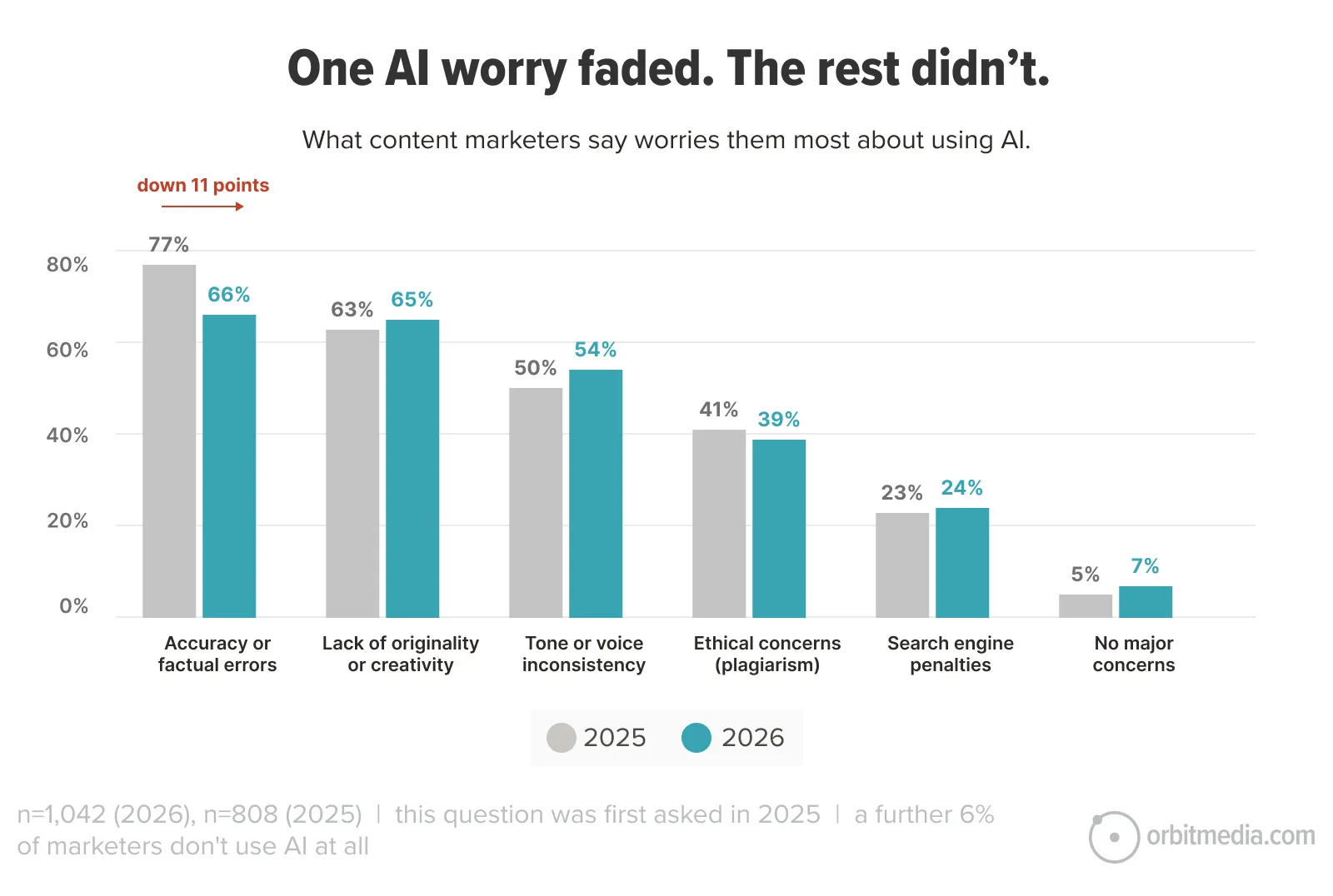
With AI came speed. As we saw already, time per post has fallen four years in a row. But the big open question remains:
“Does AI make content programs better? Or just faster and cheaper?”
The answer is now clear.
AI is table stakes. It doesn’t give marketers an edge.
Using AI does not improve content performance.
It certainly makes content production faster, as we just saw. We did the math and found that the average content marketer now spends 50 fewer hours writing than in 2022 (57 posts per year, 50 minutes faster per post). That’s a week of work saved. But for what? In the same period, “strong results” fell from 26% to 14%.
None of the use cases for AI in the survey correlate with performance. Marketers just got faster at making the same things.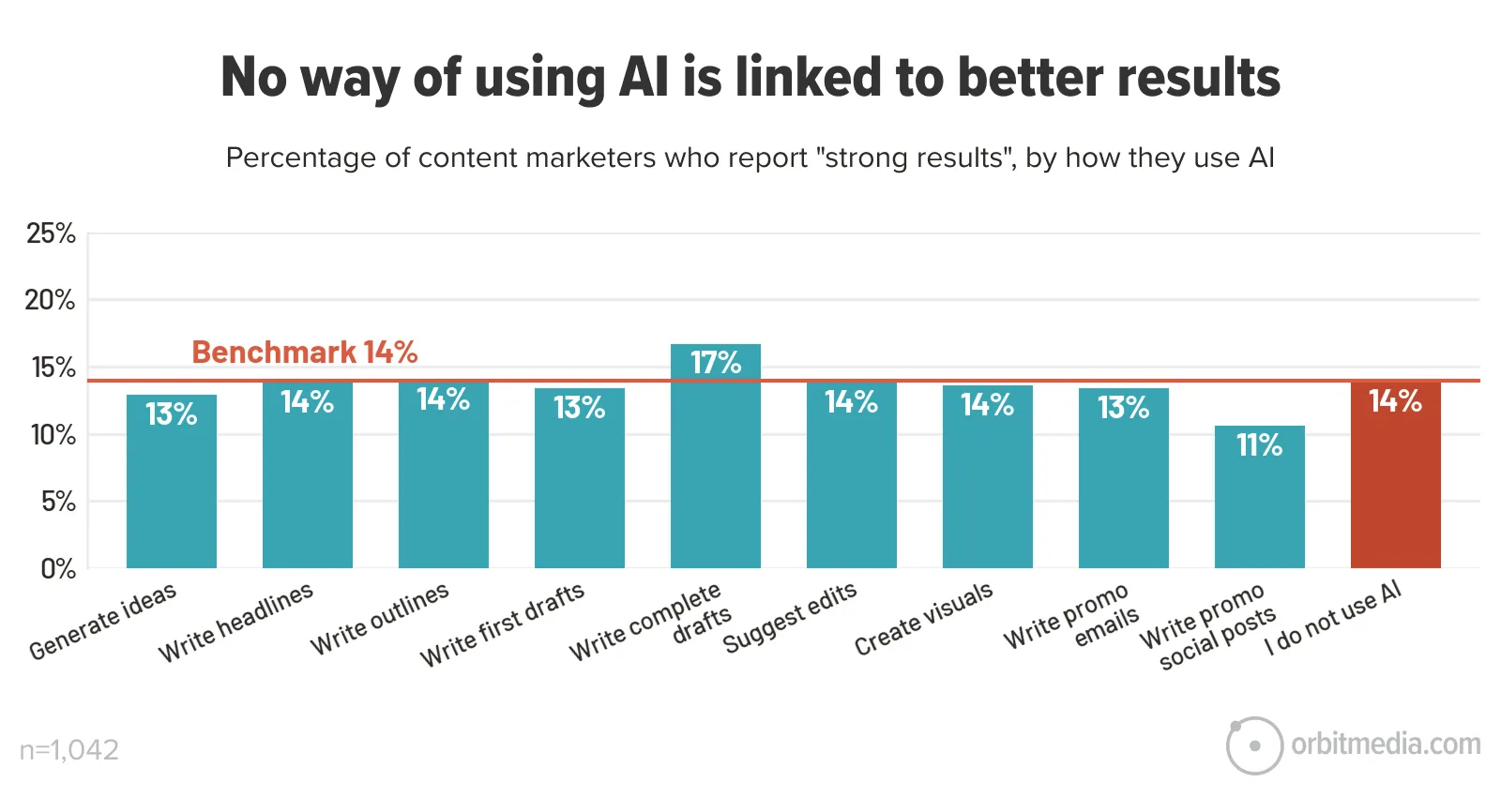
Maybe it was an experimentation phase. Many content pros are already pulling back from the “AI for everything” era. Almost every use case for AI dropped in 2026.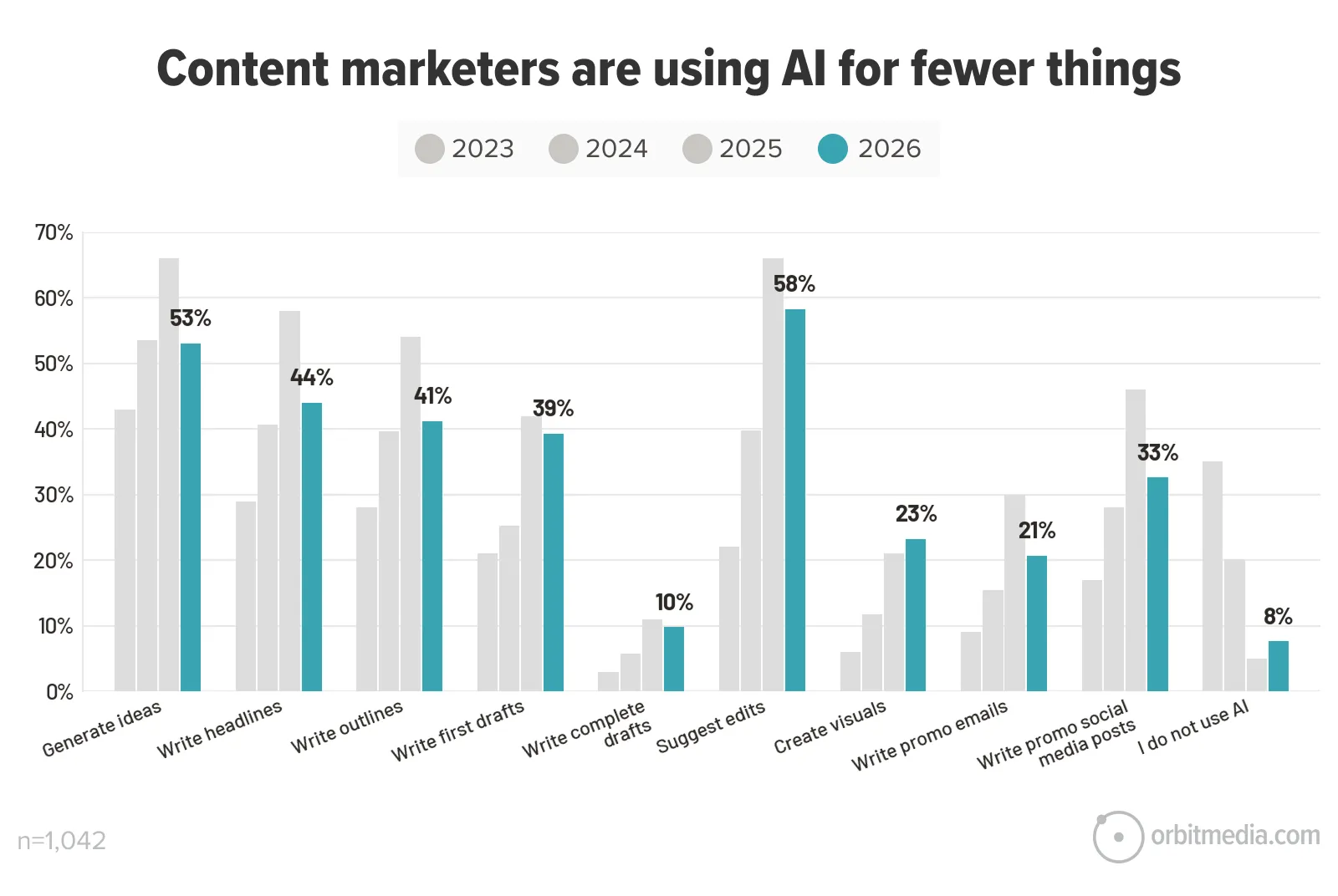
Today, 92% of marketers use AI. 8% of marketers do not. Both of those groups are equally likely to report “strong results.” No difference. But non-AI users are much more likely to report “disappointing results.” These two groups have the same odds of succeeding, but very different odds of failing.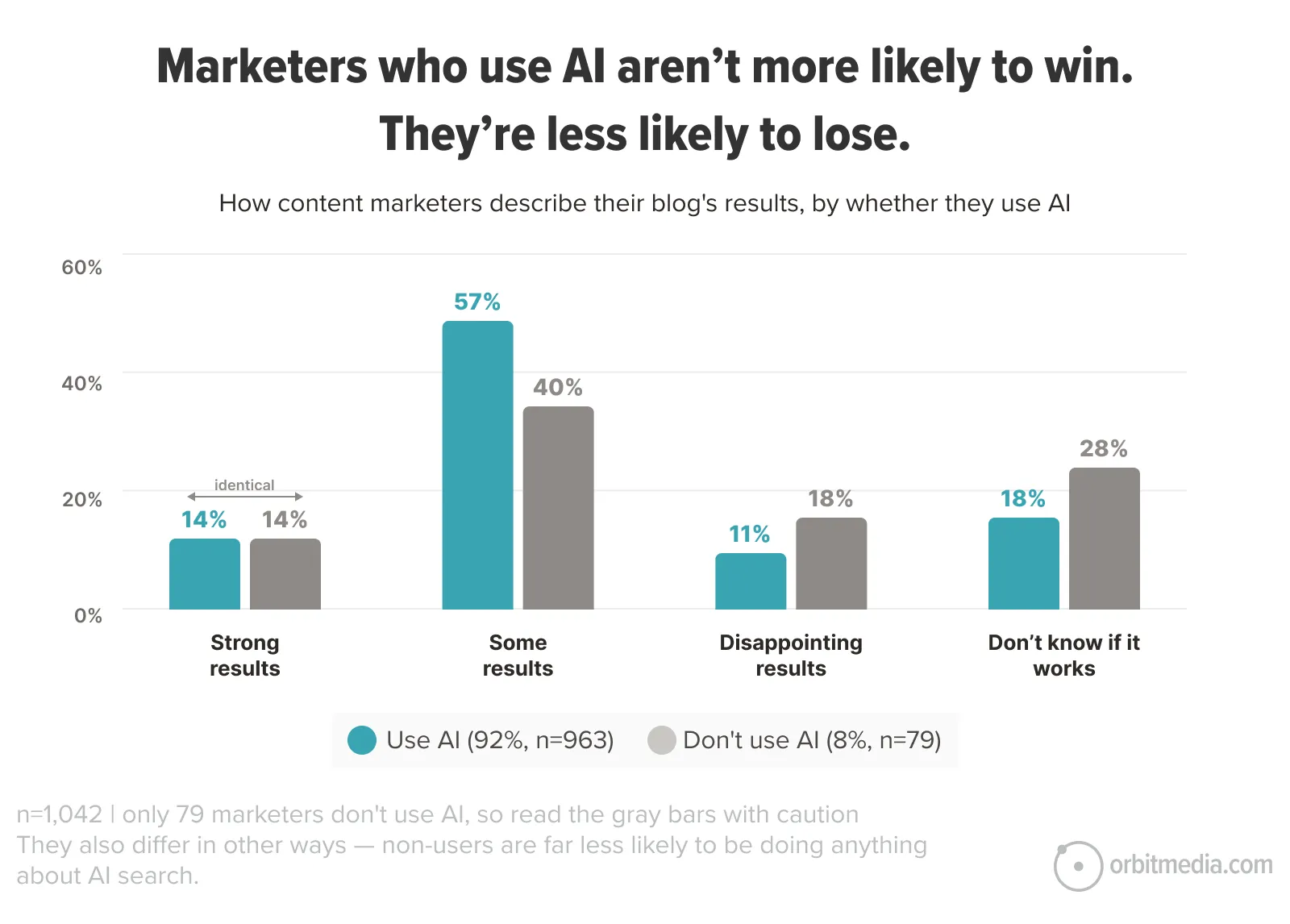
Using AI doesn’t make you more likely to outperform. But not using AI appears to make you more likely to underperform.
So the use of AI doesn’t explain the collapse in performance. It must be something else. To find out what, we need to look at what marketers quit doing.
Why did content performance drop?
The answer is obvious in the data. Performance dropped because content marketers are using the most effective strategies less often. Also, marketers are using the least effective strategies more often. Consider:
- The strategies that correlate with strong performance are ALL on the decline: influencer collaboration, paid content promotion, faithful use of analytics, keyword research, publishing original research, using a formal editing process…
- The strategies that correlate with weak performance are ALL on the rise: publish less visual content, never research keywords, publish monthly or less, replacing human editors with AI…
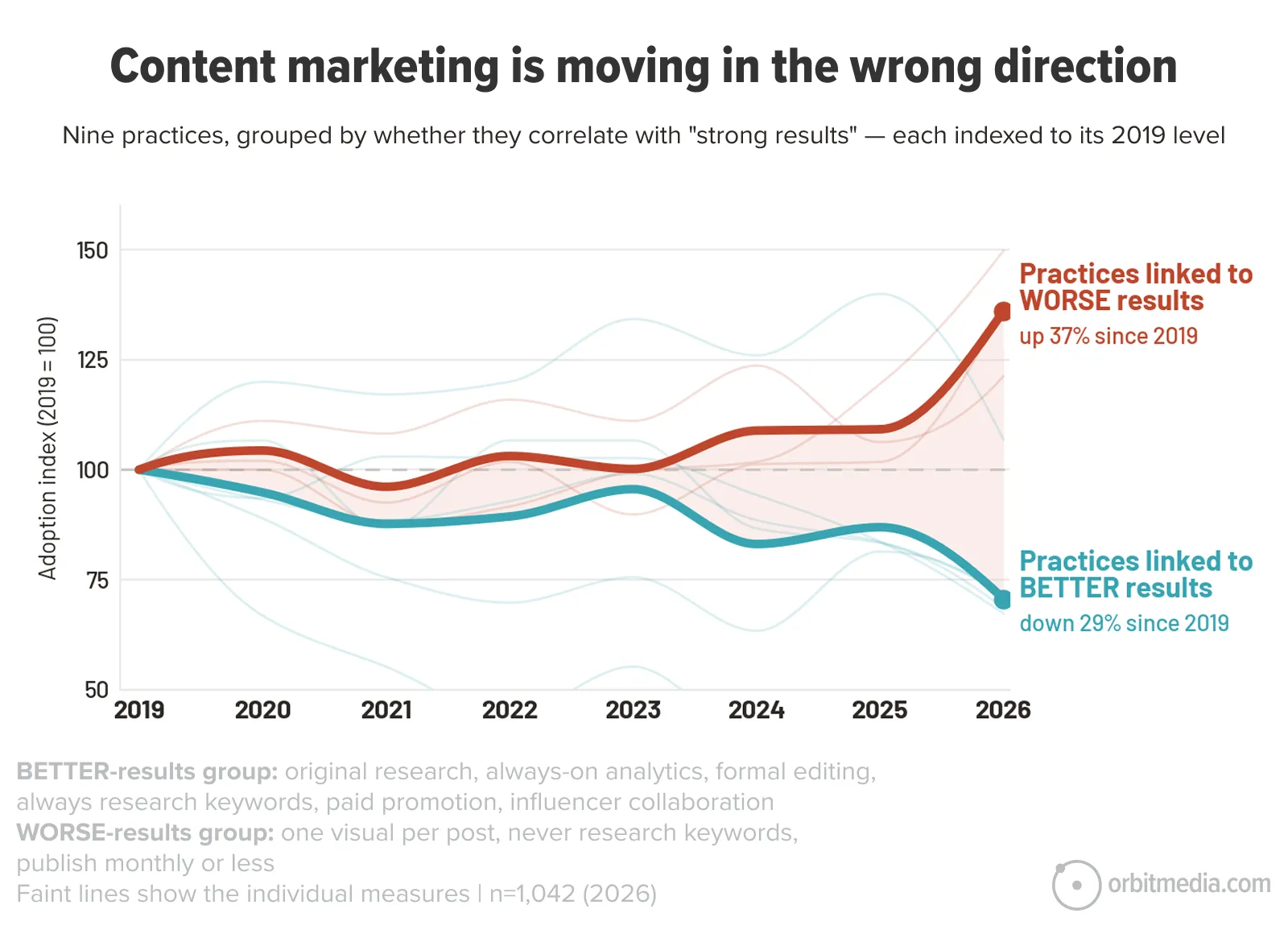
It’s not true that content marketing is less effective. It is true that the best approaches to content marketing have been abandoned.
 |
Ann Handley, Marketing Profs“AI makes it stupid-easy to remove effort. We all know that. But this data is a reminder that we need to be much (MUCH!) more discerning about which effort we remove, and which we keep. Things like publishing original research, human editing, collaboration… These aren’t inefficiencies to optimize away with our robot friends. They might look like extra steps. But they’re often where the greatest value enters the work. It’s a cautionary tale about the value of the long road in a shortcut world.” |
In 2026, it seems marketers are looking for shortcuts. Most marketers are doing less. It’s as if the entire industry has pulled back. There’s broad disinvestment in content despite the fact that the fundamentals still work just as well as they ever have.
This chart shows both the correlation of each approach with performance (blue text) and the decline in that approach over the last year (red bar). The reason for declining performance is clear.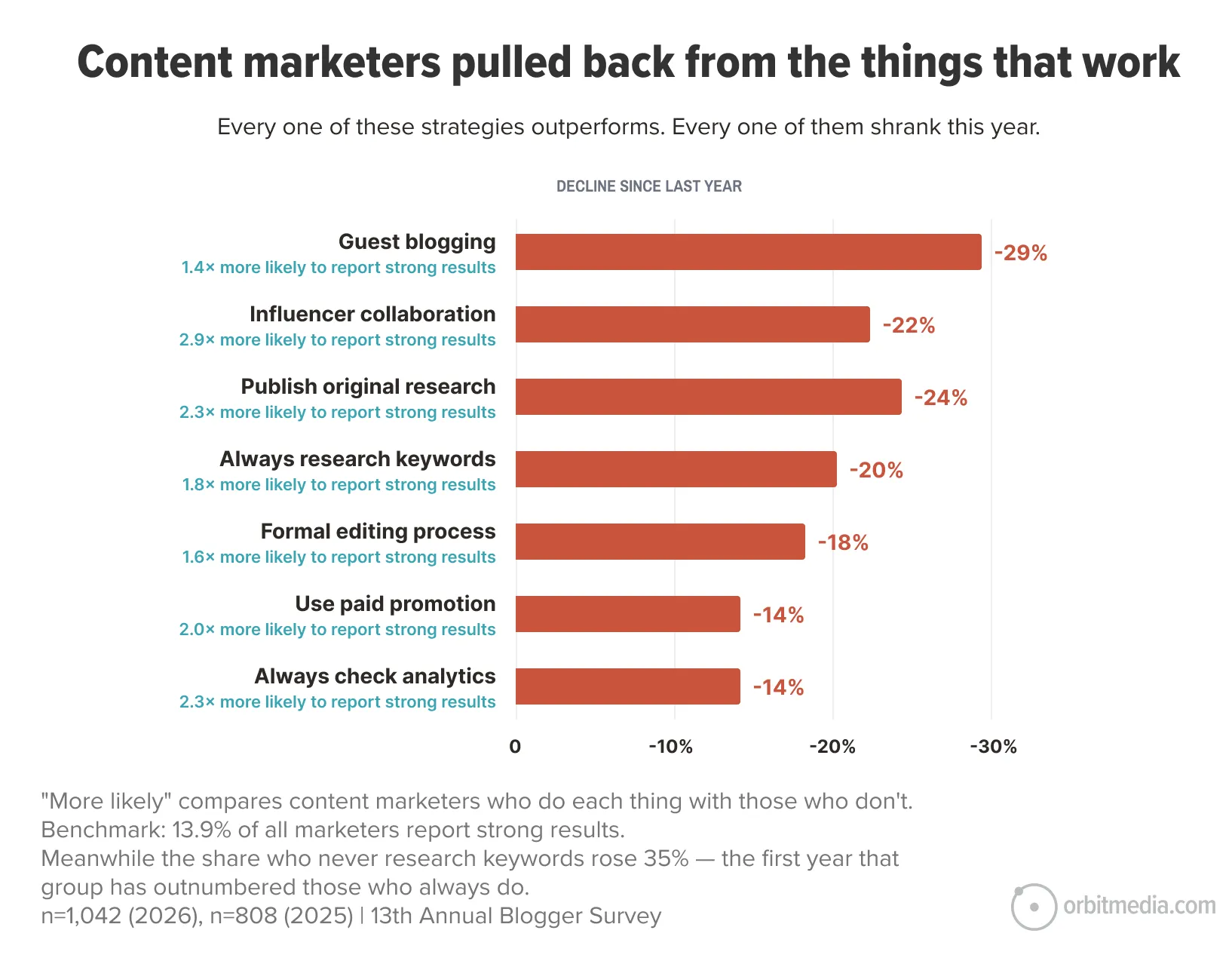
Meanwhile, content marketing has gotten steadily harder over time. Over the last eight years, we’ve asked which channels are getting harder. Nothing has gotten easier since 2019.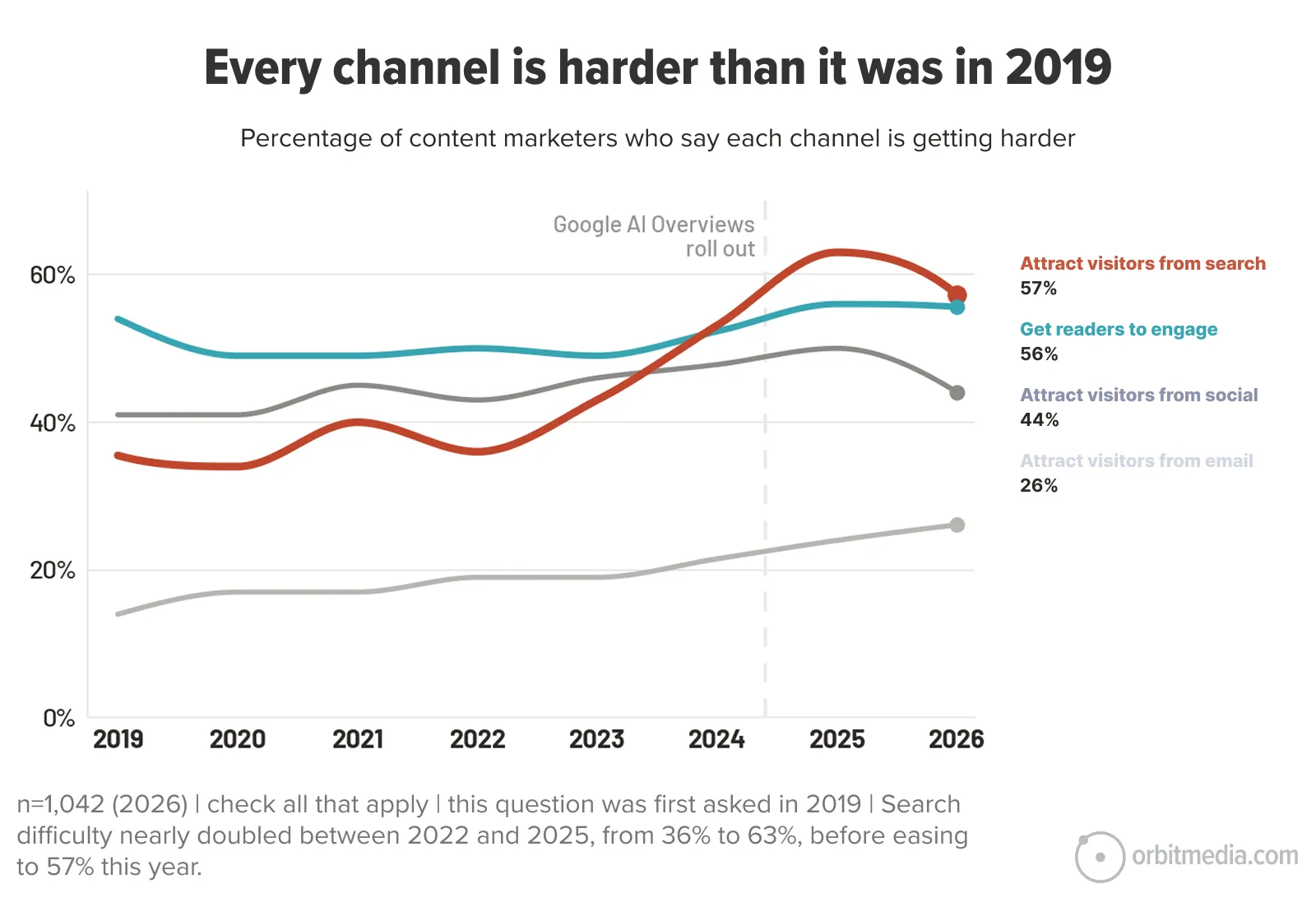
The problem isn’t that content marketing is less effective. The problem is that content marketers stopped doing that most effective content marketing. This is clear in the data.
What works now in content marketing?
Here is the correlation between content strategies and marketing performance. There’s a lot of practical insight in this chart. It shows what’s working now and why a minority of content programs are still driving business outcomes.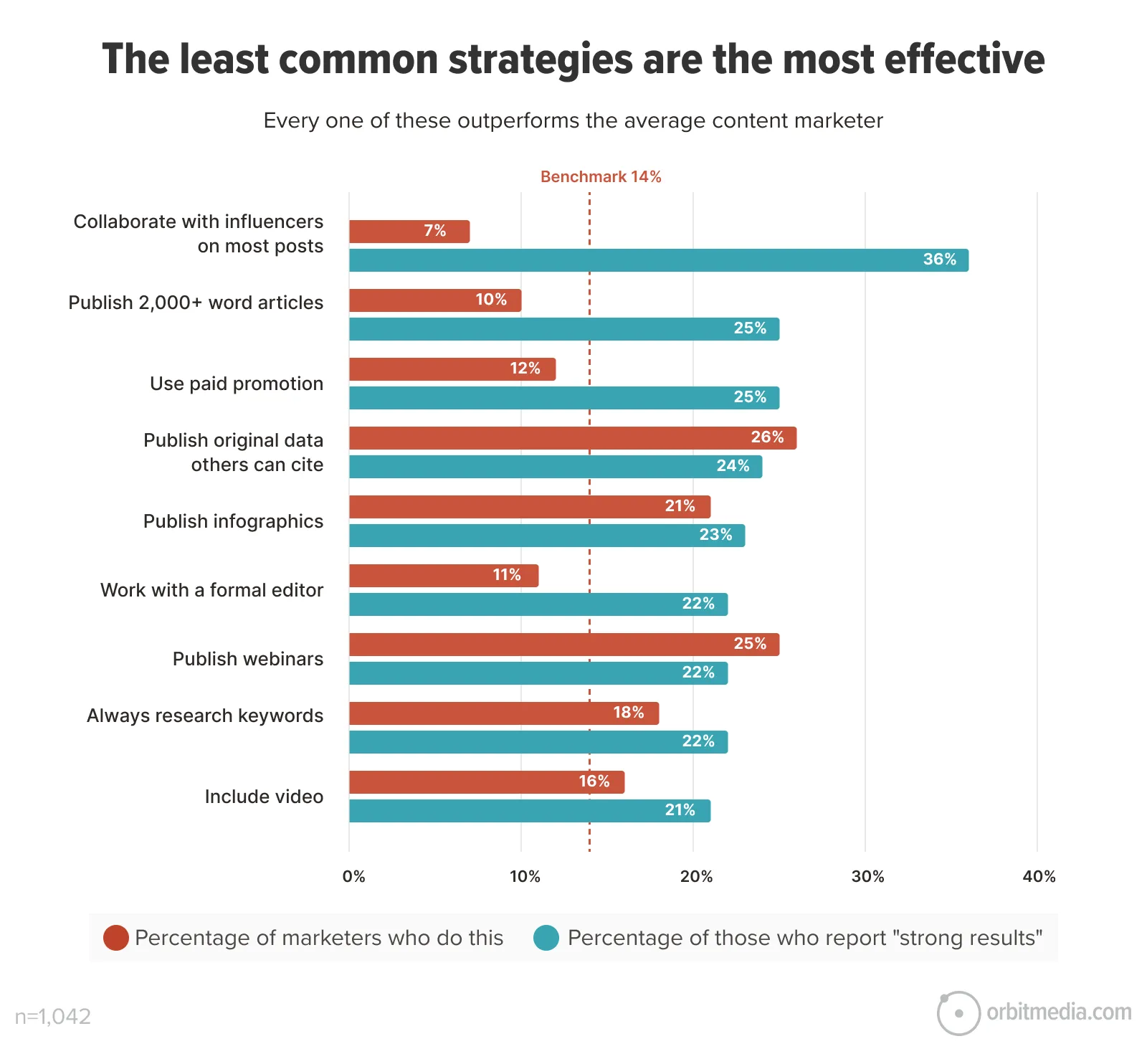
If your content program involves consistent influencer collaboration, long-form keyword-focused articles, original research reports, and webinars, you are very likely still seeing strong performance from your content program.
Let’s look at nine of the difference-making aspects of content strategies more closely…
1. Elbow grease still makes a difference
Marketers who put more effort into each piece are still more likely to drive marketing results, although outcomes are less certain than before.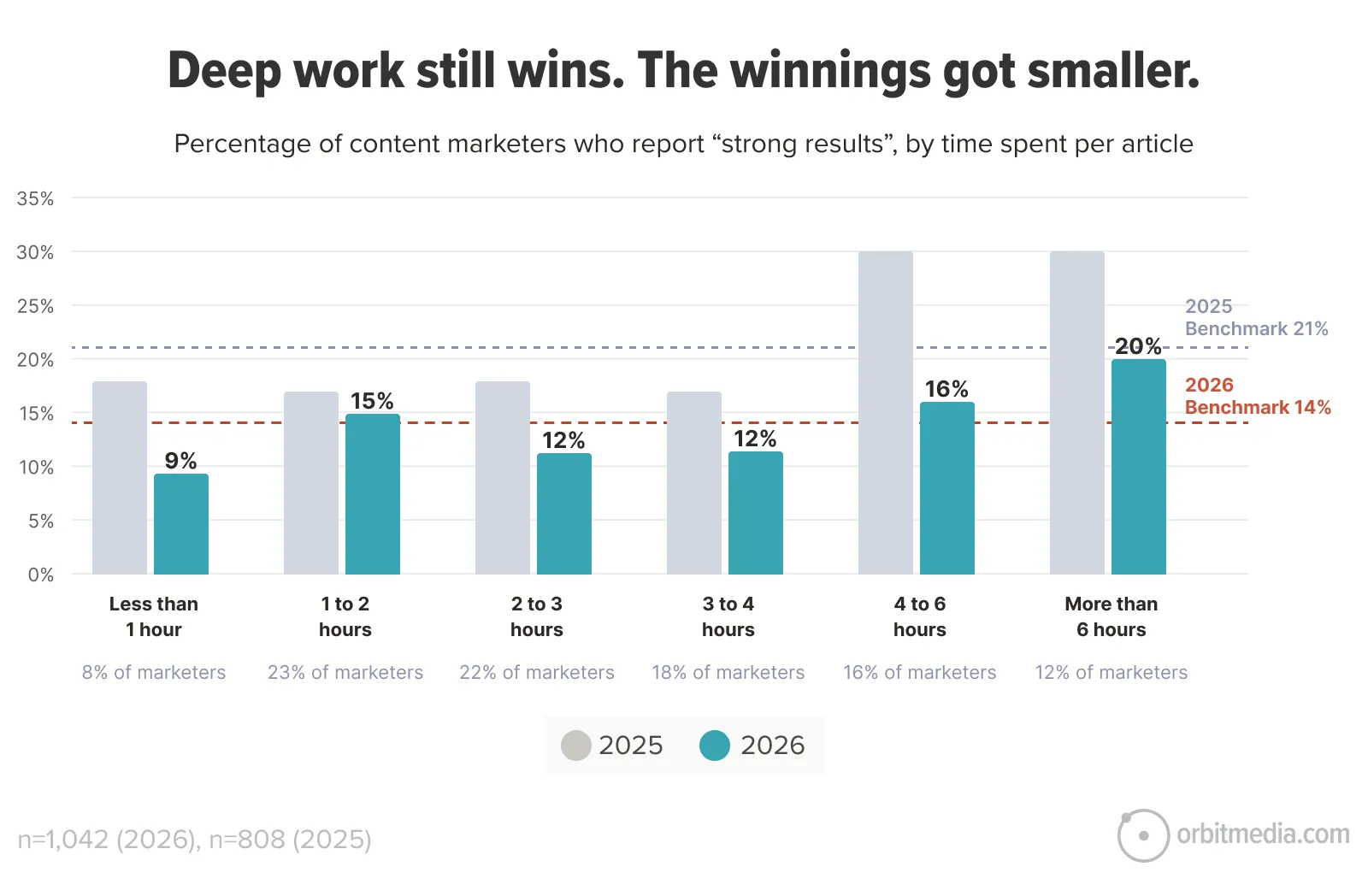
 |
Mark Schaefer, Keynote Speaker, Best Selling Author“The research presents two truths and a mystery. Truths: The most effort produces the best results. The least effort produces the worst results. Now the mystery: In the middle range of effort, more work is not necessarily a predictor of business results. Perhaps a new class of blogger is emerging who puts in the “right” type of human work. They create unique insights and original research, but they also know how to use AI as an honest and efficient co-worker for mundane research and editing. Honestly, I believe I would be in this new category.” |
2. Collaboration drives performance
The most performant content marketers don’t go it alone. The most effective marketers work with experts and influencers. They pitch articles to editors, putting their content directly in front of new audiences. And they earn mentions by publishing citable research.
We are in a post single point-of-view era for content marketing.
Red bars show how many marketers do it. Blue bars show how many of those marketers report strong results.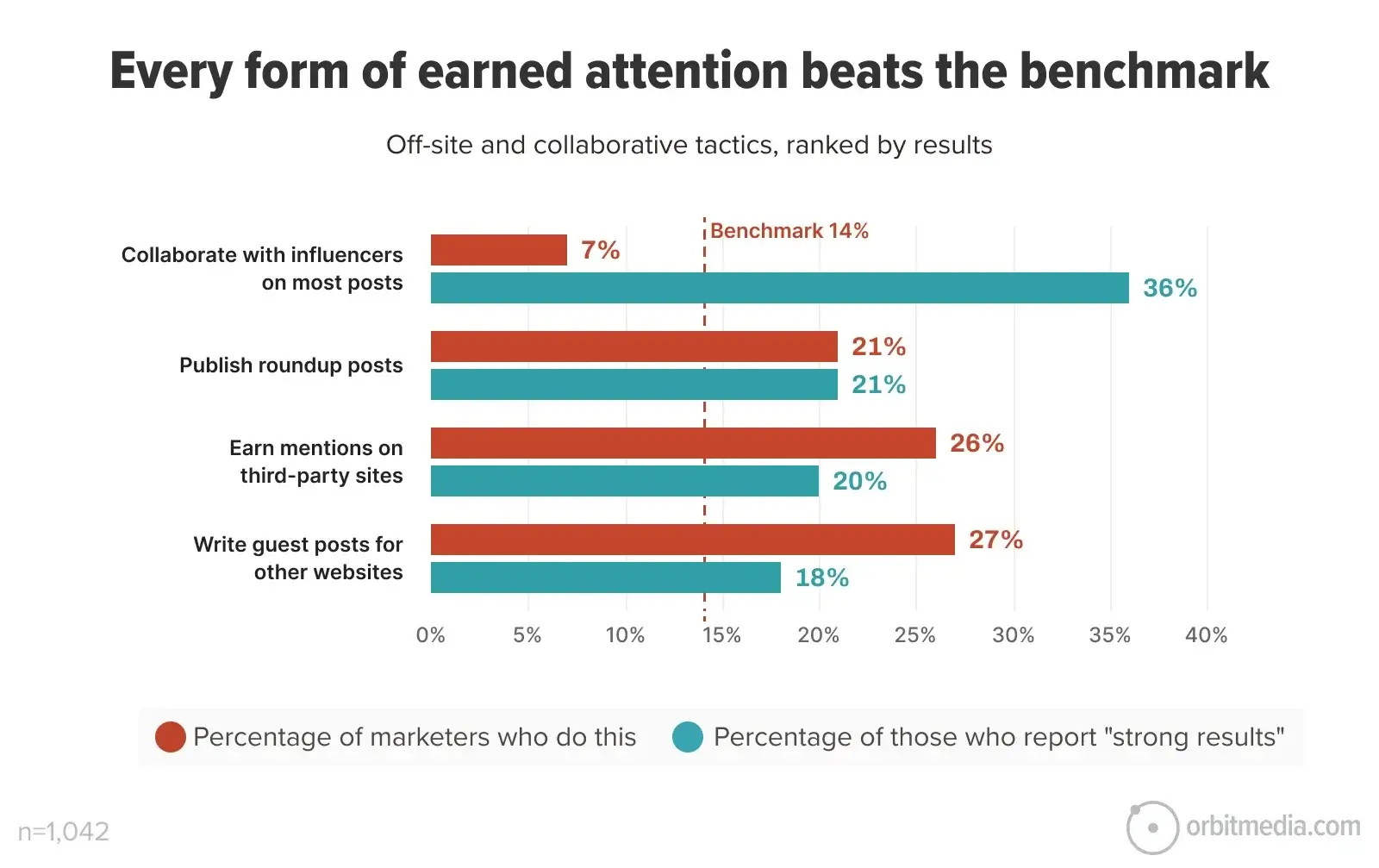
Influencer collaboration is the single best predictor of success in the dataset. Those who do it beat the benchmark by 2.6x. Sadly, it’s also the most abandoned: down from 25% of marketers in 2017 to 7% today.
Yikes. What happened to working with friendly experts?
3. Visual content outperforms
The more visual the content, the more likely it is to drive performance. Yet most content marketers add very few visuals to a typical piece.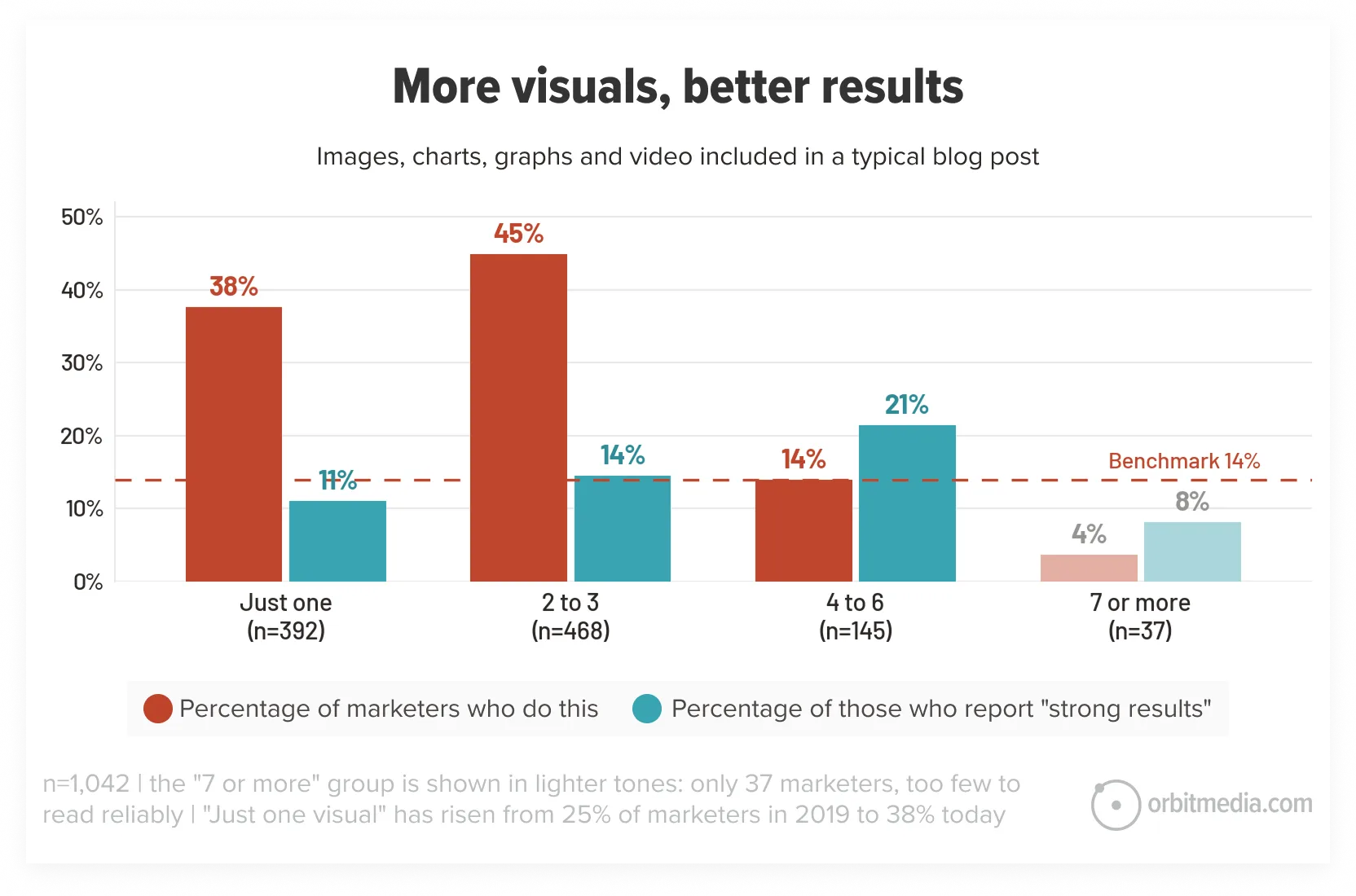
Put those visuals and collaboration together and you have a piece that is filled with images and multiple points of view. What else checks those boxes? Social streams, which as we know are highly engaging. The more your content looks and feels like a social stream, the more likely it is to perform well.
4. Content marketers who consider keywords outperform
SEO is alive and well. The big change is that AIs are doing searches on behalf of buyers. But the search is happening, keywords are used, and content that is easy for machines to retrieve performs well.
Not every URL is a keyword opportunity. But the content marketers who understand search, know how to measure topical demand and align pages with phrases are much more likely to report success. SEOs make good content marketers.
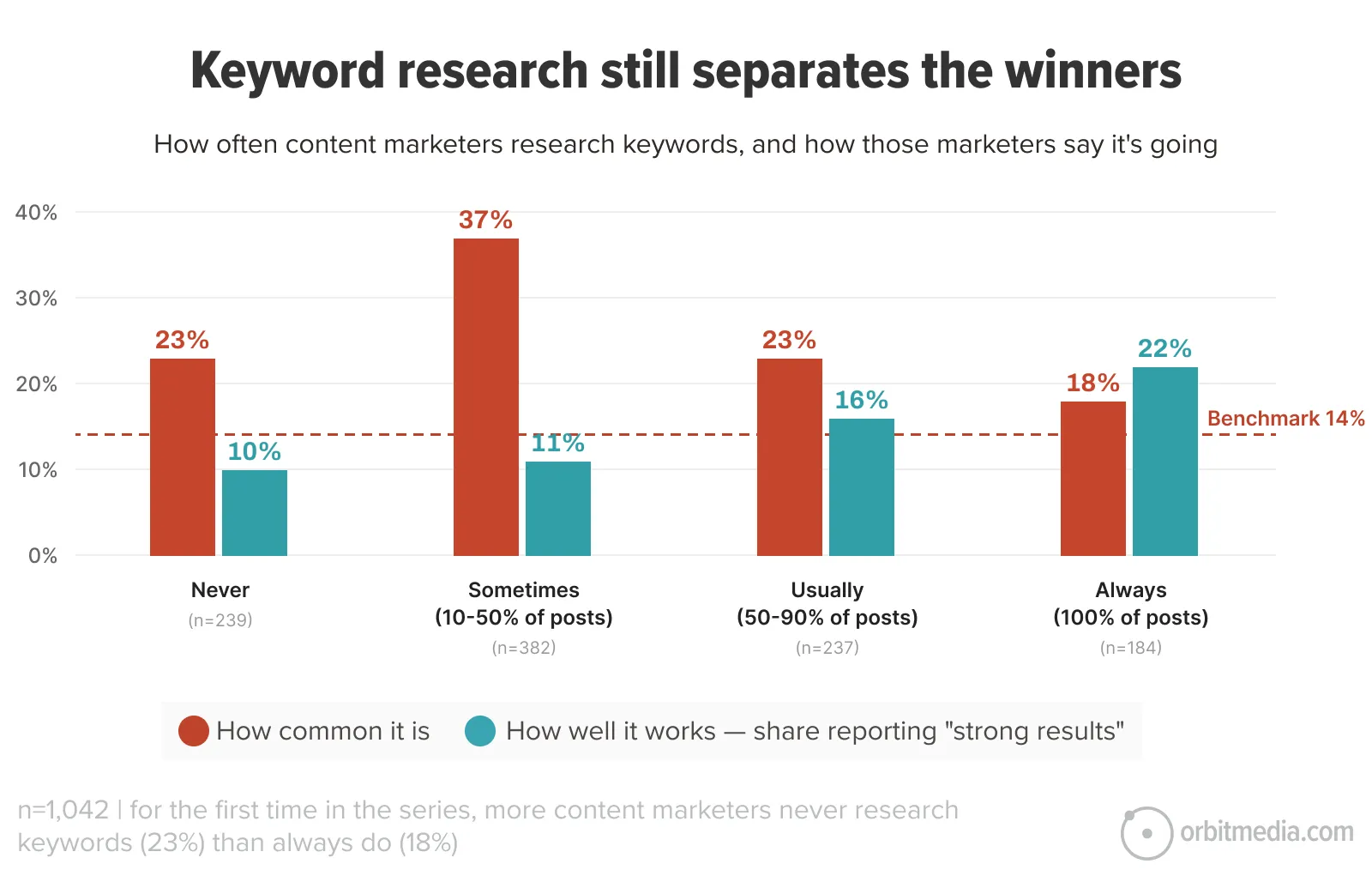
Despite the fact that keyword research still correlates with performance, content marketers are less likely than ever to consider keywords in their content. This is another effective strategy that content marketers are skipping.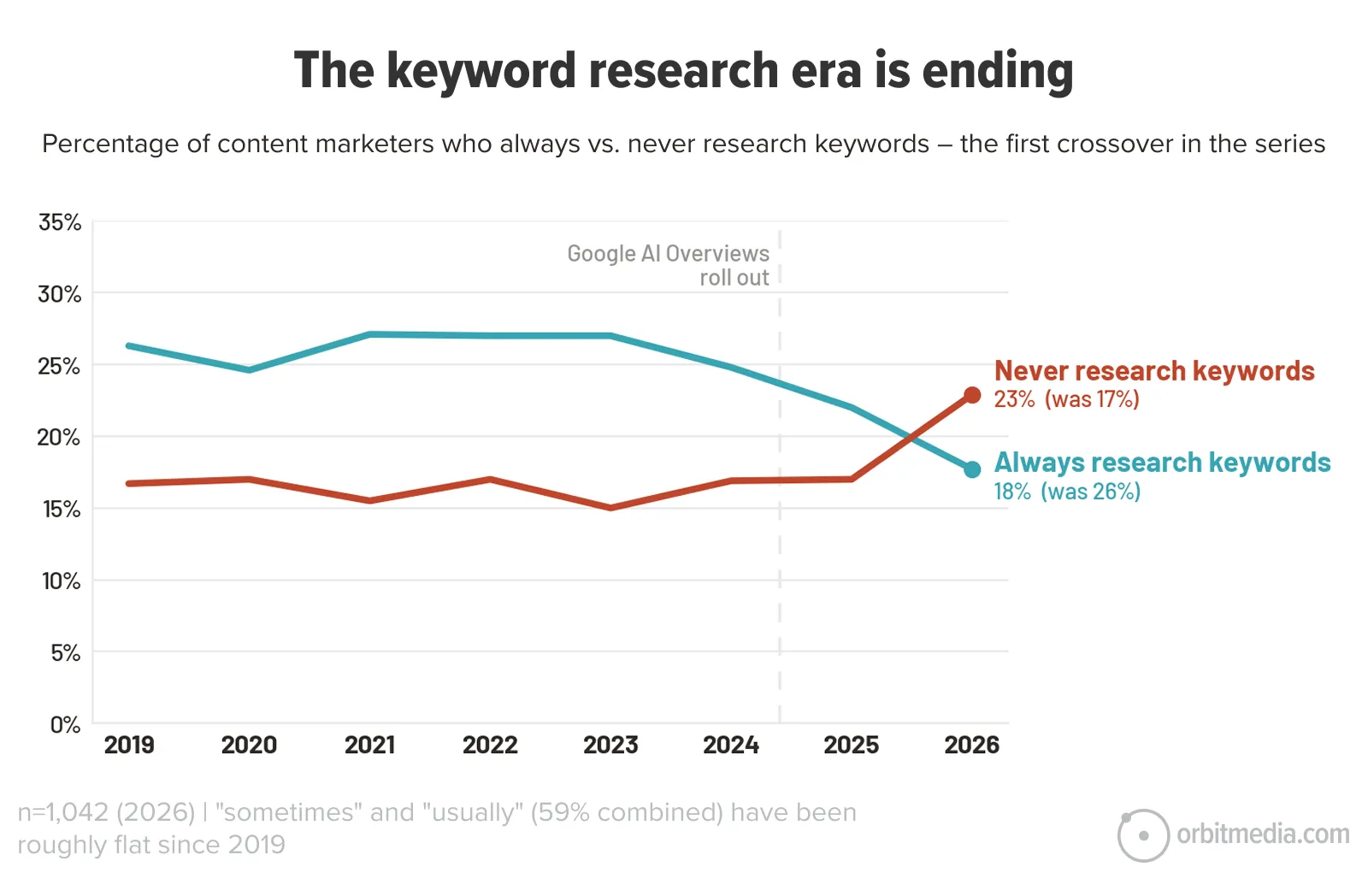
5. Some content formats perform much better than others
Blogging isn’t enough. Content can be produced in many formats and some formats perform much better than others. Unfortunately, the most effective formats are also the least common. The least effective formats are the most common.
Here again, we see the correlation between performance and the more collaborative, more visual formats. Again, red bars show how many marketers do it. Blue bars show how many of those marketers report strong results.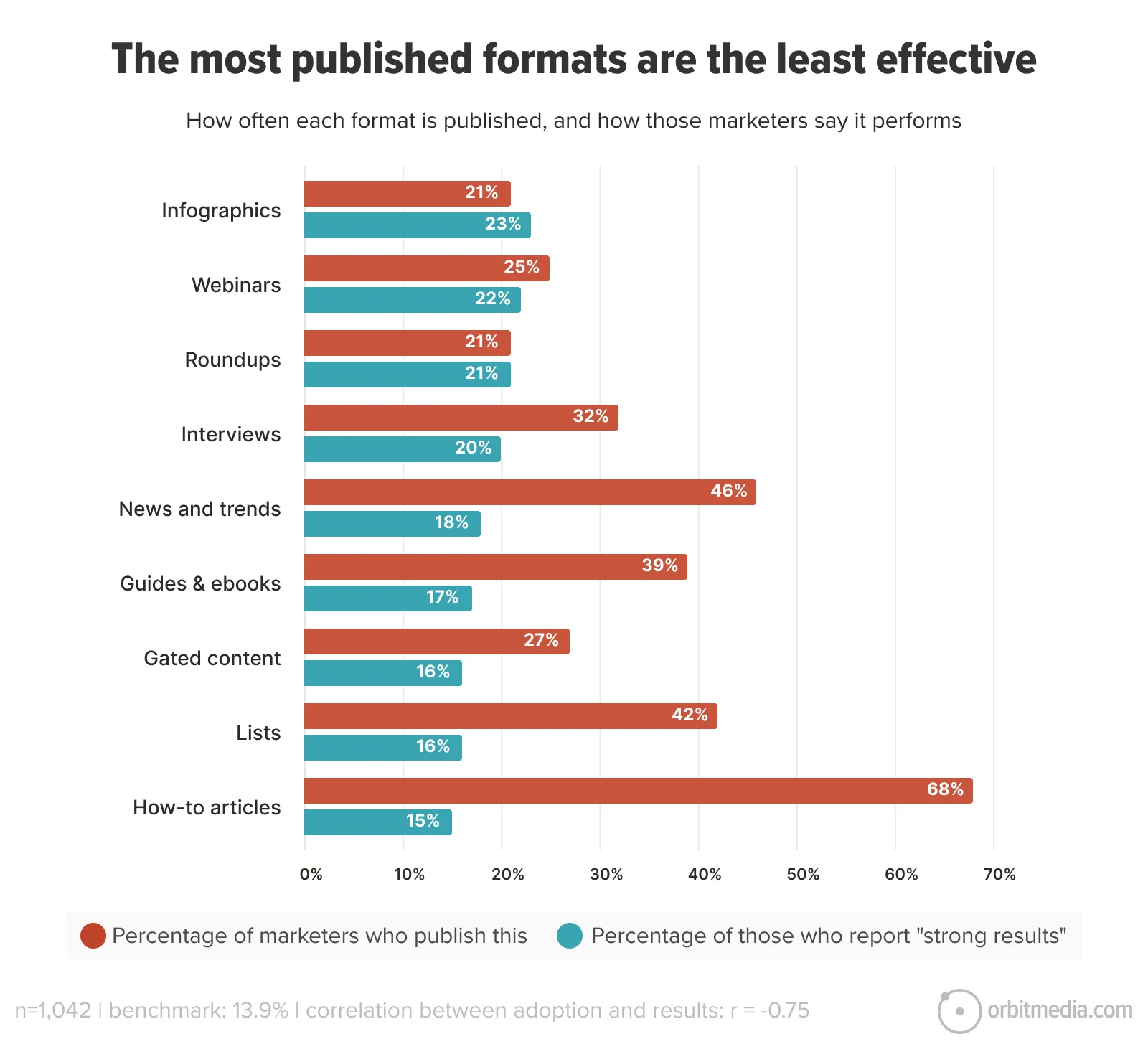
6. Original research still outperforms
Some content programs publish new research, creating new data and statistics that didn’t exist before, making the brand the primary source for new information. This is something AI cannot do, so it’s a highly differentiated format in the era of AI generated content.
Yet content marketers have also pulled back from this strategy. After rising in popularity for nearly a decade, fewer marketers now publish new research studies, despite the fact that it improves the likelihood of performance by 50%.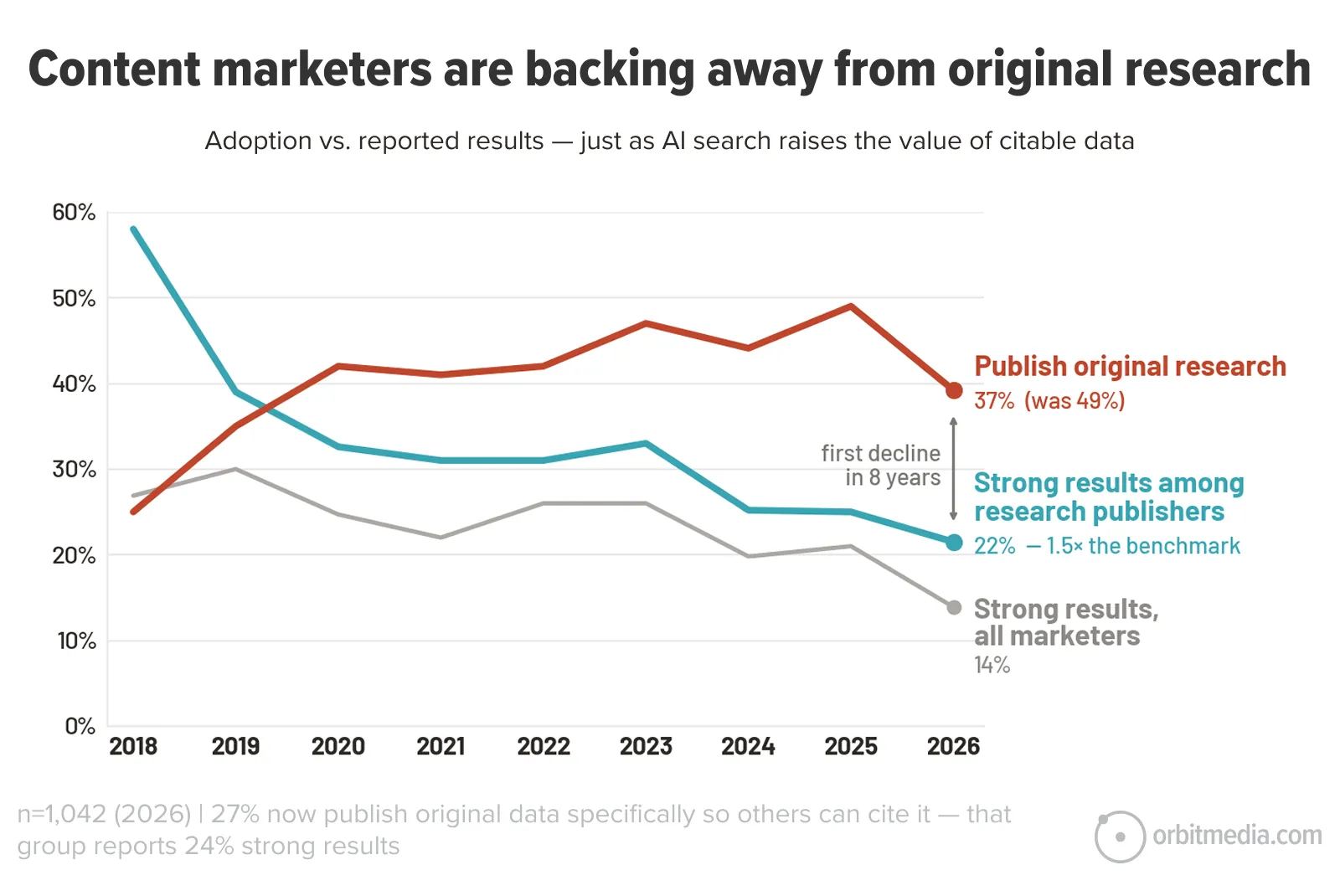
 |
Cyrus Shepard, Zyppy SEO“Wow. The idea that bloggers are retreating from original research is completely counterintuitive, as Google and AI engines have shifted to preferring exactly this type of content. That, and AI tools actually make original research easier to produce. While “strong results” for publishers are down across the board, happy to see research publishers fare better.” |
7. Human editors drive content performance
Some marketers edit their own work. Some tell AI to do it. But the marketers who have a more formal approach with human oversight are much more likely to drive performance. They have built-in defense against AI slop.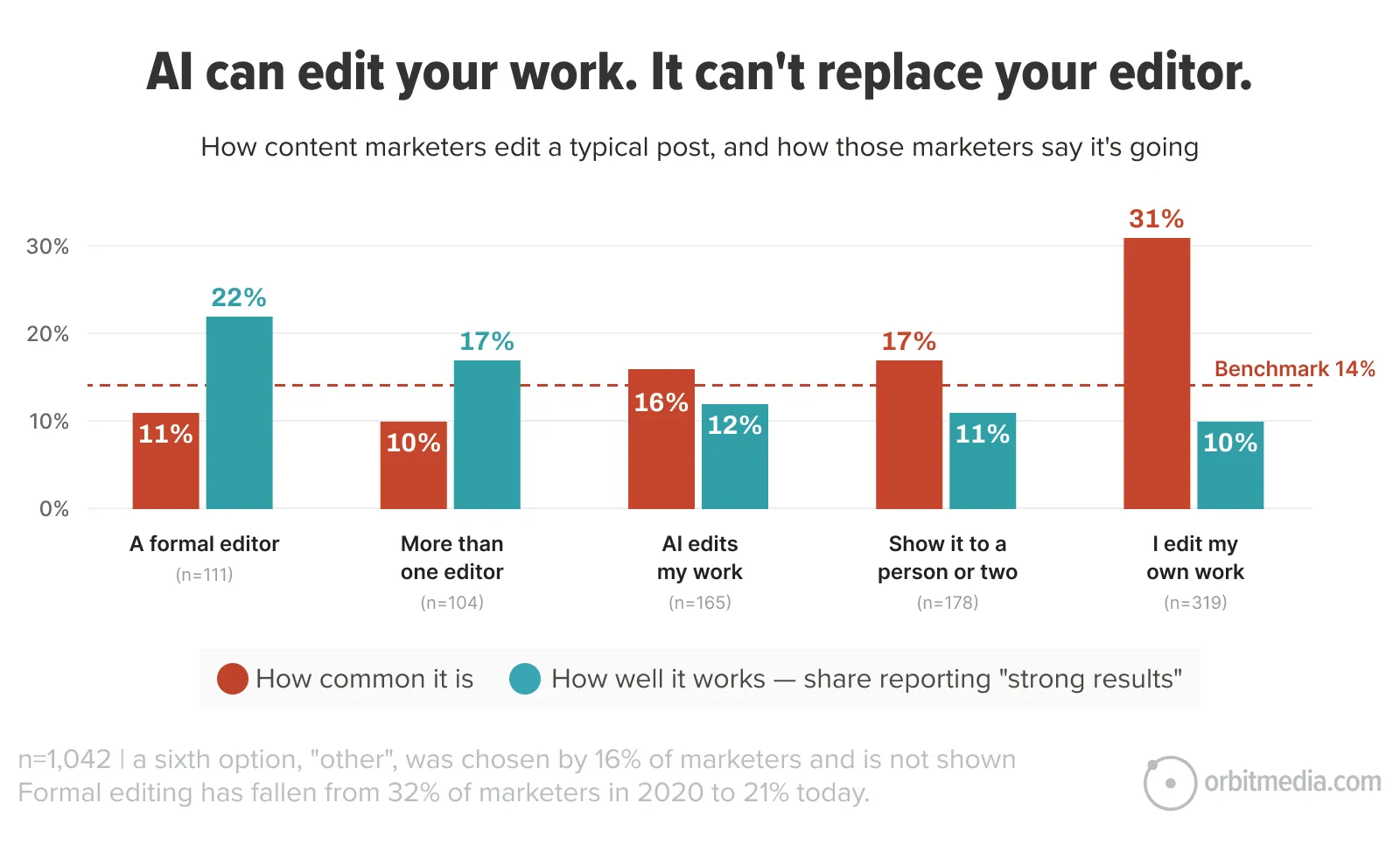
 |
Eddie Shleyner, Very Good Copy“Not surprising at all that the AI group reports worse results than the benchmark while the human-editor group beats it by nearly 2X. Context is everything. Nothing works the same way twice. It all depends on the current circumstances. Figuring that out is what thinking, feeling humans are good at.” |
8. Some promotion channels work much harder than others
Here’s yet another perfect inverse correlation between popularity and performance. The easiest and cheapest promotion channels are the least likely to drive results. The more difficult, more expensive promotion channels are more likely to drive results.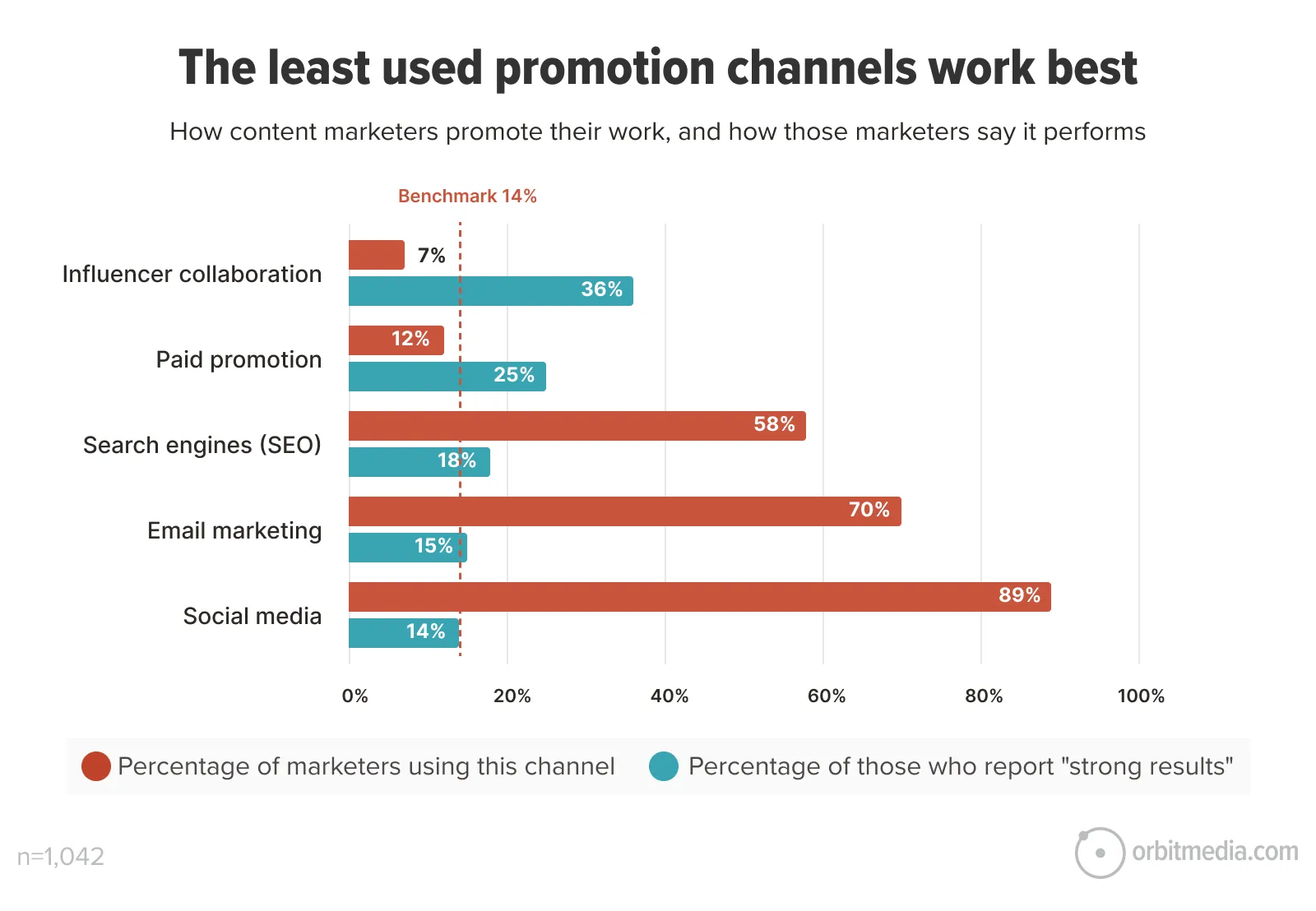
9. Not all marketers measure
Our last popularity-vs-success correlation is about measurement. We’ve seen this every year since the inception of this research in 2014. Data-driven marketers are more likely to report success. Those who check performance are more likely to see performance.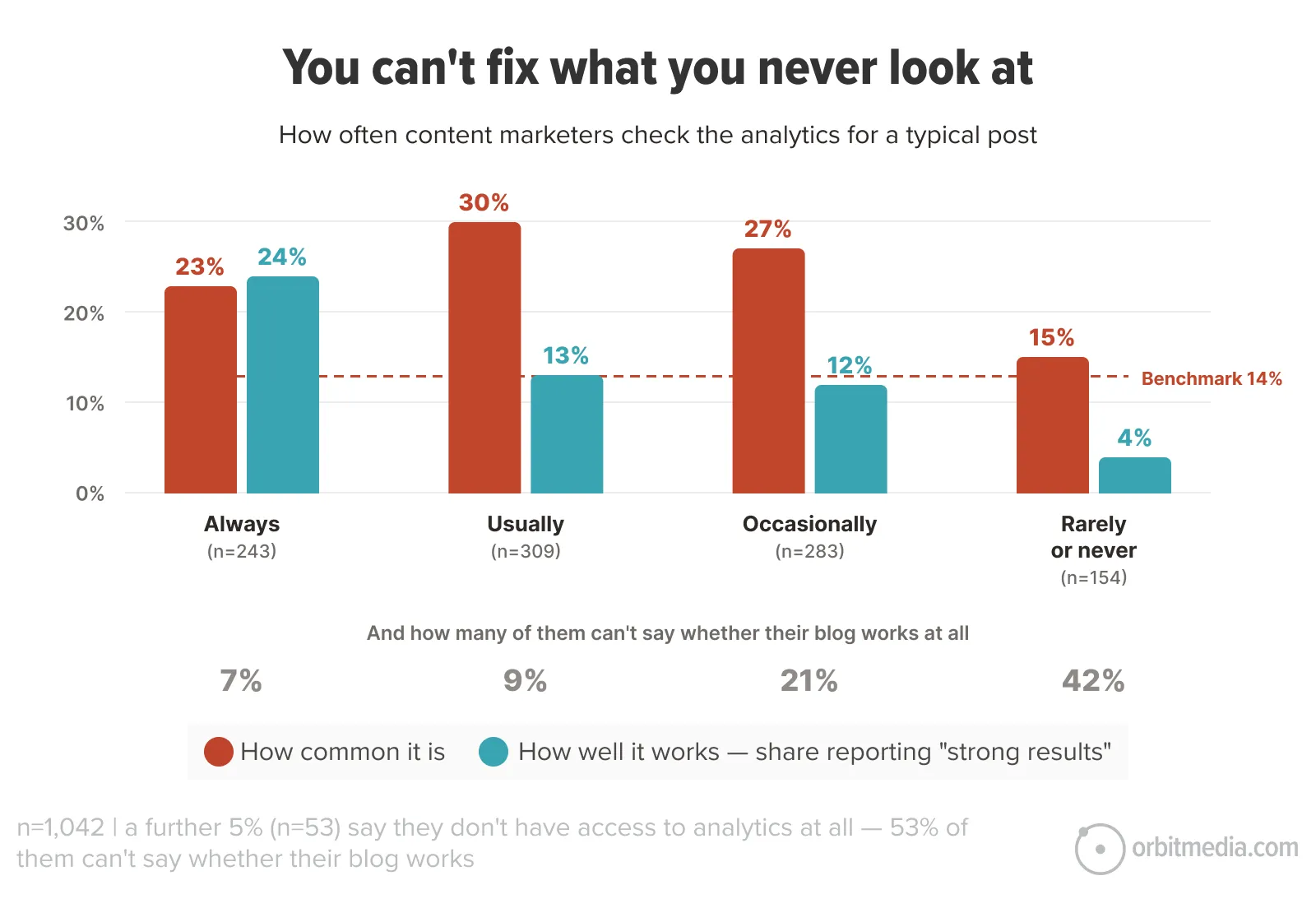
But what are marketers tracking? And how does tracking that metric correlate with results?
We asked respondents which metrics matter most, then grouped them into three categories. Here we see both the popularity of these types of metrics and the likelihood that those marketers report “strong results.”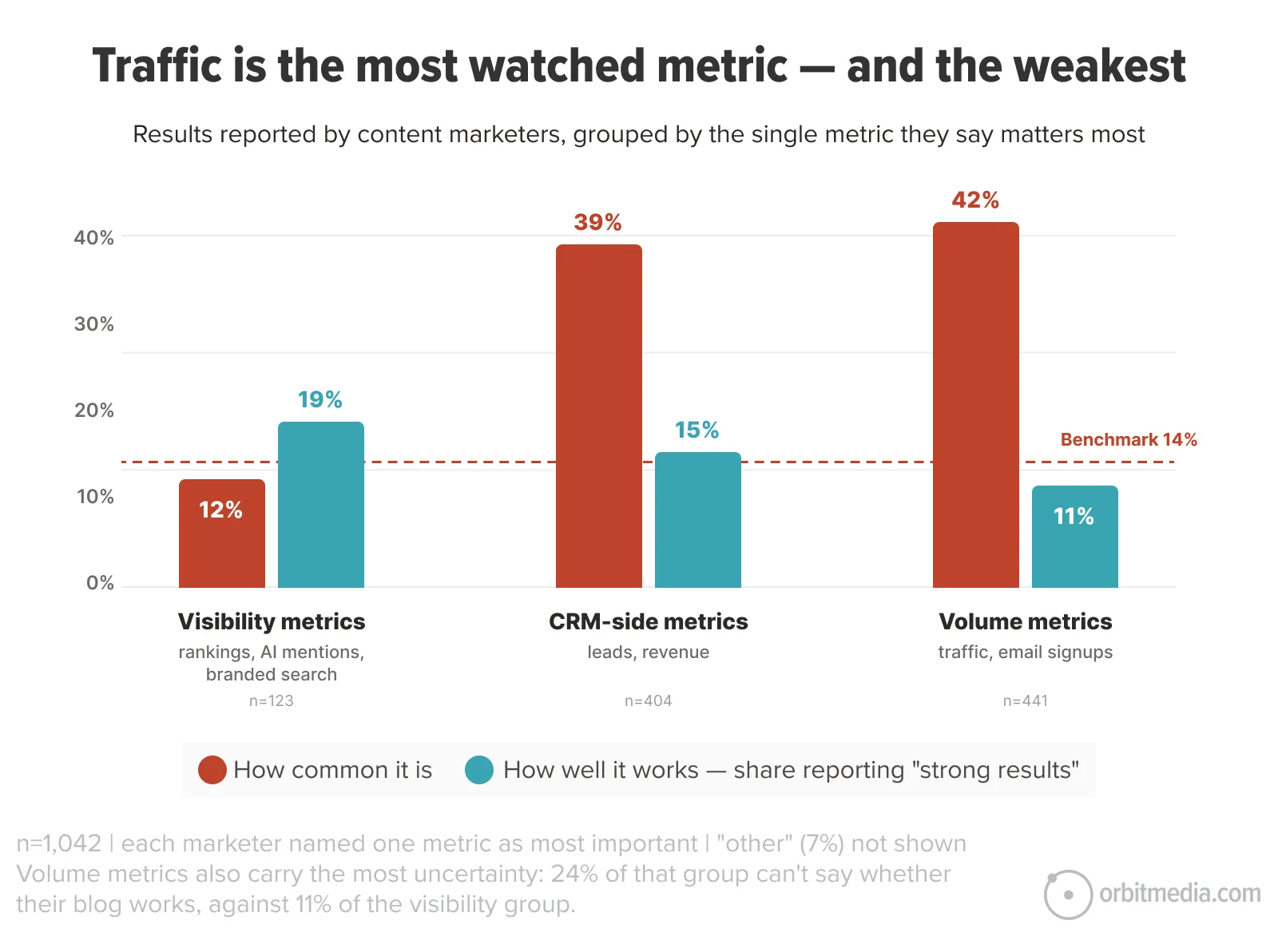
Traffic is still one of the most common ways to measure performance. But it’s become less meaningful in the era of AI, where buyers ask AI for a recommendation.
- If AI recommended the brand, the buyer then clicks a citation or searches for the brand or types in the domain directly. They’re ready to act. The source of this visitor is hard to see, but the conversion rates are high.
- If AI didn’t recommend the brand, nothing happens at all. There’s nothing to measure.
So in the AI era, traffic goes down and conversion rates go up.
Traffic was always an imperfect metric. It always suffered from Goodhart’s Law:
“When a measure becomes a target, it ceases to be a good measure.”
Of course, the best marketing metrics were always in your CRM: qualified leads, deals and revenue.
Most content programs are just blogs
We just listed eight content strategies that correlate with performance. We’ll set aside measurement because it isn’t a strategy. It’s how you know whether the others are working. So we’ll stick with eight.
How many do you do?
The more of those strategies you use in your content program, the more likely you are to win. Use six or more, you are nearly three times as likely to report strong results.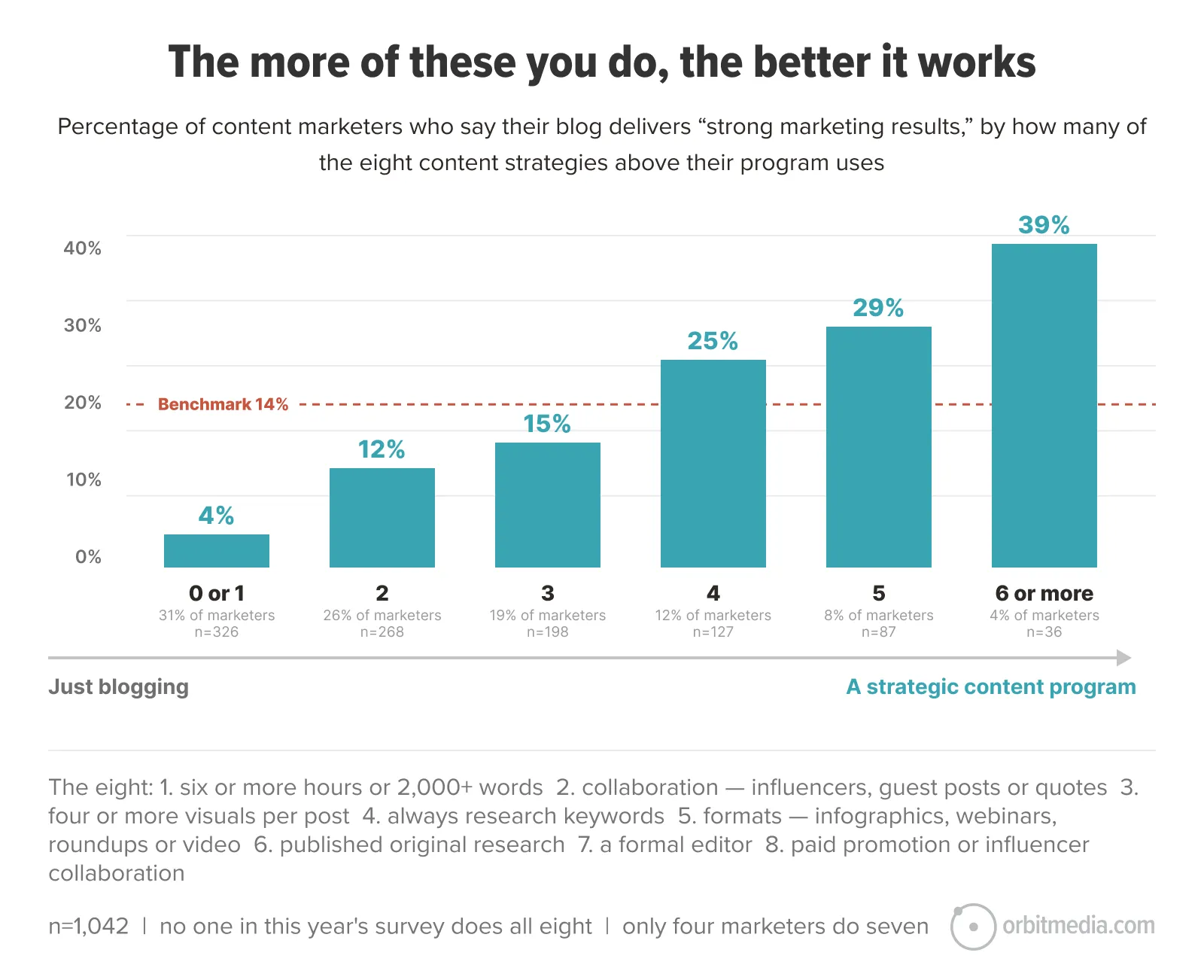
How many respondents do all eight? Zero. None of the 1,042 respondents do them all.
Note about Orbit’s own content program: We publish 6-8 research studies per year. All articles include many visuals and quotes from people smarter than us. Amanda edits everything before it gets published. We run monthly events: a webinar and a LinkedIn Live. We host an annual conference, Content Jam. Our program took years to build but it works like a champ.
Finally, our own reflections on content strategies after 19 years of publishing and 13 years of conducting this survey…
Too many content programs are just blogs. The strategy is simply to put out an endless series of text heavy, how-to articles, promoted through email and social media. They rarely use video and the content doesn’t come from a specific person.
They may write keyphrase focused blog posts, but search traffic to articles that rank for information-intent phrases has been completely torched. It will never come back to previous levels. These marketers measure traffic and they’re sad.
There’s very little creative consideration of how topics, formats and influencers combine and which combinations connect best with their specific audience.
But a small minority of content programs do things very differently. Influential experts are built into the program. Guest posting is built into the program. Annual research studies are built into the program. Events such as webinars and in-person meetups are built into the program. (By the way, events are one of the few ways to get a “deadline” into your content.)
AI makes you faster, but speed isn’t the point. If the strategy is weak, you’ll fail with or without AI. Put time spent per post, the number of strategies, and the odds of “strong results” on a 3×3 grid, you’ll see that faster isn’t better. It’s clear why AI doesn’t correlate with performance.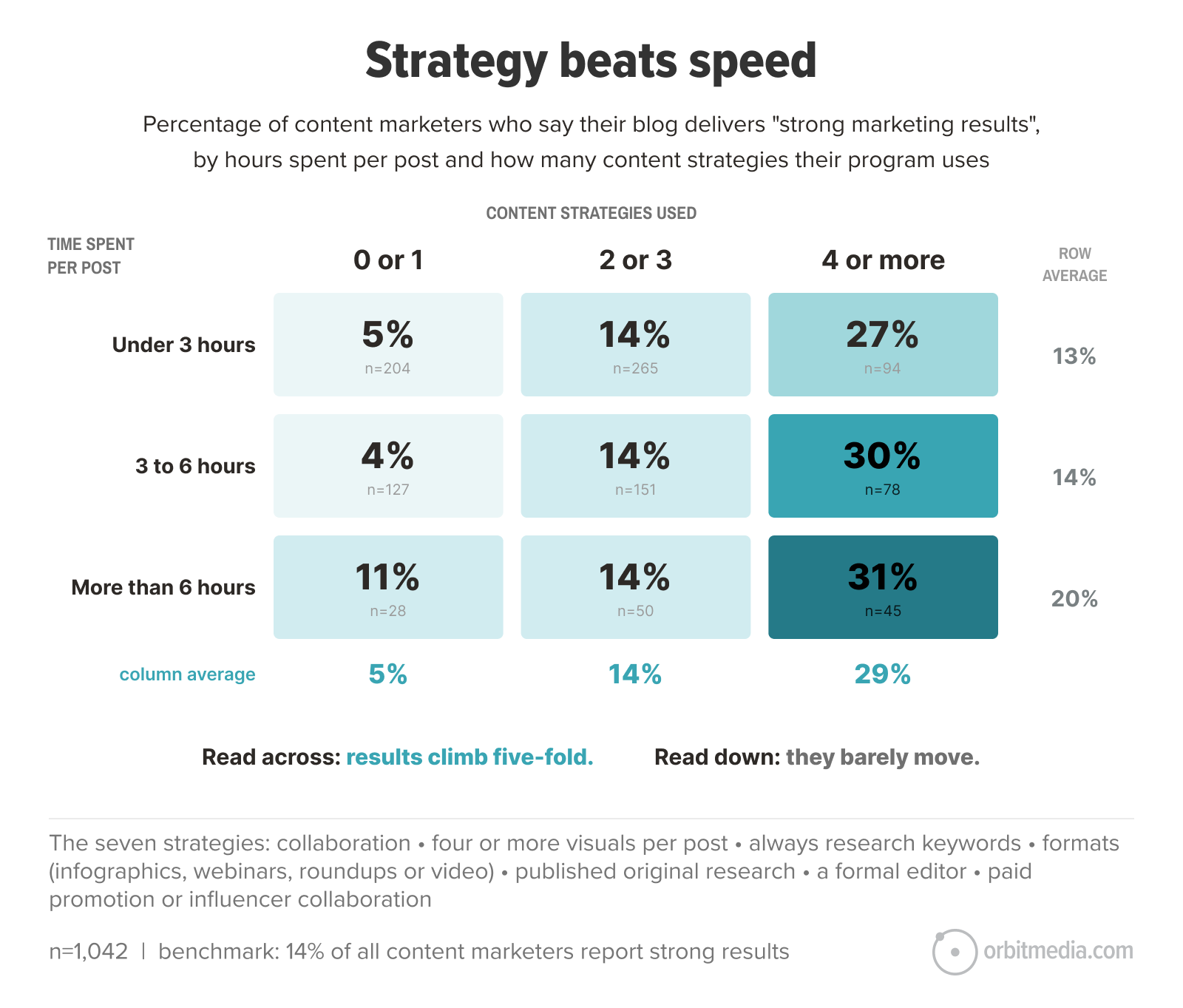
AI can be used for better performance or it can be used to create spam. And some content out there has so little value, it really is just spam.
Content at scale is a crazy idea, at least in B2B, because it misses the point of publishing entirely, which is to foster relationships (networking), show unique expertise (trust), and create early awareness (brand). And yes, eventually, leads and revenue.
When first I saw the response data, I reached out to Ann. I said, “I’m sad to say that the data is a bit concerning. The performance of content is down.” She replied, “I agree that the data is concerning… but also I kind of hope it’s a wake-up call, TBH.”
There is no better takeaway.
I love content marketing, partly because I dislike ads (the other kind of marketing). I believe that good content marketers make the internet better. We create value for real people. In the process, we drive business growth, personal growth and friendships.
ProTip: Give this report to AI and have a serious conversation about your content strategy. Make it a PDF so it can see the charts. Yes, PDFs require more resources for AI to process (energy, carbon emissions, tokens and money) but it’s worth it if it guides you toward a more effective and efficient content program.