“Everything in marketing has changed!” …Really? I’m not so sure.
At least one thing that hasn’t changed: human psychology.
The cognitive biases that affect how we make decisions haven’t changed a bit. These predispositions are built into our brains because of millions of years of evolution. They’re not going anywhere.
But marketers often miss opportunities to work with these built-in biases. I’m not suggesting that you mislead or trick your visitor. That would be unethical. But there’s nothing unethical about using the science of persuasion. It’s smart marketing.
 |
Talia Wolf, Founder and CEO GetUplift“Your role isn’t to “trigger” anything in your prospects or manipulate them. It’s to meet them where they already are emotionally and give them the information they need to feel safe enough to make a decision.” |
Your future prospect’s biases are with them wherever they are, in social streams, email inboxes and AI chatbot conversations. But here we’ll focus on webpages because it’s closer to revenue (they’re already on your site) and it’s aligned with lead generation (they’re one click away from your form).
We’ll run two AI-powered audits from two different directions. The first starts with the visitor. The second starts with a list of cognitive biases.
Prompt one: Audience motivators, barriers and persuasion
We’ll start by sharing an AI prompt for persuasion audits. This one rates the extent to which any page aligns with the psychology of any target audience. The inputs are:
- A detailed persona
Attach the file with the prompt or have the conversation in a custom GPT (or Gem or NotebookLM) trained on your persona. Don’t have a detailed composite persona yet? Use this AI prompt to generate one. - A full-page screenshot of any page
Attach the image with the prompt. To create the image, use a browser extension or Snagit to “Capture Scrollable Area”
When our URL loads, all that matters is how well the pixels on the screen connect with the brain in their head. In those first few seconds, does it align with their thoughts, emotions and biases? This audit prompt gives you clues.
ProTip: Always use a “Thinking” model for audit prompts
Persuasion and engagement prompt
You are a conversion optimization expert evaluating a B2B service page for its ability to persuade and engage visitors. Your analysis will determine how well the page addresses visitor concerns, aligns with motivations, and overcomes hesitation. I’m giving you a persona and the screenshot of a webpage.
Step 1: Identify Key Concerns & Barriers
1. What does this persona worry about when considering a company like this one?
2. What would stop them from contacting a potential partner?
3. To what extent does this webpage address those worries and concerns?List each concern and rate how well the page addresses it on a 0-5 scale (0 – Not addressed at all, 5 – Fully addressed in a persuasive and trust-building way)
Step 2: Address Negative Emotions in the Search Process
1. What does this persona really hate about searching for companies like this one?
2. To what extent does the page acknowledge and counteract that frustration?List each frustration and rate how well the page addresses it on a 0-5 scale: (0 – Not addressed at all, 5 – Strongly reassures the visitor with persuasive proof)
Step 3: Align with Motivations for Switching Providers
1. What are the main reasons this persona is searching for a new provider?
2. To what extent does the page align with those motivations?List each motivation and rate how well the page supports it on a 0-5 scale: (0 – Not addressed at all, 5 – Fully supports and persuades with compelling proof)
Final Deliverable: After rating concerns, frustrations, and motivations, summarize the key insights:
1. What is the biggest gap preventing conversion?
2. Which concerns or frustrations should be better addressed?
3. What three immediate recommendations would improve the persuasive power of the page?
Let’s take a look at an example. Here’s one of the sections from a response. You can see that it’s a simple to scan table format with ratings. High scores mean we probably aligned well with their motivations. A low score means we may have missed something.
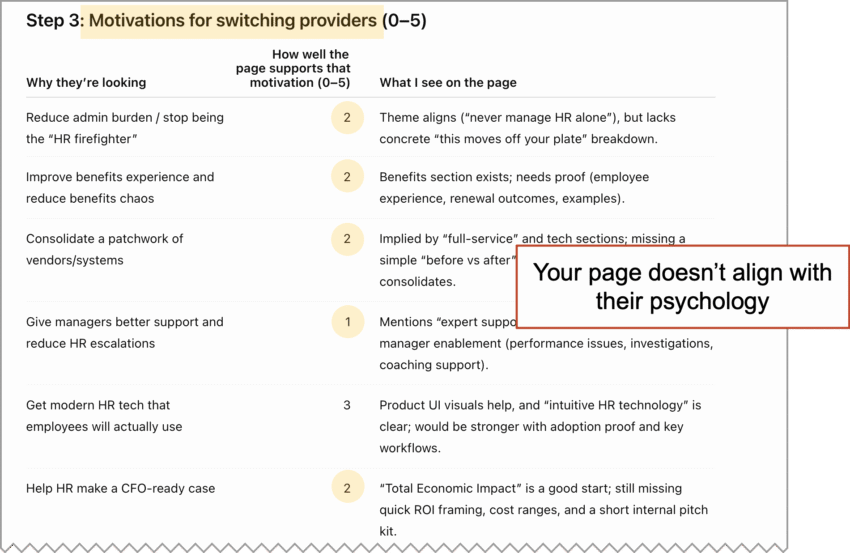
The goal of this page is simple: persuade the visitor to consider switching providers. But it doesn’t really align with their motivations for switching. It doesn’t address their objections. It doesn’t connect with the psychology of the visitor.
Try the method yourself. Scan through the report and dismiss anything that’s not a fit. The effective AI marketer strikes a balance between skepticism and trust. They are comfortable with ambiguity. They understand that AI is probabilistic.
Some marketers trust AI too much. They accept too many recommendations without validating.
Some marketers are too dismissive of AI. They miss opportunities for quick insights.
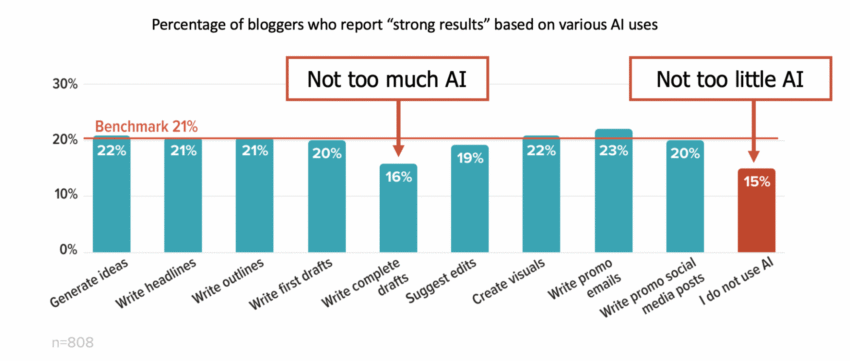
This data is from our annual content marketing survey. Balance and judgement are key!
Prompt two: Check against a set of cognitive biases
We started with the persona, but there are other ways to consider visitor psychology.
What if we gave the AI a list of cognitive biases?
Then it could scan the page, and with the persona in mind, identified any missed opportunities to leverage each specific bias. The recommendations may be very specific.
Example: Are you promoting a program that starts in the fall? Did you forget to mention the deadline? A prompt that audits for missed opportunities to add the “scarcity principal” will spot the gap and recommend a fix.
This prompt checks for 14 different cognitive biases that are relevant to marketing. Again, the input is a page and a persona.
Cognitive bias check prompt
You are a behavioral science–informed conversion optimization expert. I’m giving you a webpage and a B2B buyer persona. Your goal is to find the highest-impact missed opportunities on the page and propose specific UX + copy changes that apply relevant cognitive biases where they fit. Cognitive bias options to consider include: Scarcity Principle, Framing Effect, Availability Bias, Authority Bias, Anchoring, Halo Effect, Confirmation Bias, Loss Aversion, Ovsiankina Effect, Zeigarnik Effect, Surprise, Rhyme-as-Reason Bias, Motivating-Uncertainty Bias, Endowment Effect.
OUTPUT: Start by summarizing the page goal and visitor mindset (3–5 bullets): What action the page wants, What the persona is trying to decide/prove before acting, and The top conversion friction you expect.
Then list the top missed opportunities (6–10 items, numbered and ordered by impact). Format each item with a header that starts with the bias name: BIAS NAME — <short opportunity title>. Then a few sentences describing the friction: what’s stopping action (persona-specific)
• Where: hero / CTA / proof / pricing / form / etc.
• Change: what to change (UX or copy, specific)Example: 1–3 lines of example copy OR button + microcopy. Add the rationale for each: 1 sentence connecting the change to the bias and the persona’s decision barrier Only use bias names from the list above. Do not force-fit biases—skip any that don’t apply.
Finally, add some “Drop-in” rewrites (ready to paste)
• Headline: 3 options – Primary CTA button text + microcopy: 3 options
• Proof snippet (testimonial/case/metrics block): 2 options Each rewrite should optionally note the bias used in brackets at the end, e.g., “…” [Loss Aversion]Avoid gimmicks or hype; keep it B2B-plausible and defensible. Prefer subtle momentum, risk reduction, and internal-justification language.
When you come from this direction, providing a list of specific biases to audit against, the results are often more interesting and specific. Here’s an example:

|
Talia Wolf, Founder and CEO GetUplift“Cognitive biases aren’t random glitches in our thinking. They exist to help us make decisions more easily. Biases are the shortcuts the brain uses to protect us from emotional risk. Since every decision we make is emotional, these biases act as safeguards. Loss aversion? That’s fear. Social proof? That’s belonging and safety. Authority bias? That’s trust. Scarcity? That’s urgency and fear of missing out. Anchoring? That’s our need for certainty.” |
Be aware, marketer, of your own biases
Marketers, just like everyone else, have built in pre-dispositions. We may leverage biases and psychology to trigger action from our visitors, but we need to resist those same biases in ourselves, our judgements and our actions.
Because of the Confirmation Bias, we may “use AI” but really just ask it to validate what we already believe. To counter this, always run one more prompt that forces the opposite conclusion: “Argue why this page should NOT be changed” or “What would make this idea fail?”
Because of the Overconfidence Effect, we tend to feel certainty that it’s a good idea even before we’ve seen the proof. But don’t get too confident. Every marketing idea is really just a hypothesis. To counter this, validate with data.
- Set up an AB test …when you have sufficient traffic, skill with testing tools or a helpful partner
- Make a change and measure the pre/post difference …when the risk is low, you have low traffic and high confidence
- Run an AI simulation …when you trust the accuracy of your personas, you can mock up a revised page and check it with clever AI conversion prompts.

Source: https://www.orbitmedia.com/blog/data-driven-marketing-decisions/
Because of the Planning Fallacy, (another bias) we may underestimate the time and effort the changes will take. But this work takes time. Depending on your approval processes, a simple copy edit may take a week or more to push live. To counter this, set quick deadlines and remind everyone that you can change it back anytime.
Because of the Endowment Effect, we may get attached to our new, updated messaging. We may be too reluctant to change it again, even if performance doesn’t improve. To counter this, commit to reviewing data and re-evaluating the page on a schedule. Put it on the calendar.
Finally, we may feel smart when we read about behavioral psychology!
But because of the Illusion of Explanatory Depth bias, we tend to think we understand this stuff more deeply than we really do. But human behavior is chaotic and unpredictable. Even the best researchers are surprised all the time!