Right now, somebody is asking AI who they should contact in your category.
When a buyer asks an AI tool who to hire, what website content influences that recommendation? To find the answer, we looked at 704 websites across four industries, ran 96 prompts across four AI tools, then reviewed 8,771 recommendations across the 1,916 responses.
With all of the usual disclaimers that come with correlation studies (full methodology below), let’s look at the connection between homepage facts and AI recommendations.
We focused on recommendations because they’re more valuable than citations. We focused on homepages because they’re more visible than other pages. Details below.
First, let’s quickly define those:
- Homepage facts: The specific, checkable statements about the company that would be true of some companies and false of others, published on the homepage. (“Innovative solutions” and “a passionate team” are not facts.)
- AI recommendations: An AI tool, asked for help by a buyer, names a company as one the buyer should consider. (Simple mentions or being cited as a source are not recommendations. We are not concerned with citations in this research.)
This is a study of what (facts) and where (the homepage) brands can influence AI recommendations. You’ll also learn what doesn’t affect AI recommendations (high word count, taglines, testimonials, etc).
Note: We left out the big brands because they play by different rules. The top quarter of companies by Domain Authority get recommended a lot (44% of the time) but we’ll set those aside and focus on the other 75%, because these are the brands that can earn recommendations through better copywriting.
We’ll share four insights:
- More facts on the homepage correlate with more AI recommendations
- Facts on the homepage matter more than facts on interior pages
- Some facts correlate with AI recommendations more than others
- Some ways of presenting facts correlate with AI recommendations more than others
At the end of this research, we’ve added some prompts you can use to audit the facts on your homepage.
More homepage facts, more AI recommendations
Every SEO has read the “more words, higher rankings” correlation studies. Pages with more words are more likely to rank high in search results. Adding words has been an SEO tactic for 20 years.
But we found no connection between word count and AI recommendations. We did find a strong connection between facts and recommendations. More facts, not just more words, correlated with more AI recommendations.
Across homepages with 15 to 60 facts, the chance of being recommended by an AI tool rose from 5% to 30%. The typical homepage states 31 facts.
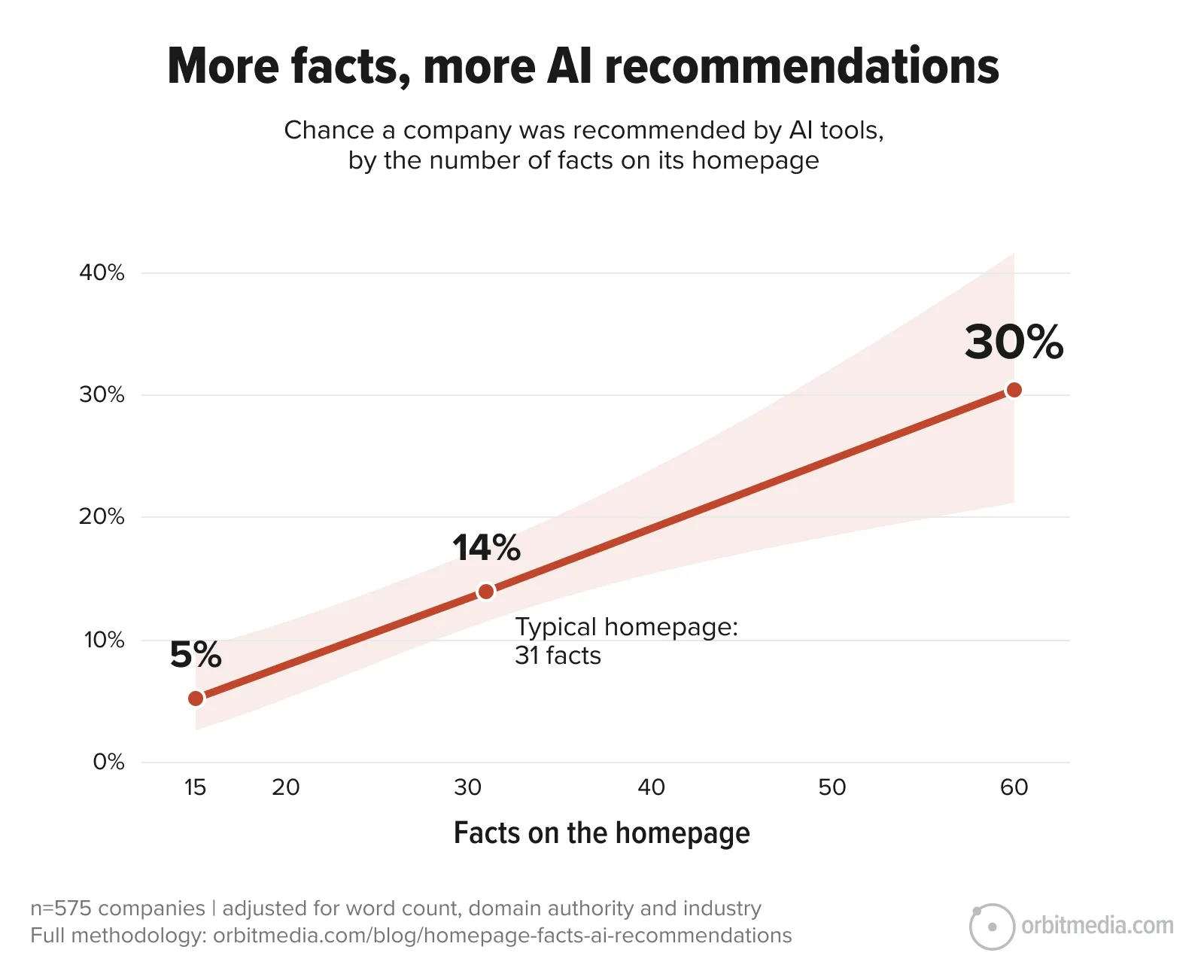
It’s a surprisingly simple insight. Homepages with more factual information give the AI more opportunities to confidently recommend a brand to a user. The average response includes 4.6 recommendations. Facts are a big factor in getting into that mix.
 |
Flint McGlaughlin, Founder of MECLABS“Machines prefer options with high clarity, high corroboration and low ambiguity …because these reduce the risk of recommending incorrectly.” |
This reframes the idea of AI-friendly copywriting. Many SEOs recommend FAQs, schema tagging, E-E-A-T, etc. But here we found something much more straightforward and specific. The more facts on the homepage, the more likely a brand is to be recommended by AI. It makes perfect sense.
Imagine you’re an AI.
Your user asks you for a recommendation. You start researching possible options. You land on some company websites. You skip past the generic web copy. They mostly have the same vague claims, but a few have genuine, factual information that you can compare to your user’s prompt. Once you’ve gathered enough facts, you build a shortlist and respond.
Facts are what AI needs to match brands to users accurately. This is common sense but not conventional wisdom.
The homepage is where facts matter most
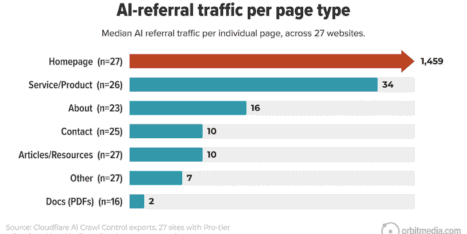
We focused on the homepage because we know from our earlier research on the Cloudflare data of 74 websites, that AI bots request homepages 15x more than any other type of page. It’s the page that they read the most, by far.
If you really want AI to know something about your brand, put it on your homepage.
It is your most crawled page, therefore it’s where your content has the greatest likelihood of getting in front of two kinds of AI bots: the bot that puts you in AIs training data and the bot that fetches things when users ask.
It’s the page AI is most likely to check and therefore the strongest URL for influencing AI recommendations. This supports our theory about a maximalist approach to homepage copy (“Domus Maximus”) which we’ll cover in a future article.
Facts on homepages influence the likelihood of recommendations more than facts on interior pages. We checked homepages against four interior pages per website (about, services, industries, work).
Facts that appear on the homepage had a greater correlation with recommendations.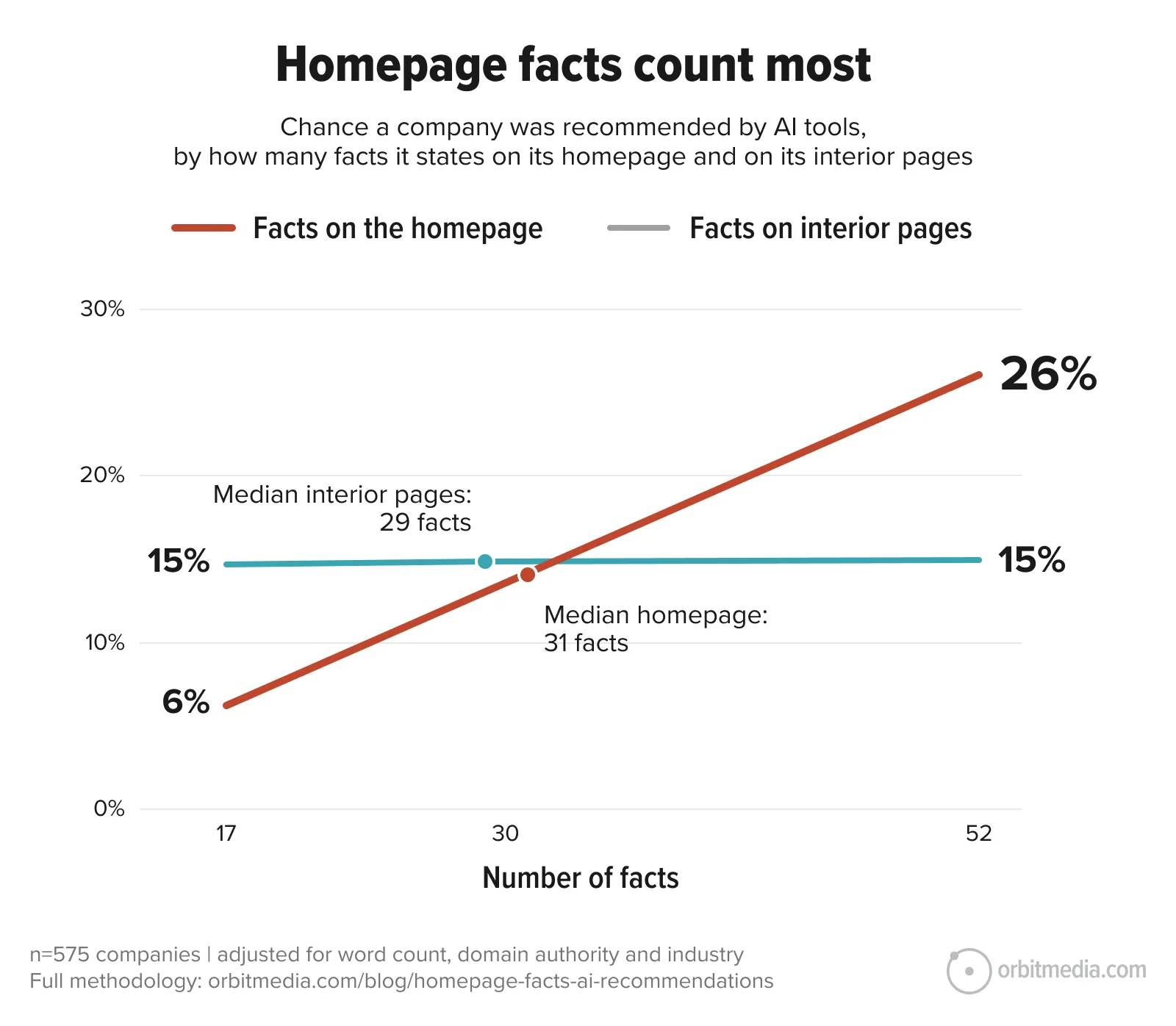
When AI tools did recommend a company, two-thirds of what they said about it was stated on its homepage. Only 5% appeared on an interior page.
This doesn’t suggest that interior pages shouldn’t be as factual. Or that the same fact shouldn’t appear in several places. Fill your pages with facts. Those facts are what AI needs to accurately make good recommendations.
Which kinds of facts drive AI recommendations?
We looked for correlations between types of facts and AI recommendations.
To do this, we grouped every fact on every homepage into five categories, then compared the homepages that included “none,” “some” and “more” facts within each category. This analysis shows that not all types of facts pull equal weight. Some types of facts influence AI recommendations more than others.
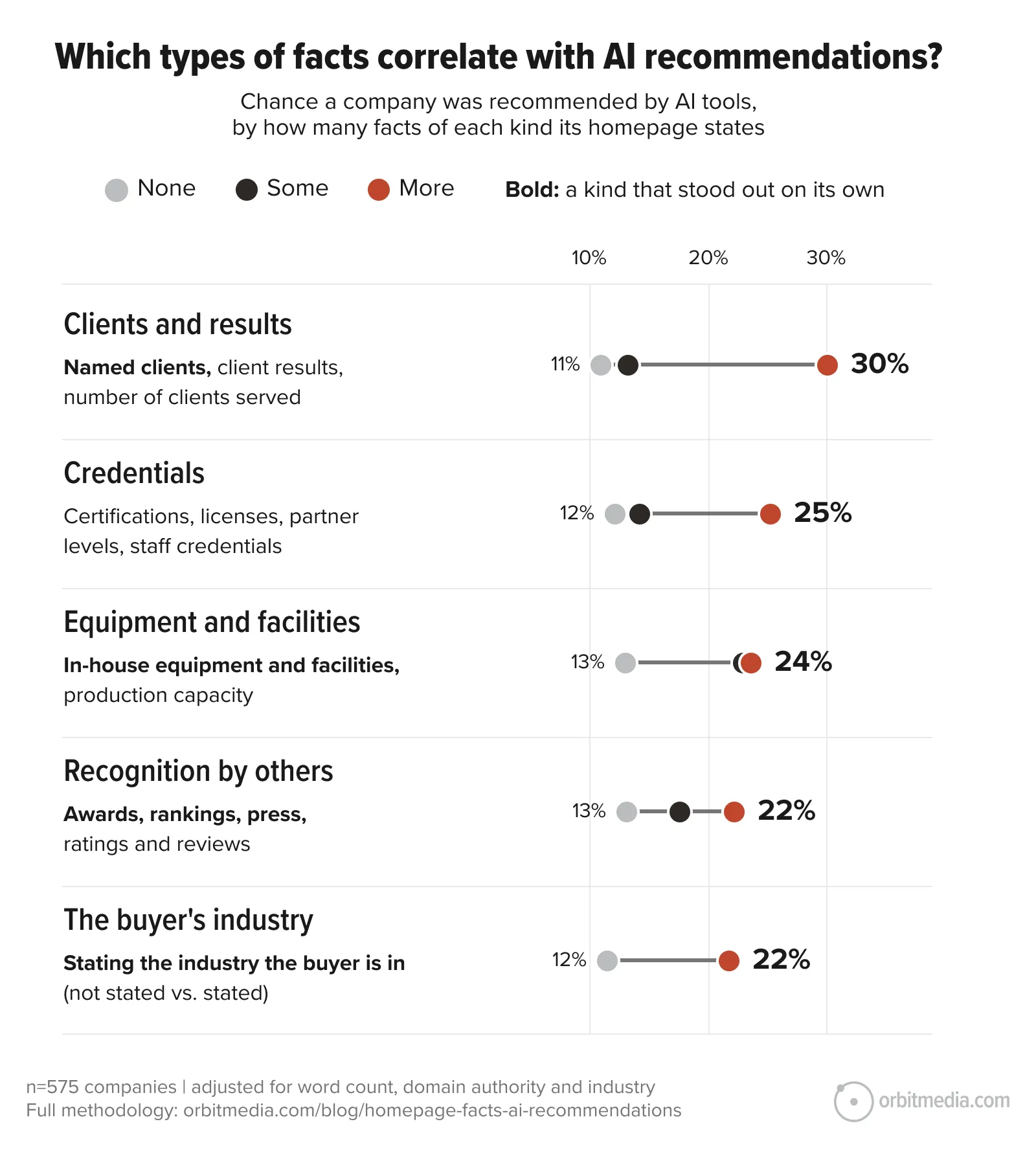
Let’s look closer at some of these categories. The more of these facts a homepage stated, the more often the company was recommended. These facts train AI to be a sales rep for your brand.
- Clients and results
Homepages naming 5 or more clients or client results were recommended 30% of the time, vs. 11% for homepages with none. The strongest correlation and apparently, what AI looks for and trusts. Can’t name your clients? Too sensitive or confidential? So be it. Name their industries. If you can’t do that, just do something else. Lots of other facts you can add… - Credentials
Homepages with 3 or more credentials were recommended 25% of the time, vs. 12% with none. Certifications on their own didn’t move the needle. Several credentials together did. More on how to publish those below. - Recognition by others
Awards, rankings and ratings went from 13% with none to 22% when homepages included two or more. Everyone recommends validation on third-party websites, but here we see that the same validation helps when you put it on your own site. Won an award? Don’t forget to tell everyone. Put it on your homepage. - Capabilities, equipment, facilities and tools
Listing specific capabilities helps get you on the shortlist (“an in-house 24/7 security operations center,” “17 extrusion presses”). The difference was significant: 25% with vs. 13% without. - Industries served:
AI users often tell the LLM about themselves, knowing that it can improve the quality of responses. That may explain why naming 6 to 9 of your buyer’s industries did better than naming fewer. Naming more than that didn’t improve anything, so don’t go nuts with a giant list.
When the homepage facts match more of the buyer’s requirements, that brand was far more likely to be recommended by the AI. The facts that matter most are exactly the ones your buyers put into their prompts.
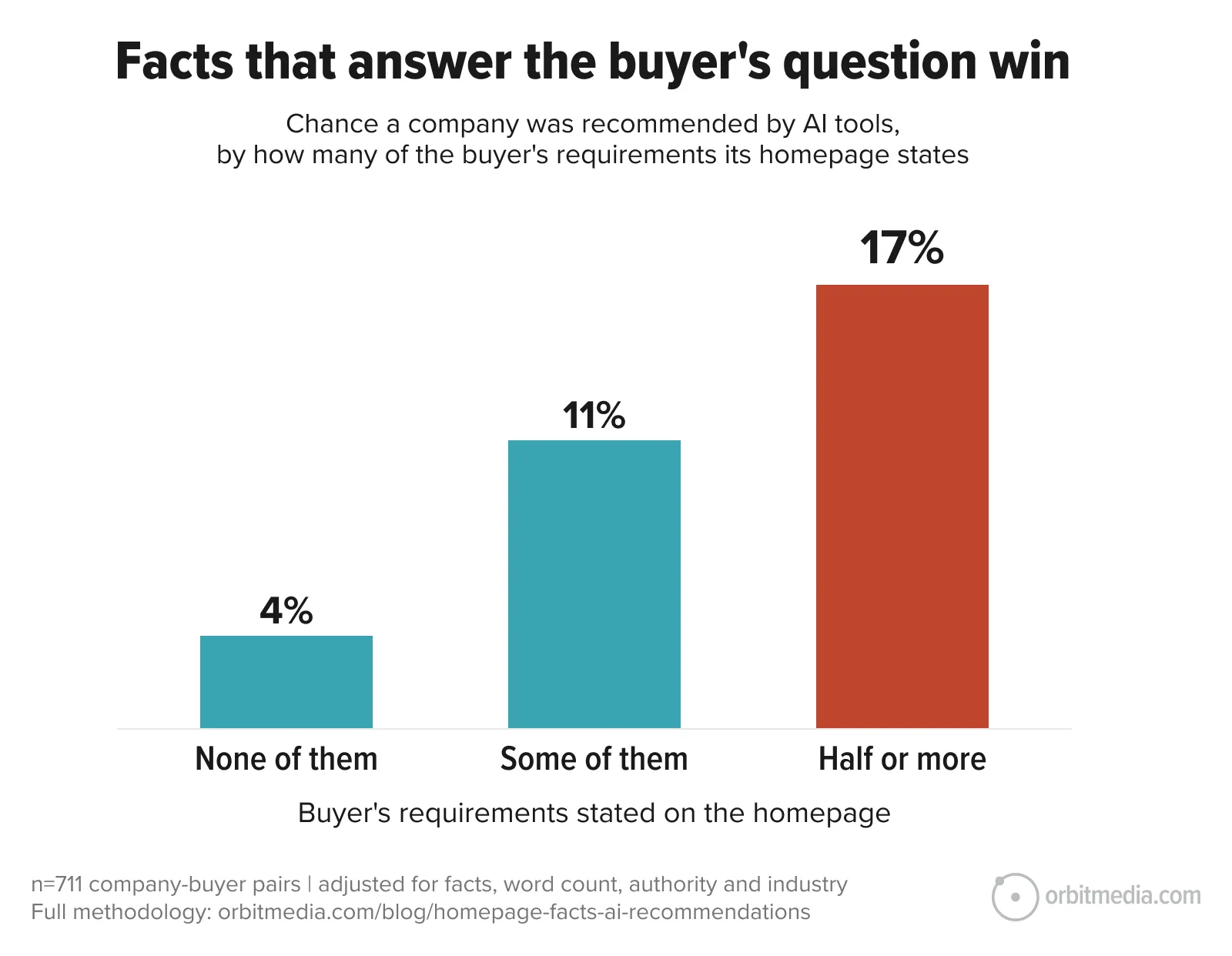
But in the dataset, 25% of them stated zero facts that aligned with the detailed buyer prompts. A quarter of all of the homepages state none of the buyer’s requirements. Naturally, those brands got recommended the least.
Alignment means details, both in the prompts and responses. The research revealed that when user prompts contain more details, AI responses contain more recommendations.
We ran sets of prompts carefully tuned to specific buyers, with descriptions of who they are, their situation and their likely constraints. Here are some examples of the longer, more detailed prompts we tested:
- Manufacturing: “I’m a mechanical engineer at a medical device startup. We need tight-tolerance machined parts in titanium and PEEK, starting with prototypes and moving to a few thousand units a year. We need an ISO 13485 shop in the US. Which precision machining companies should I contact?”
- IT services: “We’re a small defense subcontractor with 60 employees, and our prime contractor says we need CMMC Level 2 certification next year. We don’t know where to start with the technical controls or documentation. We need an IT provider that has taken companies through CMMC. Which providers have that experience?”
- Accounting: “I’m the finance director at a nonprofit with a $15M budget and several federal grants. We need a new audit firm for our annual audit and single audit, and help with our Form 990. Our board wants a firm with real nonprofit experience. Which CPA firms are strong in nonprofit audits?”
- Web design: “I’m the VP of marketing at a B2B professional services firm with about $50M in revenue. Our website looks fine but generates very few leads, and we can’t tell which pages drive inquiries. We want an agency that focuses on B2B lead generation, not just visual design. Which agencies are known for that?”
Including well-aligned facts matters more than just including lots of facts. Alignment over fact count. Quality over quantity.
The best source of buyer intelligence? Your own voice-of-customer data. Here’s a method for analyzing sales calls. Another great source for intelligence? AI buyer personas. Here’s a process for using personas.
The key is to know the buyer’s language before you write your web copy. Again, pretty obvious. But think through that and you’ll conclude that winning AI recommendations is equal parts SEO and conversion optimization.
If the page isn’t optimized for conversion, it’s not optimized for AI search.
Facts in text, not just images
AI isn’t rendering pages and looking at the images. It scans the code like any bot. So client logos, award seals, certification badges aren’t seen by AI. Mentions of these must also appear as text.
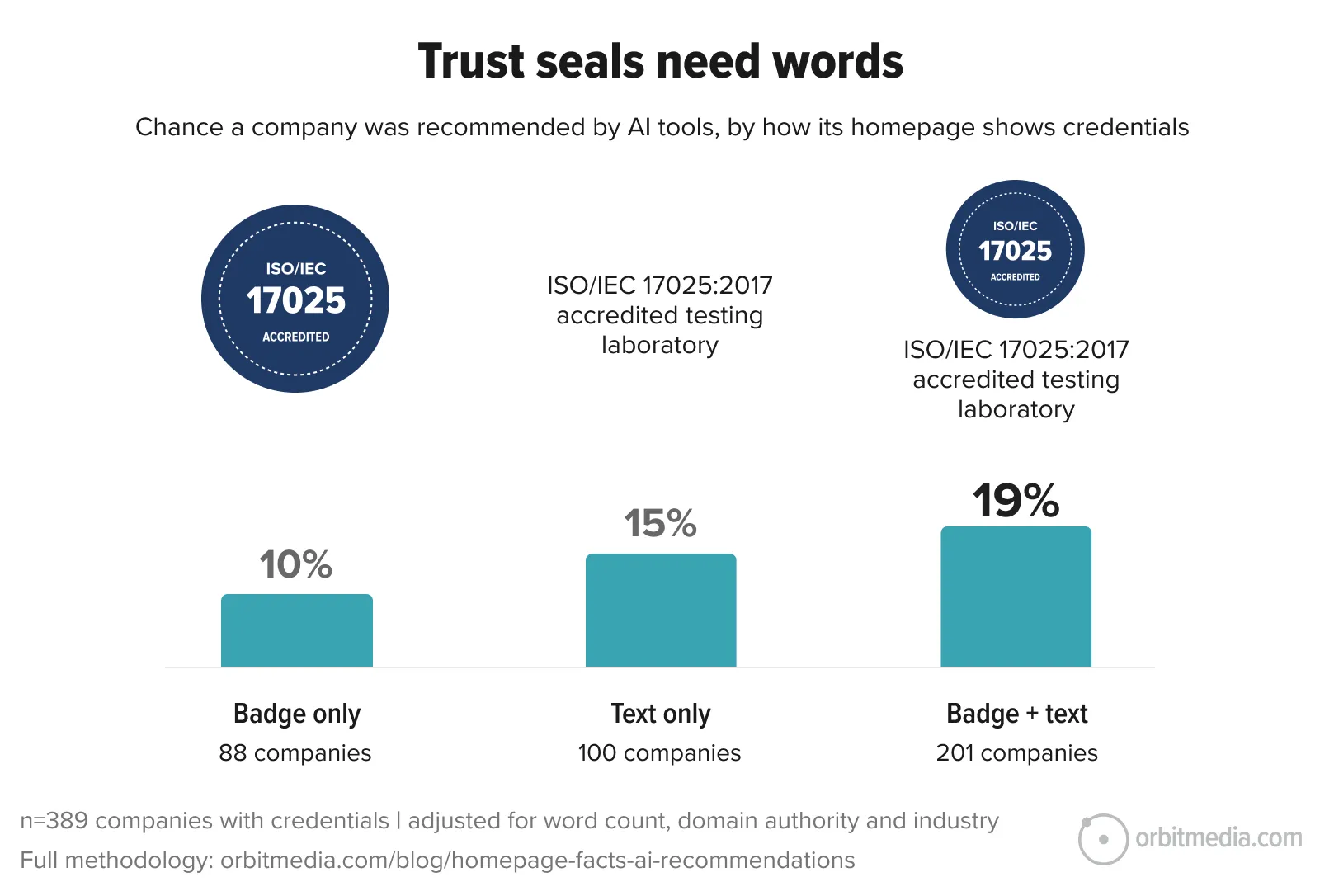
This isn’t necessarily a checklist. But the facts that went with recommendations have something in common: they’re proof. A named client hired you. Someone gave you an award. You hold the credential. You own the equipment.
Only human marketers can gather this evidence because many facts aren’t on the internet yet. Success stories, awards, staff credentials all need to be collected offline. That’s work that AI cannot do. Offline investigation is a human-only activity.
FAQs sometimes help
The most common advice in AI search articles is “Add FAQs.” They refer to that little box with expandable accordions, usually at the bottom of the page. SEOs are wallpapering the internet with these boxes.
But the little box itself isn’t what makes a difference. What’s inside it makes a difference. The FAQ section is simply a delivery format for facts. When they include helpful facts, they help. It all depends on what they include.
22% of homepages have them. The typical FAQ box has six questions. Homepages with an FAQ section carried more facts. But having an FAQ box didn’t correlate with AI recommendations beyond the facts it carried within it.
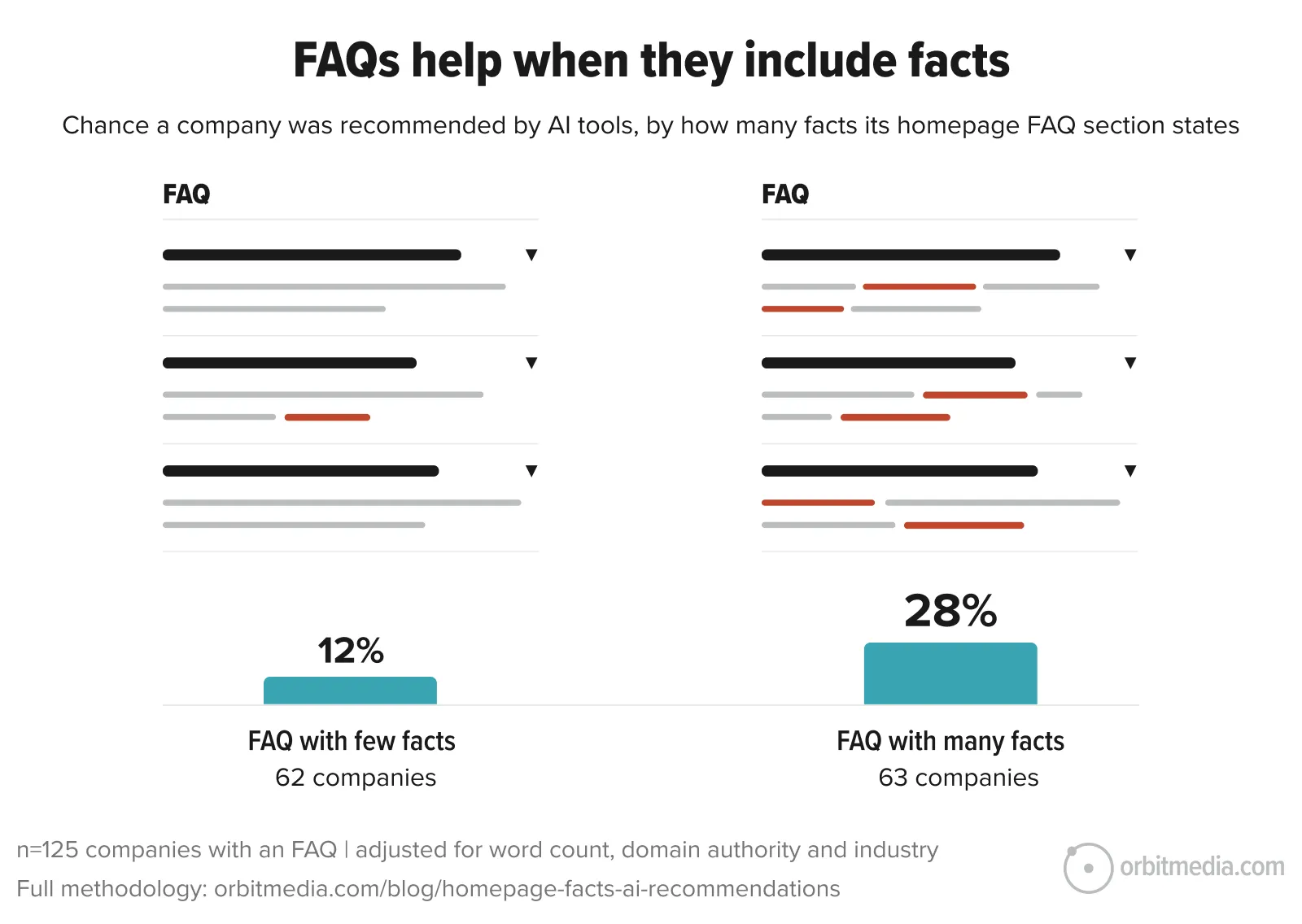
So the point is not to “add an FAQ.” The point is to fill the page with buyer-aligned facts.
If someone suggests adding FAQs, make the conversation about buyer research. And if you discover a really important question, add it higher on the page. Don’t hide the most important answers into a little box at the bottom. Your human visitor won’t see it there.
What doesn’t seem to matter for AI recommendations
Some of the most common homepage advice made no difference in our data. Here’s what you can stop worrying about, at least where AI is concerned. But if any of these are important to your human visitor, definitely add them.
Many of these surprised me.
- Word count doesn’t matter.
Longer homepages weren’t recommended more often. If anything, the trend went the other way. Length only helped when those extra words included more factual answers. - Testimonials don’t help AI recommendations.
A great story may tug human heartstrings. But the AI is looking for cold, hard facts. Of course, testimonials aren’t factual. But they’re compelling for human visitors and should be kept. The day humans stop making buying decisions, I’ll stop recommending testimonials. - Branded processes? AI doesn’t care.
Your “proprietary 5-step method” apparently doesn’t matter to AI. General descriptions of how your company works (“white glove service,” “a single point of contact”) didn’t help either. They’re more like promises than proof. - Saying what you DON’T do doesn’t matter to AIs
When AI considers recommending you, saying what you do is more important than saying what you don’t do. This kinda surprised me. I’d heard the opposite. - Company profile facts aren’t helpful
Years in business, founding date, team size, ownership, etc. These made no reliable difference. They’re factual, but don’t tend to align with buyer prompts. Makes sense. - Generic headings and menu labels are perfectly fine.
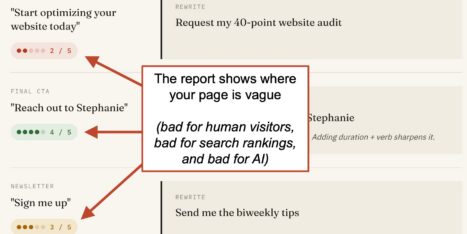
Vague subheads (“What we do”) and navigation labels (“Services”) didn’t hurt AI recommendations. Specificity is good for busy human scanners and good keyword relevance for search engines, but AI reads all the words under your boring subhead. It finds what it needs or it doesn’t. This surprised me too. - Pricing? Not sure.
So few homepages show prices (just 8%) that we couldn’t detect a correlation. More homepages showed price terms (“flat monthly price” or “no long-term contract”) which did appear to help in quote-based industries.
And one thing that went with fewer recommendations: heavy self-praise
AI is less likely to recommend “best, leading, world-class” brands
We checked the self-praise and found a lot of it. More than half of the homepages we studied called themselves “the best,” “leading” or “world-class.” Three in four used words like “innovative,” “seamless” or “passionate.”
There are so many great companies on the internet!
But when we checked for correlations with the superlatives and hype, we discovered that self-praise actually seemed to reduce the likelihood of recommendations. Homepages that used the most praise words were recommended 10% of the time, vs. 16% for the rest of the dataset.
These words aren’t persuasive for visitors either. “You like your own brand …Okay. We get it.”
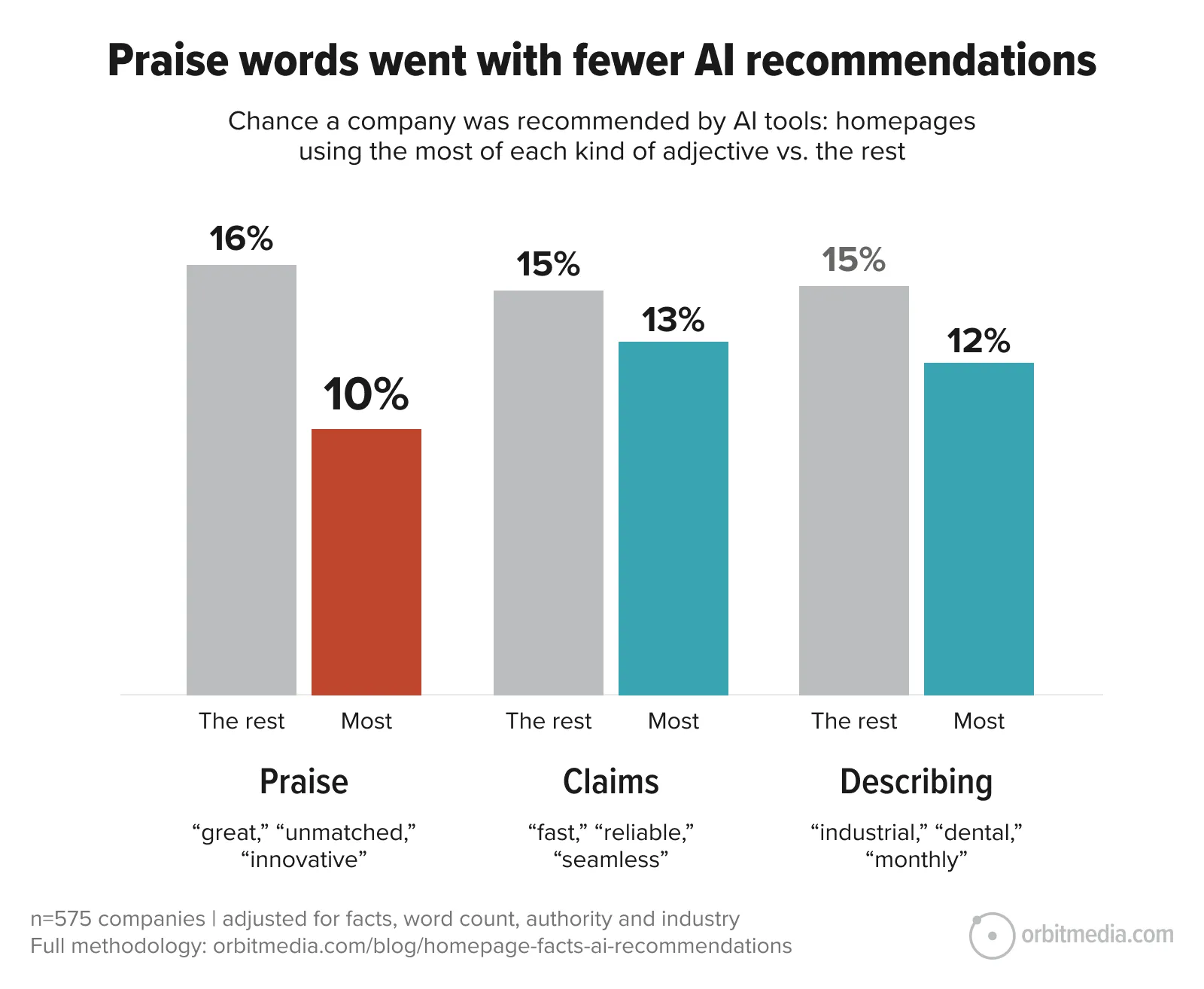
Self-congratulatory copywriting doesn’t help you here. Quit patting yourself on the back or you’ll hurt your arm. “We put our customers first” may be your slogan (and may work great in brand marketing) but taglines don’t train the AI.
How to audit your homepage facts
How many facts are on your homepage? Maybe you’re suddenly wondering. How do you score against a buyer prompt? How do you compare to competitors? Here are three prompts that answer those questions in the context of the findings of this research.
Run all three in the same conversation. Different models will show different numbers. That’s fine.
Fact Score Prompt #1 (count and score)
This simply scores your homepage against the research findings.
Score this company’s homepage on the facts it states, using the scorecard below.
A fact is any specific, checkable statement about the company: something that would be true of some companies and false of others, and that a buyer could verify or hold the company to. Don’t count slogans, adjectives or self-praise, general services (“web design,” “managed IT”), vague promises (“we deliver results”), standard calls to action (“free consultation”), the company’s own name, contact details, navigation labels, blog headlines or legal text. Count only what’s written in the text: a client logo or award badge whose name isn’t in the text doesn’t count. Count each fact once, even if it’s repeated. Split lists: “ISO 9001 and AS9100 certified” is two facts, and ten cities served are ten facts.
Score each row 1 to 5 with these scales. Use the scales exactly; don’t adjust for the industry.
1. Total facts (all kinds): 1 = under 15, 2 = 15 to 23, 3 = 24 to 31, 4 = 32 to 41, 5 = 42 or more
2. Clients and results (named clients, plus client results with a number or a client name): 1 = none, 2 = 1, 3 = 2 to 4, 4 = 5 to 9, 5 = 10 or more
3. Credentials (certifications, licenses, accreditations, partner levels, staff credentials like “12 CPAs”): 1 = none, 2 = 1, 3 = 2, 4 = 3 or 4, 5 = 5 or more
4. Recognition (awards, rankings, press mentions): 1 = none, 3 = 1, 5 = 2 or more
5. Equipment, facilities and tools (“an in-house security operations center,” “17 extrusion presses”): 1 = none, 3 = 1, 5 = 2 or more
6. Industries served (named industries or types of customer): 1 = none, 2 = 1 or 2, 3 = 3 to 5, 5 = 6 or more
7. Self-praise (scored in reverse; count uses of “best,” “leading,” “world-class,” “innovative,” “excellent,” “tailored,” “unique,” “exceptional,” “cutting-edge,” “game-changer,” “passionate” and similar, but not “best practices”): 5 = none, 4 = 1 or 2, 3 = 3 to 5, 2 = 6 to 9, 1 = 10 or moreStart with one table: Category | Score (as “4 ●●●●○”) | What the page states (counts and two or three examples) | One way to raise the score. Under the table, give the average of the seven scores, with one decimal. Then list every fact you counted, grouped by kind, so I can check your work.
Homepage: [paste the page text, or the URL if your AI tool can read web pages]
Fact Score Prompt #2 (Buyer prompt alignment)
This scores your homepage against a buyer prompt.
Here’s a request a buyer might give an AI tool: [paste a real buyer request, from sales calls or RFPs]
List the requirements in it (industry, company size, location, credentials, specific services). For each one, say whether the homepage above states it, and quote the words that do. Count the same meaning in different words (“hospitals and clinics” for “healthcare”). Show this as a table: Requirement | Stated? (yes/no) | Words on the page. Then score the buyer match 1 to 5 by the share of requirements stated: 1 = none, 2 = under a quarter, 3 = a quarter to under half, 4 = half to under three quarters, 5 = three quarters or more.
Fact Score Prompt #3 (Competitive Matchup)
This third prompt scores your homepage against your competitors
Then score these competitor homepages the same way and show the scores side by side in one table, one column per company:
[Competitor 1 URL]
[Competitor 2 URL]
[Competitor 3 URL]
AI search is the intersection of SEO and conversion optimization
SEOs are, by nature, information retrieval specialists. They tend to focus more on the machine and less about the persona using the machine, which was effective in the era of deterministic search algorithms.
But we are now in the era of probabilistic language models. These machines do more than retrieve, they recommend. They are focused on helping the user. So if we also focus on that user, rather than the machine, maybe we can better align with both.
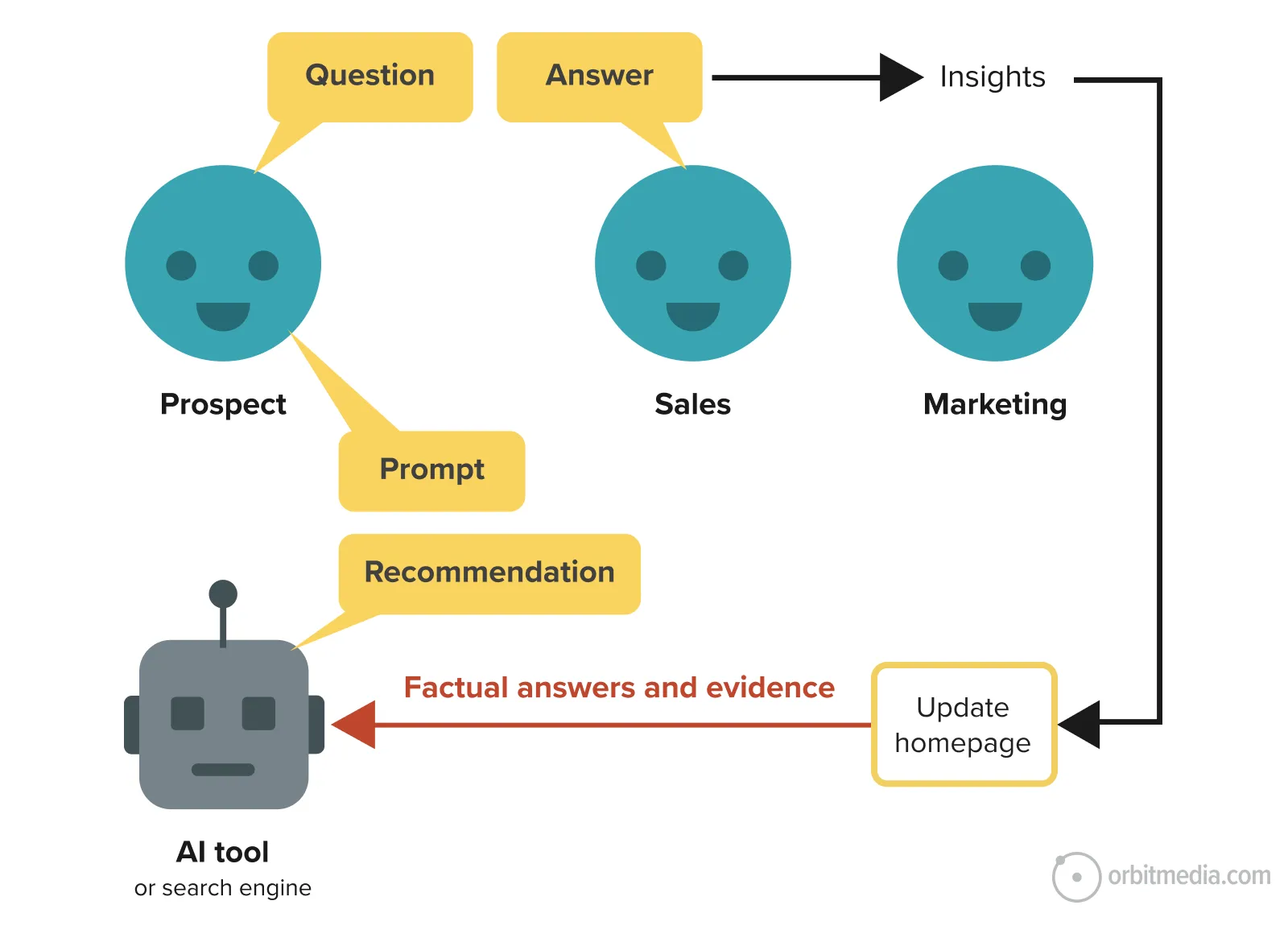
SEOs are so focused on machines, sometimes they research the differences between machines: ChatGPT, Gemini, etc. But how useful is this? Can you build a strategy that focuses on AI but not another? And they all change so fast. I don’t find model comparison studies very helpful.
I asked one of our strategists, Melissa Graham, about this. Why do SEOs miss gaps that are obvious to conversion optimizers? And vice versa? She explained it perfectly.
 |
Melissa Graham, Senior SEO/CRO Strategist, Orbit Media“SEOs think about gaps between their site and their competitors Conversion optimizers think about gaps between their site and their buyers.” |
We need SEO or the machine will never find us. But this alone isn’t insufficient. You can be visible in AI without being recommended. The real goal is to get on AI’s shortlist when the buyer prompts.
That means factual answers to real buyer questions, supported by factual evidence.
Methodology
Process: It took 12 hours over a single week in October 2026. We spent around $400 in tokens and API calls. The exchange involved about 100 prompts from our end, pushing back on the analysis and looking for deeper insights.
Buyer prompts: 48 buyer needs in four industries (web design agencies, IT managed service providers, CPA firms, manufacturers), each written as a short keyword and a detailed request; neither named a company.
AI answers: each prompt run five times in ChatGPT, Gemini, Google AI Mode and Perplexity in October 2026 (1,916 answers, US, English), collected through DataForSEO. Claude Opus 5.5 identified the companies each answer recommended.
Companies: found through Google’s top 100 results for each keyword, before any AI tool was asked, plus companies the AI tools recommended. 704 Google-found company homepages analyzed; the main sample excludes the top quarter by domain authority (575 companies).
Facts: Claude Sonnet 5.5 listed every specific, checkable fact on each homepage: open definition, including ownership, guarantees, policies and other kinds
Buyer-question match: Claude listed 3 to 6 requirements from each detailed prompt and checked which ones each homepage’s facts and full text.
Claims traced: for 975 AI recommendations, Claude listed the specific claims made about the company and checked each against its homepage and up to four interior pages.
Analysis: chance of being recommended at least once in 40 answers, adjusted for homepage word count, Domain Authority (DataForSEO), industry and total facts. Correlation, not causation. AI answers vary: only 4% to 18% of recommended companies appeared in all five runs of the same prompt.