Maybe you’ve heard…
The key to AI visibility is FAQs, schema markup and off-site citations on sites like Reddit. This is the consensus in the SEO community, standard advice on SEO articles and a common theme at SEO events.
To confirm my suspicion, I used a tool to scan 150 articles about AI search optimization on SEO blogs. Indeed, when categorized, these were the top recommendations.
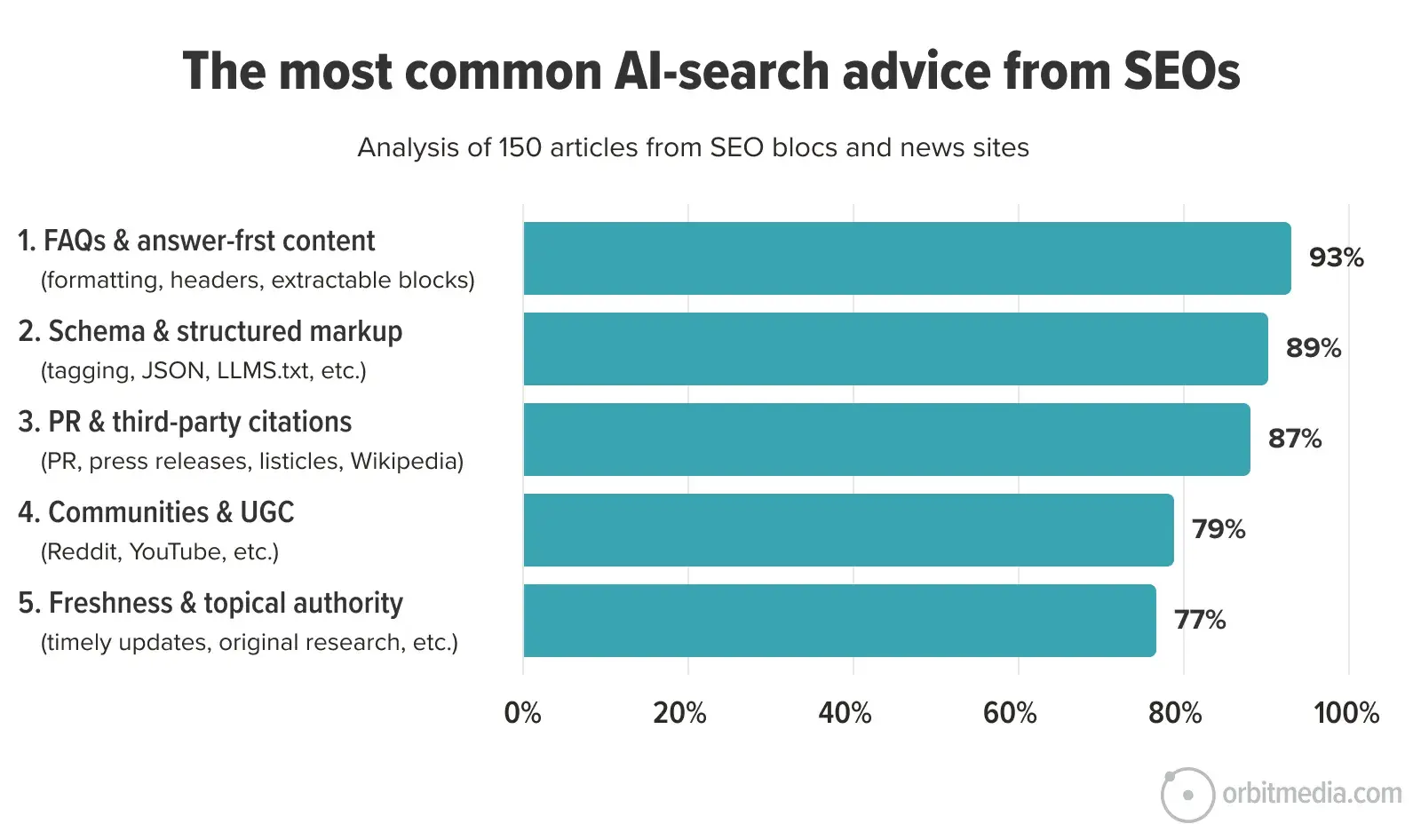
I could easily have had the tool scan 500 or more articles, but the rankings stopped moving after the first 60. These top five categories were already locked in. Why have the AI burn the calories? More sources would have produced the same chart.
I worry that SEOs are often over-relying on checklists and tools without thinking creatively or strategically. It’s too easy to let best practices be a crutch for low performance. And in this case, I’m skeptical of the best practices themselves.
Before I skewer the typical SEO advice, let’s review the summary of the standard advice from SEOs on AI search optimization:
Typical SEO advice about AI search
- FAQs & answer-first content (93% consensus in the dataset)
Structure pages with Q&A headers, extractable answer blocks and dedicated FAQ sections so AI can easily parse and cite your content. - Schema & structured markup (89% consensus in the dataset)
Tag your content with JSON-LD schema (Article, HowTo, Organization, Product) and configure llms.txt and robots.txt so AI crawlers can read it. - PR & third-party citations (87% consensus in the dataset)
Earn mentions in press coverage, listicles, analyst reports and Wikipedia because 85% of AI brand citations come from third-party domains, not your own site. - Communities and UGC (79% consensus in the dataset)
Build authentic presence on Reddit, YouTube, LinkedIn and review sites where AI engines verify brand claims against real community conversations. - Freshness & topical authority (77% consensus in the dataset)
Update cornerstone content quarterly, publish original research and build topic clusters because AI citations decay after roughly 13 weeks.
Clearly, they’re all saying pretty much the same thing. I’m going to challenge that thinking now.
Here comes some unconventional wisdom about AI search optimization. I’m not saying my advice is original. I’m sure hundreds of SEOs do these things every day. But this is advice you don’t see in many articles.
SEOs suggest FAQs
…but don’t know which questions are frequently asked
Yes, AI users ask questions and AI gives answers. So it makes sense that the grammatical structure of questions and answers would help AI respond to users. The idea of adding FAQs makes sense.
The Problem: SEOs often have no idea what questions are frequently asked
How do SEOs know what questions to answer? The articles recommend SEO tools, Google, competitors and prompts.
They are mostly saying the same thing: just look up the questions, generate the FAQs, drop them into pages …move on to the next item on your checklist.
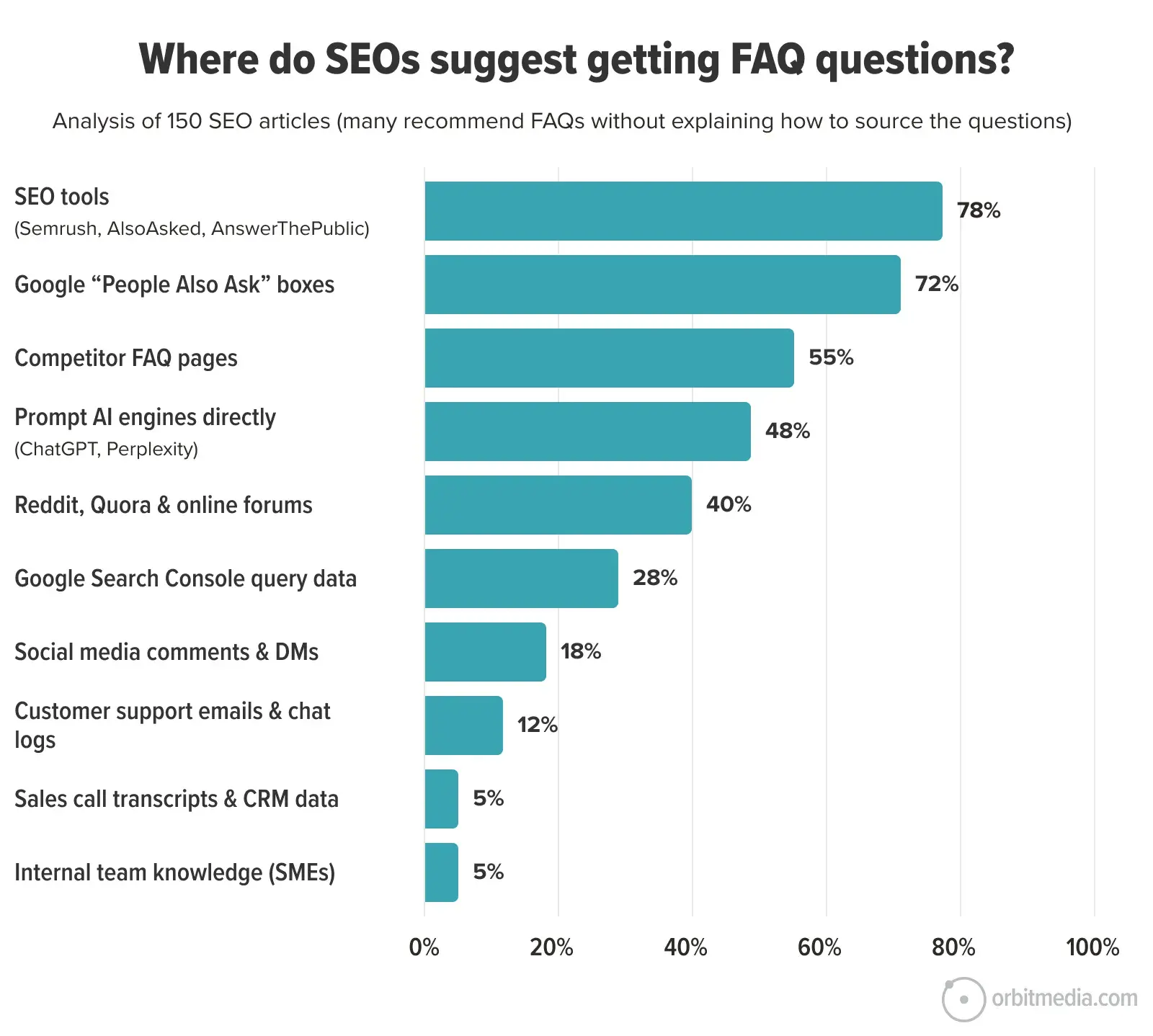
Look at the unusual advice at the bottom. Just look up the questions, generate the FAQs and drop them into pages. Easy, right? Move on to the next item in your checklist.
But you ended up with the same questions everyone else has.
The Fix: Ask AI to analyze your sales call transcripts
Use your own data to discover what questions your specific audience is asking. You probably have a lot of this first-party data. It’s your sales call recordings.
Post-covid, we’re all on virtual calls and many of these meetings are attended by AI notetakers. Indeed, I’ve been in meetings with more notetakers than humans! Jock and I had a lot of company that day.

Those sales call transcripts are huge piles of language directly from your target audience. It’s their problems and their questions in their words. A goldmine.
Export those transcripts. Put them all into a lightweight file (TXT or markdown) and upload them to your favorite AI. If they’re too long, break them up into multiple files. Better yet, make it a tool (custom GPT, Claude Project, Gemini Gem, etc.) so you can talk to it anytime. The insights are incredible.
I put 65 sales call transcripts into NotebookLM and it worked especially well because that tool sticks closely to the source material. It rarely hallucinates. It’s not as generative (AI engineers call this “low temperature”) which makes it bad for analysis but good for extraction. You get your prospects’ actual words back.
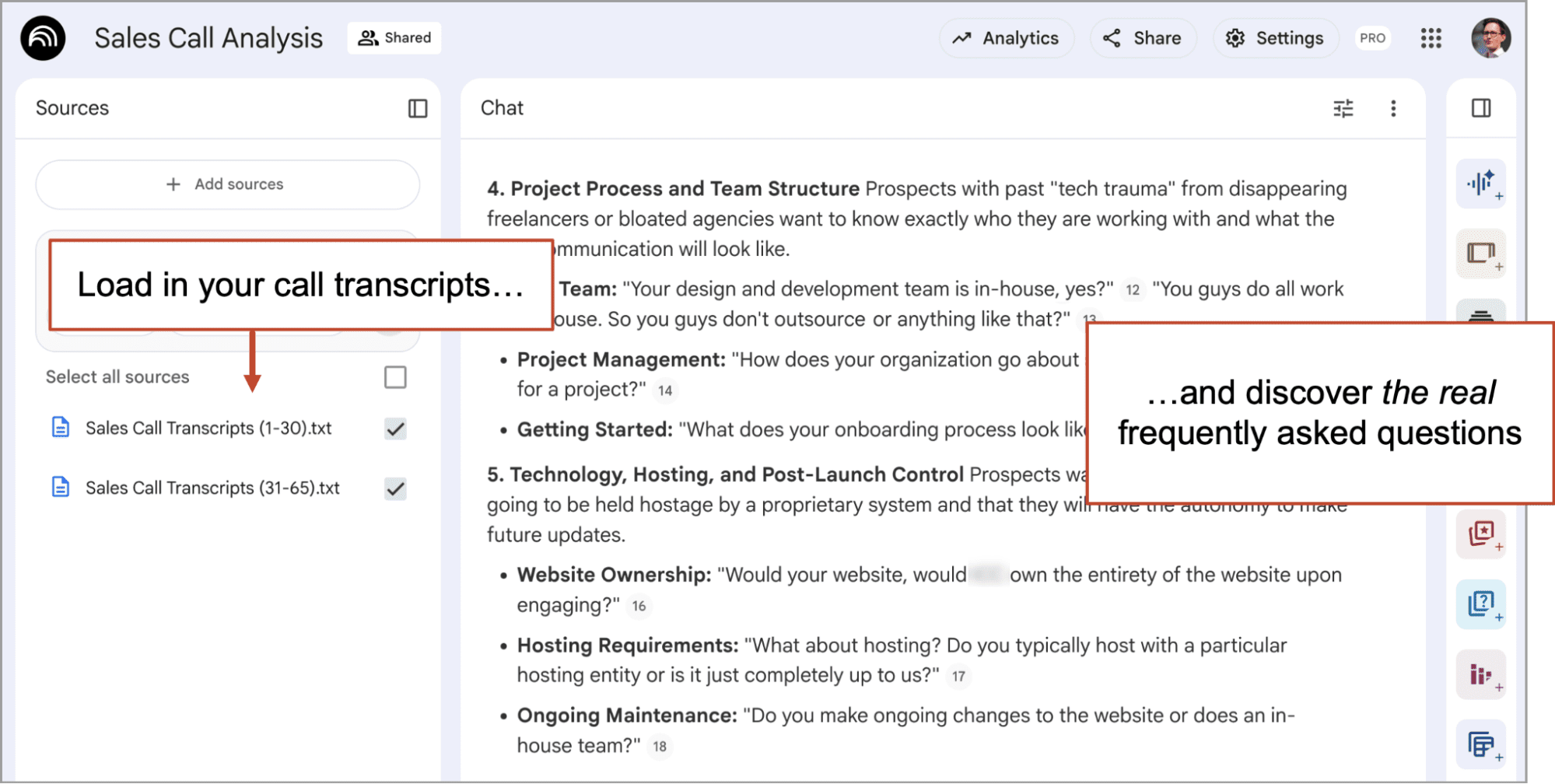
All loaded in? Use these prompts to find the real FAQ of your prospects.
- “What are the most common questions prospects ask in these calls? Categorize and give specific examples”
- “Analyze the prospects’ language to determine the most significant question they are thinking but hesitant to ask.”
- “What do prospects assume about us that’s wrong?”
- “What words and phrases do prospects use to describe their problem before they know the name for the solution?”
- “What specific criteria or requirements do prospects mention when comparing options?”
Voice of customer (VOC) is the gold standard in audience research and you’re sitting right on top of it. Call transcripts are a rich source of insights about questions and concerns. There is none better.
And it’s really all about your visitor in the end. Empathy is the entire point of a truly frequently asked question.
Answering the right questions isn’t just good for FAQs. It’s why you have a page and a visitor.
Yet, only three of the 150 articles analyzed suggested this approach. The most effective method is the least likely to be recommended by SEOs.
SEOs suggest schema markup
…even on pages with thin content
It’s easier for a machine to understand a page if the content elements are tagged. These tags are called “schema” and the schema.org website is a huge repository of all possible tags. Crawlers, including GoogleBot and GPTBot, can use these tags, so it makes sense to add schema markup.
The problem: SEOs recommend schema as a retrofit, not a content opportunity
The typical SEO advice is a workflow handled by technical SEOs and looks like this:
- Audit your pages
- Identify content that matches a schema type
- Add the JSON-LD schema markup
- Check it with a tool (Schema Markup Validator or Google’s Rich Results Test)
In other words, there is zero consideration for the content or the visitor. The page may have huge holes. Or it may have very little content at all. But the SEO articles all recommend the same approach: wrap what’s already there in tags and call it a day.
Your page can pass the schema test, but be useless at helping an AI understand your brand.
The solution: Use schema as a tool for planning content
Rather than thinking about schema as a tech SEO checklist item, handled after the page is live, use schema during the content creation process to give you new ideas for making your pages more complete.
Schema standards are a checklist of elements a complete page should contain.
For example, the “ProfessionalService” schema has properties for “serviceType,” “areaServed,” “hasCredential,” and “knowsAbout.” If your page doesn’t include those, you have a content gap.
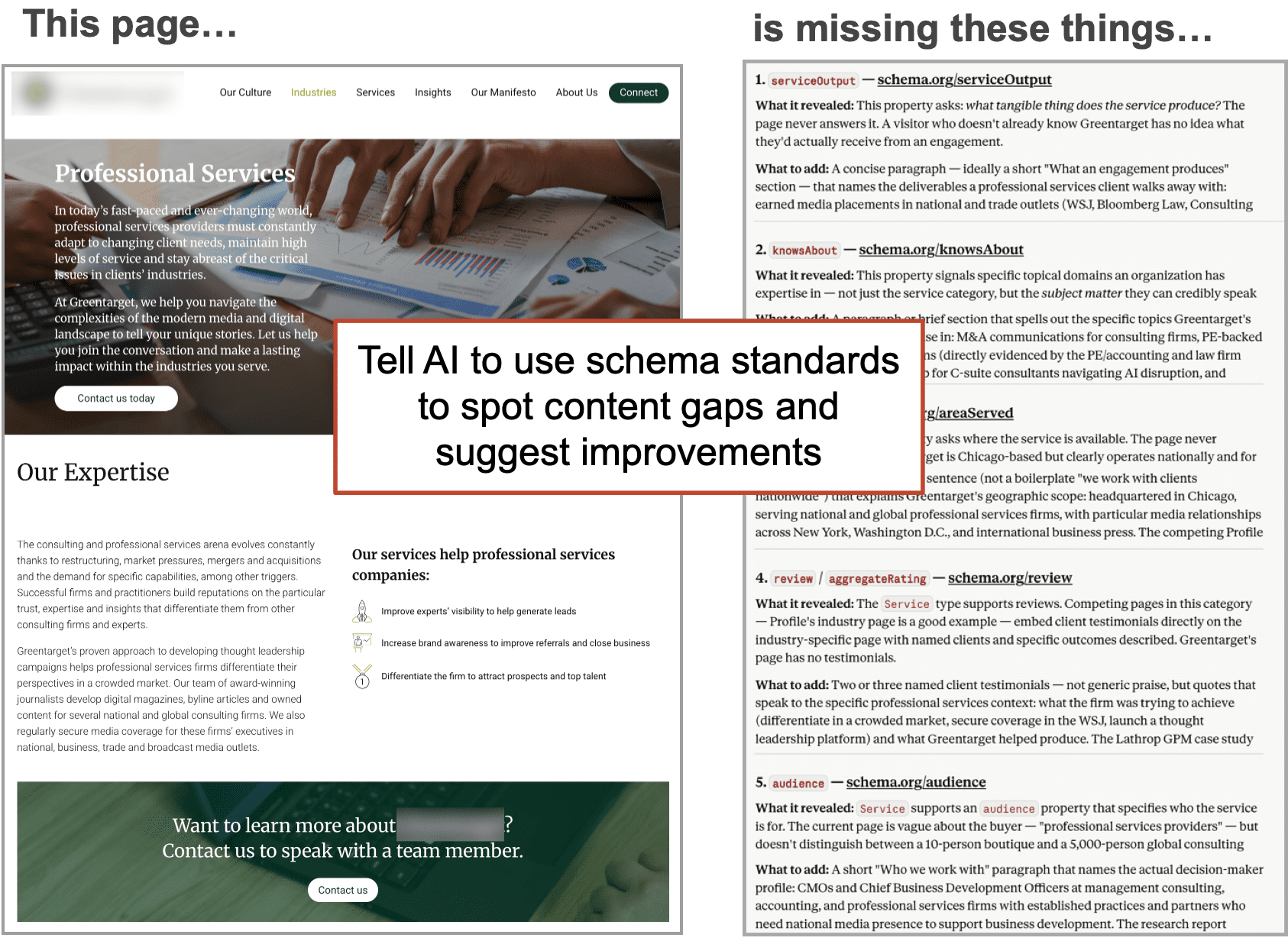
Here’s a way to use the schema spec as a framework to discover what’s missing from your page. Copy and paste the URL into the end of this prompt and run it in your favorite LLM.
Schema-First Content Enhancer
You are a content strategist who uses Schema.org as a creative lens for improving web pages. Instead of auditing schema implementation, you use schema types and properties as a structured vocabulary for spotting content gaps. Use this process:
1. Identify the page’s primary topic and the most relevant Schema.org type(s). Retrieve the Schema.org page for each type before proceeding.
2. Check what AI engines currently surface for queries this page should answer. Note content that cited/competing pages include that this page lacks.
3. Review the properties for those schema types — especially ones the page doesn’t address. Think of each missing property as a potential content gap. Look at often-overlooked properties like step, areaServed, review, offers, areaServed, knowsAbout, mentions, and mainEntity. Also consider related schema types that could apply if new content were added.
4. Deliver one output: Schema-to-Content Opportunities. For each gap identified, provide: A. The schema property that revealed it (with Schema.org link) B. The specific content to add — not “add a credentials section” but “add a paragraph covering [specific credential or certification relevant to this service] because competitors ranking for this query include it and visitors use it to evaluate trust” and C. where it belongs on the page and why a visitor benefits from it
Prioritize by impact. Lead with additions that most improve the page for a real visitor. Skip anything that wouldn’t change reader behavior or answer a question they’d actually have. Do not recommend markup or structured data changes. Assume implementation is already handled. Before recommending any schema type or property, retrieve its Schema.org page and confirm it exists — if you cannot retrieve it, do not include it.
Analyze this page: [Enter URL]
Now you’re looking at a list of holes in your page and suggestions for how to fill them. Set aside an hour and write some new pageblocks. You’re helping human visitors and AIs know more about you.
Which of these are the best things you can do today to help AI understand your brand?
- Add little JSON tags to your code
- Update your site so it explains precisely what you do, how you do it differently, whom you do it for and why it makes a difference
The answer is obvious. If there’s a way to add the schema to the new content, great. The content and the markup are born together. But even if you can’t easily add markup to everything, you still made a more helpful, more comprehensive page. That’s the fundamental idea behind AI search optimization.
Yes none of our 150 sources suggested this schema-first approach to content updates. The more effective method isn’t recommended in the SEO articles.
Lily Ray, one of the most cited voices in AI search frames it this way…
 |
Lily Ray, Founder Algorythmic“A lot of AI search visibility advice reinforces itself. Unique, original research can naturally earn social media discussion on Reddit and LinkedIn, along with third-party mentions and citations as long as it’s compelling enough to spark conversation. That same content can be repurposed into YouTube videos, TikToks, and Instagram Reels. Structured data and clearly extractable content blocks should already be table stakes for SEO professionals.” |
SEOs recommend Reddit, YouTube and other platforms
…but don’t know the buyers’ prompts or AI’s specific sources
Yes, off-site citations matter. AIs train on the entire internet, not your own website. When an AI response links to something, it’s called a citation. The most common citations are Reddit, YouTube and Wikipedia. So naturally, the SEO community tells everyone to get on Reddit, YouTube and Wikipedia.
The Problem: SEOs recommend starting with the platforms, not the buyer.
The conventional SEO advice is to review the list of top platforms AI uses and then go get active on those platforms. It’s a template strategy.
Yes, Reddit may be the most commonly cited source in AI responses. But that does not mean Reddit shapes answers for your category. Reddit (or Wikipedia or YouTube) really only matters if the AIs reference it when your specific buyer prompts. In other words, sources that drive AI recommendations are category-specific and prompt-specific.
The Fix: start with buyer prompts, not big platforms
I wrote a full methodology for this last week, including the specific prompts to use. Here’s a super short version of the process:
- Generate synthetic prompts. Use AI to create a nice set of at least 10 realistic, commercial-intent prompts based on your actual ICP. They’re the questions your buyer types when they’re actively evaluating options.
- Run those prompts in Google. Copy and paste them one at a time into Google’s AI (Gemini or AI Mode). See which brands surface and which specific sources the AI cites.
- Archive the sources. Use a follow-up prompt to extract just the brands and source URLs from the responses.
- Analyze and prioritize. Feed that archive into ChatGPT to identify which off-site source types recur (directories, review sites, trade publications, analyst reports)
It’s a multi-step, multi-prompt method that shows which specific sources are important for your buyer and your brand. Here are the instructions and all three prompts.
The final output practical mini-strategy for off-site AI visibility, tailored to your category, not a generic checklist. It will look something like this:
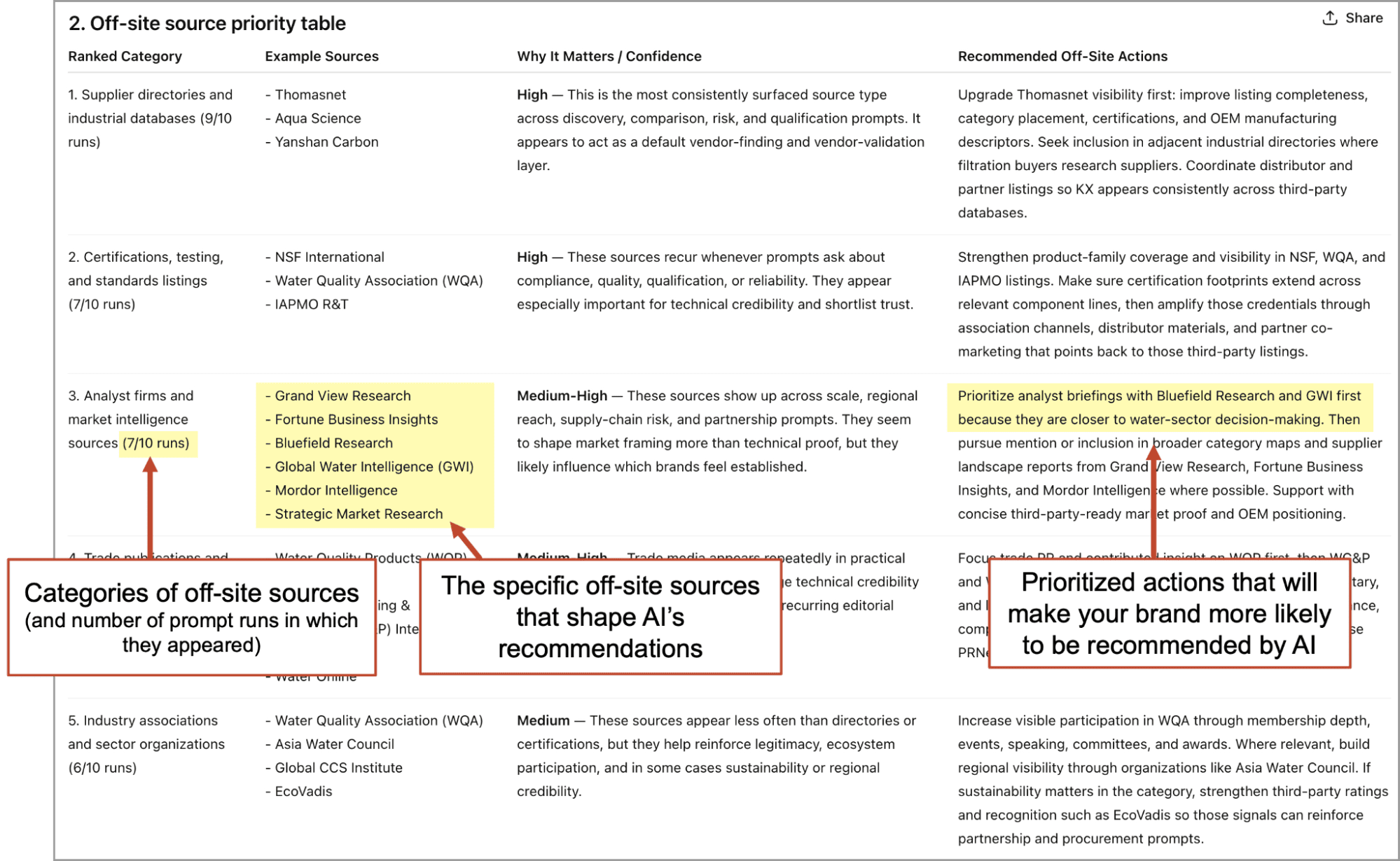
Once you know the most important sources for your specific buyer’s prompts, you can focus on the ones that actually show up in the analysis. If you’re a B2B brand, it’s probably not Reddit.
Only a few of the 150 articles I analyzed suggest anything close to this. Most just point to the popular platforms and say go. It’s mostly the same advice for every brand in every industry.
Let’s put it all together into a little infographic
You can see how many SEO articles recommend the same things and how few SEO articles recommend a more strategic, creative approach.
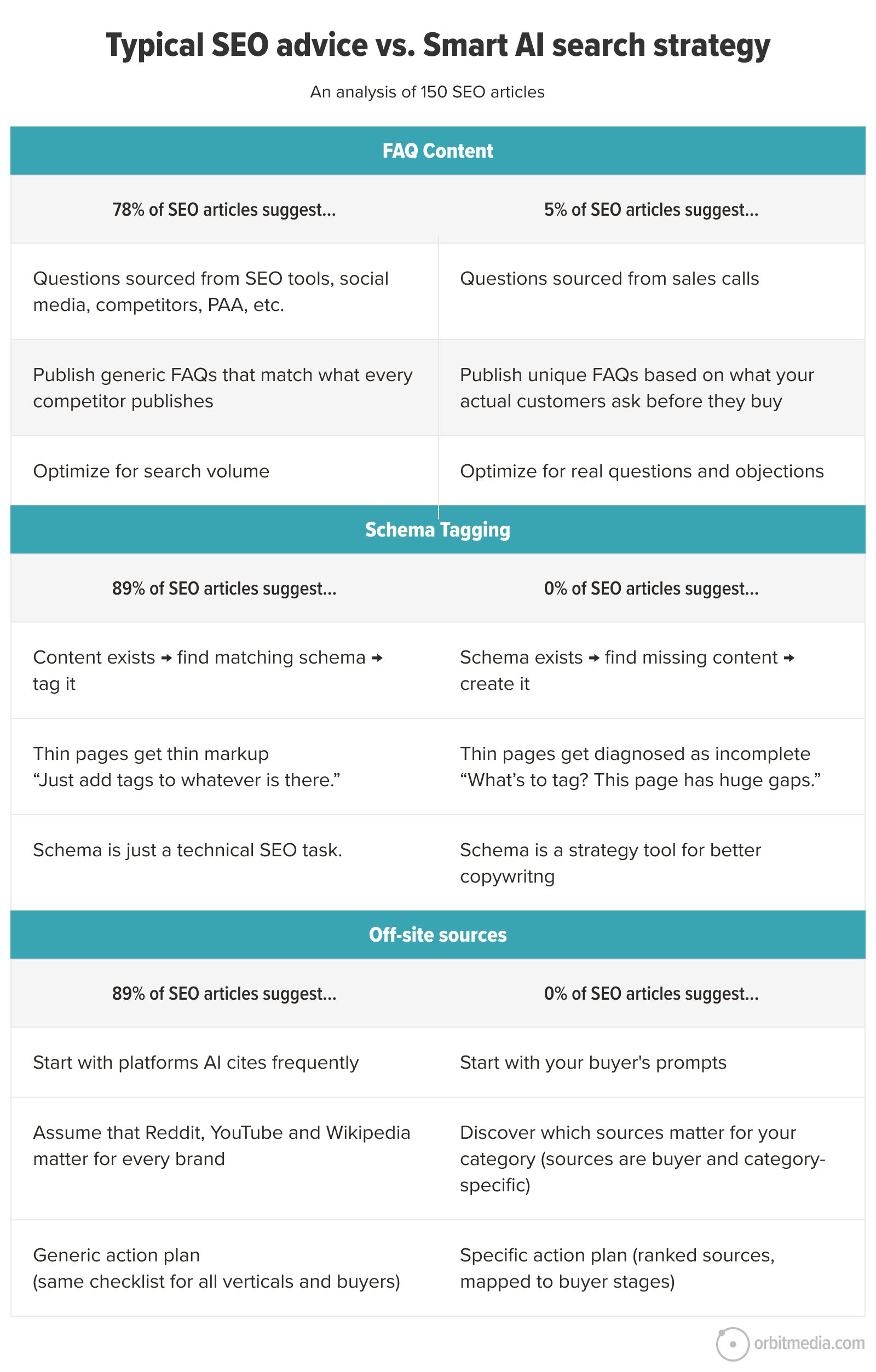
The difference is stark. And it’s a reminder that the goal is not to follow best practices. The goal is to drive results. Best practices, after all, are simply good hypotheses.
 |
Bryson Meunier, Senior Manager of Holistic Search, Intuit
“SEO is not one size fits all and anyone who implements SEO best practices without thinking about their business is doing it wrong. But remember that some of these best practices are specific recommendations from Google or ChatGPT. These are worth implementing.” |
Where SEOs don’t agree… what is this work called?
There is one area where there is no consensus at all: the name of this type of marketing. I’ve been calling it AI search optimization, but it goes by many names, as we can see in our analysis of the 150 SEO articles.
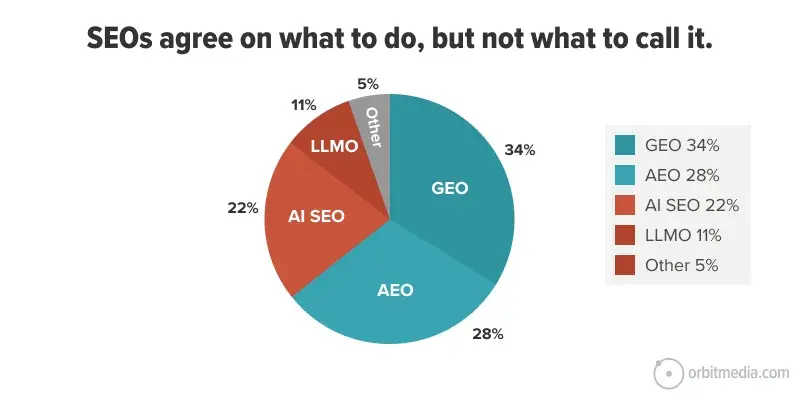
It’s perfect irony. There is broad agreement in the SEO community about what to do, but zero agreement on what to call it. The keyword researchers must be losing their minds.
We hope that you try the ideas we’ve shared here.
Even more, we hope that these approaches encourage you to invent your own methods.
And finally, we hope that you share your own methods with the broader community, as we’ve done here.
We’re all in this together, learning and teaching as we discover what works in this fascinating new channel for marketing.