Suddenly, AI visibility audits are everywhere.
Agencies offer them. AI consultants offer them. SEO software companies offer them. Enter your URL and… presto. See how visible you are in AI answers. Free. Fast. But what’s in all of these AI audits?
Let’s audit the audits.
We found 100 free AI visibility audits exactly the way any marketer would. We searched Google, read “best AI visibility tool” roundups and browsed Product Hunt launches. We also clicked on some cold DMs on LinkedIn. Brave, I know.
Then we read what each one says it does. We reviewed their pages and pitches to find out what the typical AI visibility audit checks. It’s a lot of little things. Here’s a breakdown:
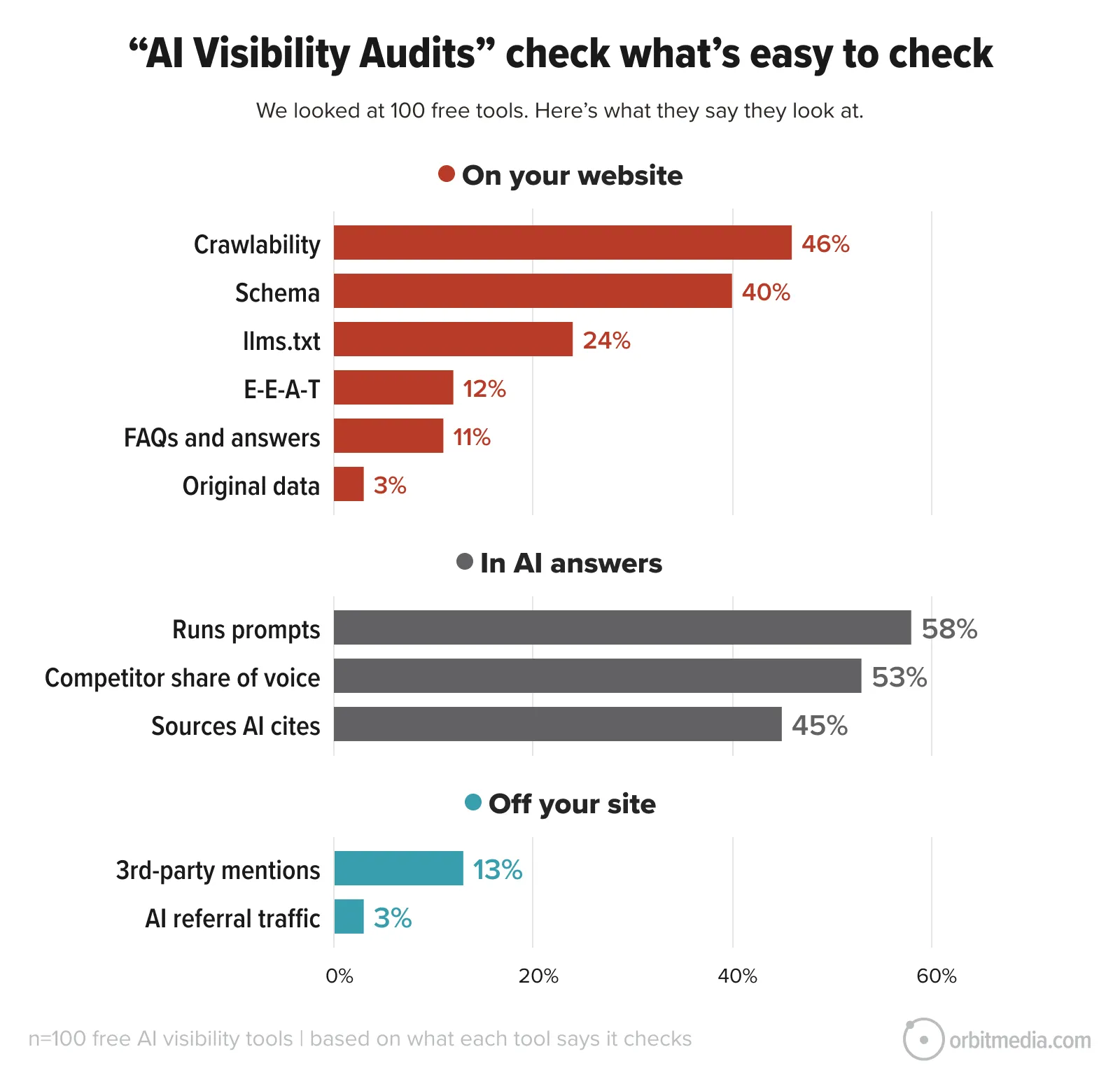
Notice something missing?
The tools don’t start at the beginning, where every good marketer starts: analysis of the buyer. Instead, they skip considering the target audience. Most just ask for your URL. When they do ask for more, they don’t ask for much.
- Some ask about your product or service (“Describe your product or service”).
- Some ask you to describe your business (“Tell us about your company.”).
- Some ask you to enter a sample prompt (“What would a potential customer ask an AI?”).
“AI Visibility Audits” start too far downstream
Imagine your buyer at 10pm, researching options, looking for a new partner, typing into ChatGPT…
“We just hired a new sales leader who said our website is embarrassing. But the CEO doesn’t want a redesign, she wants better leads. We got burned last time when we gave the project to our branding agency. They’re good at writing, but they don’t understand Analytics or AI search. Who should I reach out to?”
That’s not really a traditional search. It’s a conversation with an AI. And what does the AI do? It matches them with a shortlist of best-fit options based on all the details they provided. So AI visibility starts with buyers, not bots.
The irony is that many of these tools (58%) actually run prompts, but where do they get the prompts? According to their own descriptions, they scan your website …then make them up.
Think about that for a minute. The AI visibility audit reads your page, writes buyer prompts based on the content it finds, asks the AI and then grades your page on the answer. See the problem? The tool can’t know if your content is misaligned with your audience if it only looks at your content.
These AI audits typically focus on the final outcome (AI answers), but skip the beginning (buyer insights). They claim to check “visibility” without knowing who’s looking or why. Think of it as a sequence:
- Buyer personas. Who’s asking?
- Buyer prompts. What do they ask AI?
- Your content. Does it answer them?
- Technical setup. Can AI read your site?
- AI answers. What does AI say about you?
Every step depends on the one before it. You can’t write content that aligns with your buyer’s questions if you don’t know the questions. You can’t know the questions if you don’t know the buyer. And yet, many tools claim to check for “FAQs.”
The more mechanical the step, the more likely it is to be checked. The more empathetic the step, the less likely you’ll see it in reports from these free AI audit tools.
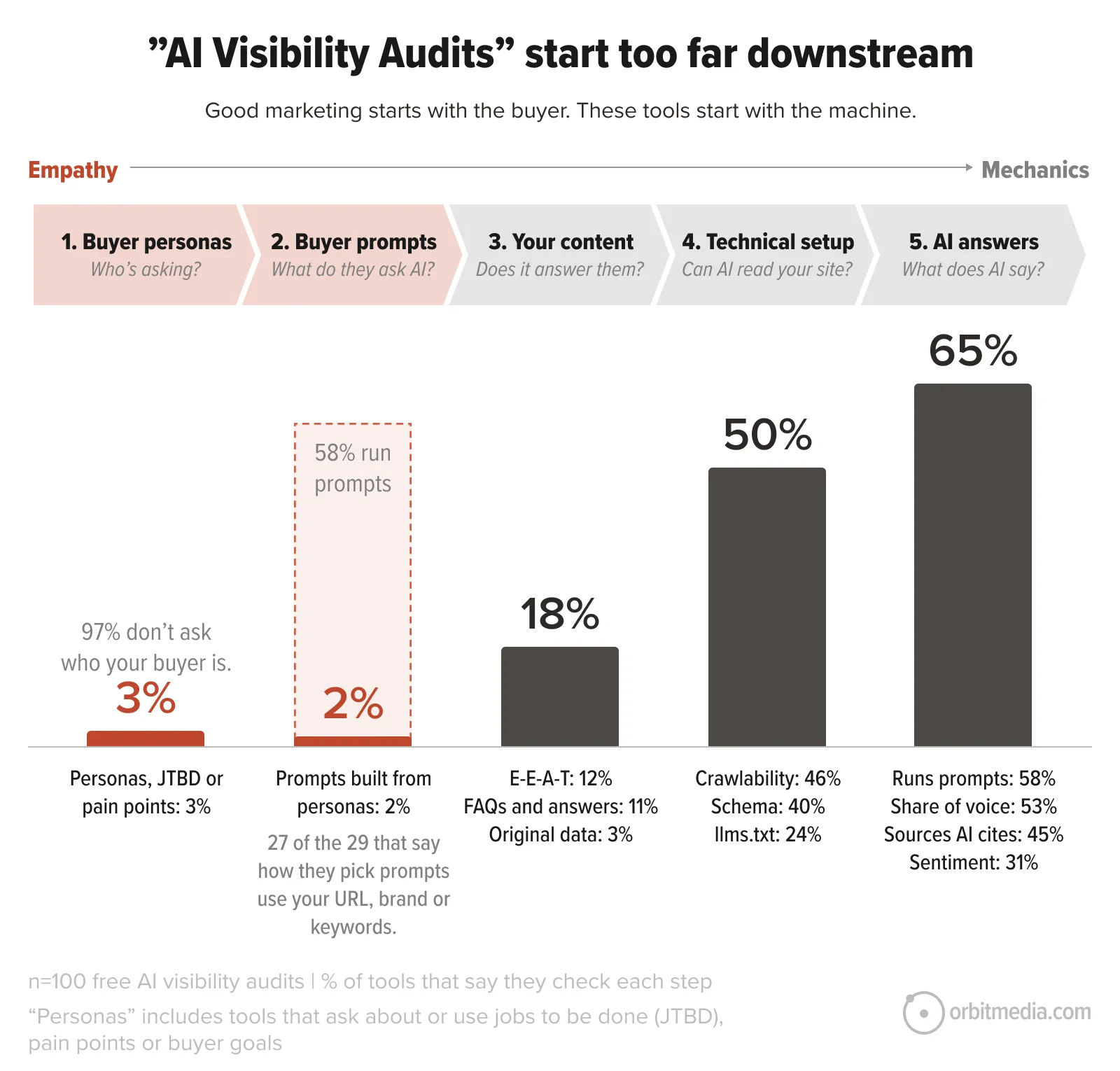
If you agree that these audits don’t check for the things that are key to visibility and AI recommendations, consider making your own. A smart marketer could vibecode one of these tools in less than a day, using whatever inputs you’d like, using whatever first-party data you have.
Or skip the free tool and ask a skilled AI search optimization pro to run an audit. The good ones will start by asking you a lot of questions about your buyer and ask for whatever first-party data you have.
How “AI Visibility Graders” score websites
I entered my site into 14 of these, then reviewed methodologies.
They all score using different criteria and weights. Some are based more on technical setup. Others are based on content structure. We averaged these to show the scoring system of a “typical” AI visibility audit.
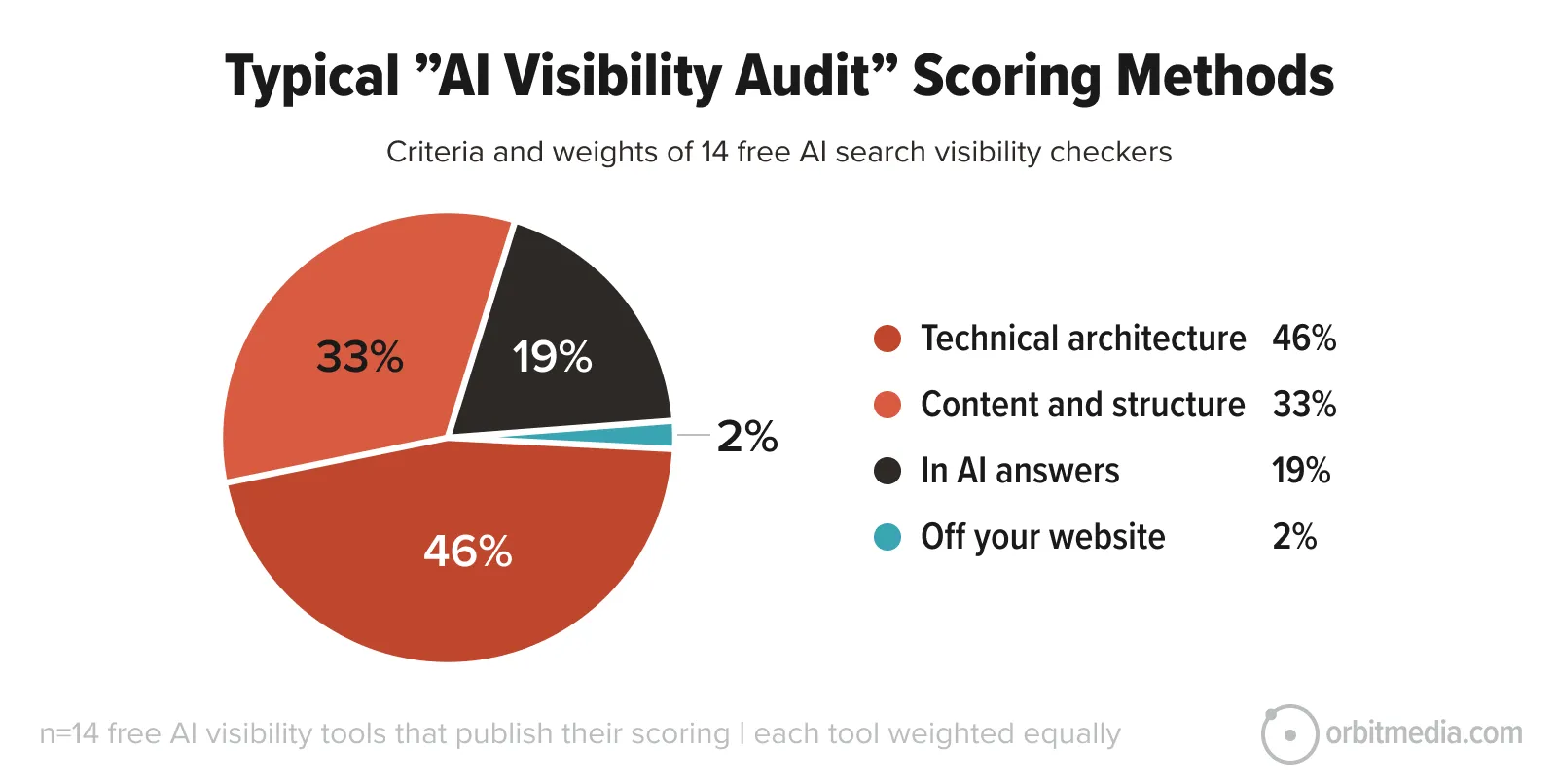
These little tests revealed some big problems with the tools. Some missed things that are present. Some didn’t check things they claimed to check. A few of the audits didn’t work at all. Most of these are not robust tools. But hey, they’re free, right?
The scores themselves are all over the place. The scores for orbitmedia.com ranged from 28 to 100. If the tools were reliable, wouldn’t the scores line up better than this?
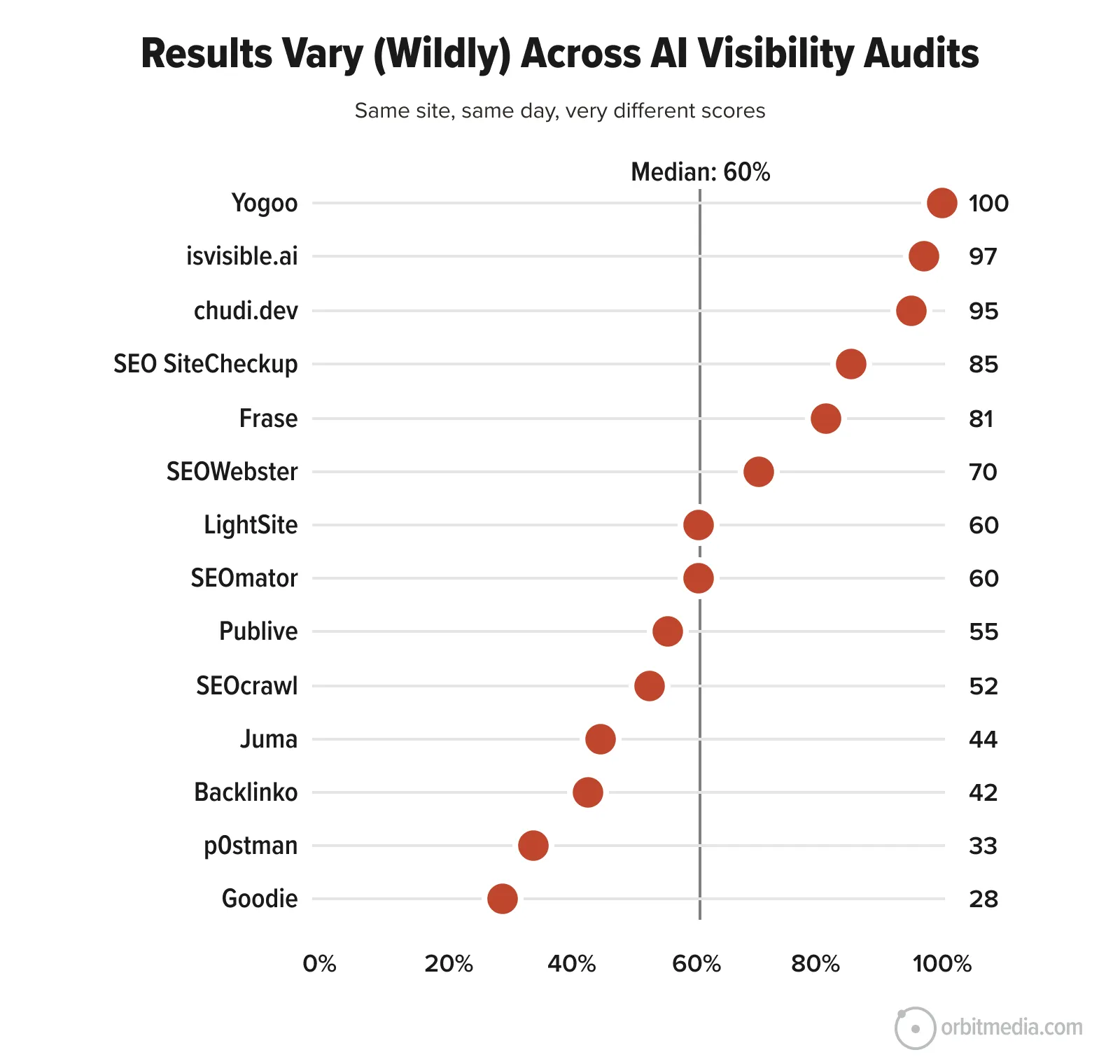
To me, this shows how AI visibility scores are arbitrary to the point of meaninglessness. This should cast doubt on all marketing graders, I think.
“AI Visibility Audits” don’t audit AI visibility
If the idea is to audit your brand’s visibility when your buyer asks for a recommendation, these tools don’t live up to the name. A better name would be “AI Readiness Checker” or maybe “Technical SEO/GEO Grader.” These would be a better fit for two reasons:
- Most audit the website, not the visibility of the website.
The scores in these audit tools are heavily weighted on website attributes, not AI answers, as we saw above. - When they do ask AI, they ask their own questions, not the buyer’s questions
For a tool to really audit the AI visibility of a website, it would have to know your buyers’ specific questions. These would come from your own data, such as sales call transcripts or vetted persona research. The problem is obvious when the tool lists “competitors” that you don’t actually compete with.
Who makes these tools and why? Mostly, they are sales tools.
Free tools are one of the oldest plays in content marketing. HubSpot built its brand (way back in the early days) on a Website Grader. It attracted thousands of links (good for SEO) and highlighted the need for their product (agitate buyer pain).
AI visibility audits are the newest version of the same idea. Four kinds of companies are making them, and they ask you for different things, depending on their business model.
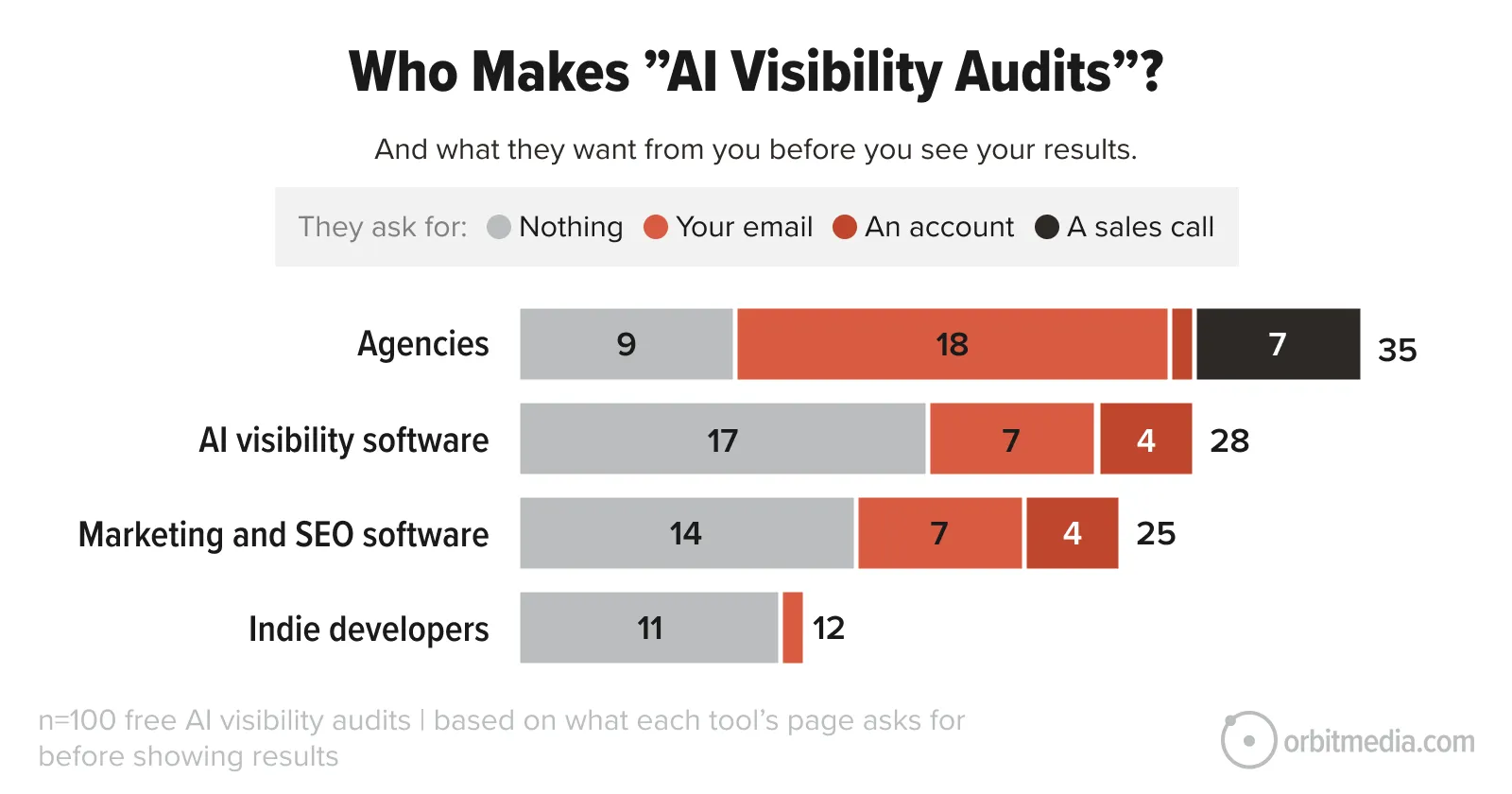
Here’s how the dataset breaks down:
- Agencies. These AI visibility audits are classic lead magnets. They ask for something before showing results. Seven of them wanted me to take a sales call. These are top-of-funnel tools built to drive leads for the agency’s SEO and GEO services.
- AI visibility software companies. The free AI visibility audit is a preview of the paid tracker. The tool shows a gap or problem, then sells you the monthly monitoring program.
- SEO and marketing software companies. HubSpot, Semrush and Ahrefs all added these tools to their playbook. It brings in links (HubSpot’s grader has more than 1,200 linking sites) and signups, triggering an email nuture sequence.
- Indie developers (12 AI audits). Vibecoded side hustles from solo tech types. Most of these don’t even require that you enter your email address. Just drop in a URL and fire away.
But keep the incentive of the developers in mind when you read the score. An audit built to start a sales conversation is built to find problems. Some of them have calls to action throughout the report.
SEOs have always skipped buyer research
That isn’t new. SEOs have overlooked buyer analysis for 25 years, probably because they aren’t full funnel marketers. They think more about the machine and less about the human typing into it. That’s why they’re focused on “AI visibility” and not “AI recommendations.”
But AI search changes things completely. The buyer is now having an actual conversation, in their own words, about the true story in their own life. It is a hyper-personalized buyer journey. This is what SEOs get wrong about AI search.
You could never guess all their prompts. And you don’t need to. You just need to know what triggered the buyer journey and their decision criteria for choosing a partner.
Success depends on empathy. A site that is not optimized for conversion is not optimized for AI search.
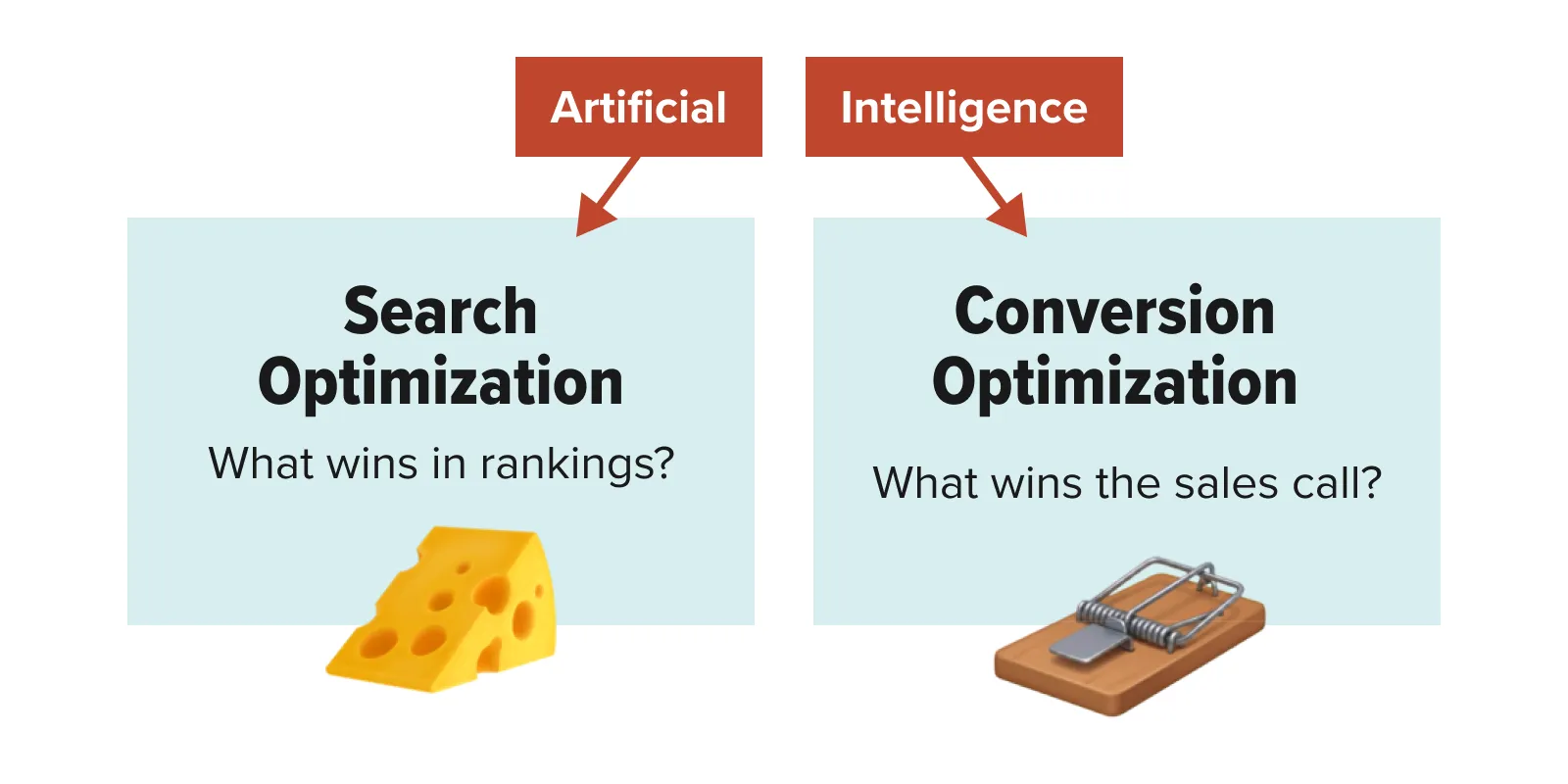
This doesn’t mean these free tools have no value. Even if they only look at your website’s plumbing, plumbing is important. Crawlability, schema, FAQ sections may all be useful. But don’t expect scans of these to accurately predict if your brand is visible when your buyer is looking for help.
 |
Kristen Hicks, freelance copywriter“The last couple of years have been stranger than usual. But most of what works best in the era of AEO isn’t new: speaking to your audience’s needs, updating old posts, conducting original research and adding expert insights. That and including FAQ sections more often, that wasn’t quite so common a couple years ago.” |
Start with research. Know your buyer. Capture the questions they actually ask, in their words. Then answer those questions as only you can and support each answer with evidence.
All done? Great. Now go run a free audit.
Methodology
Audit findings come from a review of 100 free AI visibility audits (also called GEO or AEO audits, graders and checkers) in October 2026. For each tool, we examined what its own page says the audit checks, then we ran the 18 ungated tools on orbitmedia.com and compared each report with its page’s claims. Scoring weights come from the 14 tools that publish how their scores are calculated.