How are marketers adapting? What’s working?
Your buyers have already changed how they research decisions.
72% of them use AI tools every day. More than half use AI chat as a primary research tool. Clearly, the buyer journey has changed. So what are we doing about it?
Our recent survey of 1000+ content marketers has the answers. We held back this data from the report because it really deserves its own analysis.
This report looks at what marketers are doing, what AI search tools are checking for and what correlates with performance. Here it is…
71% of content marketers are adapting for AI search …sort of
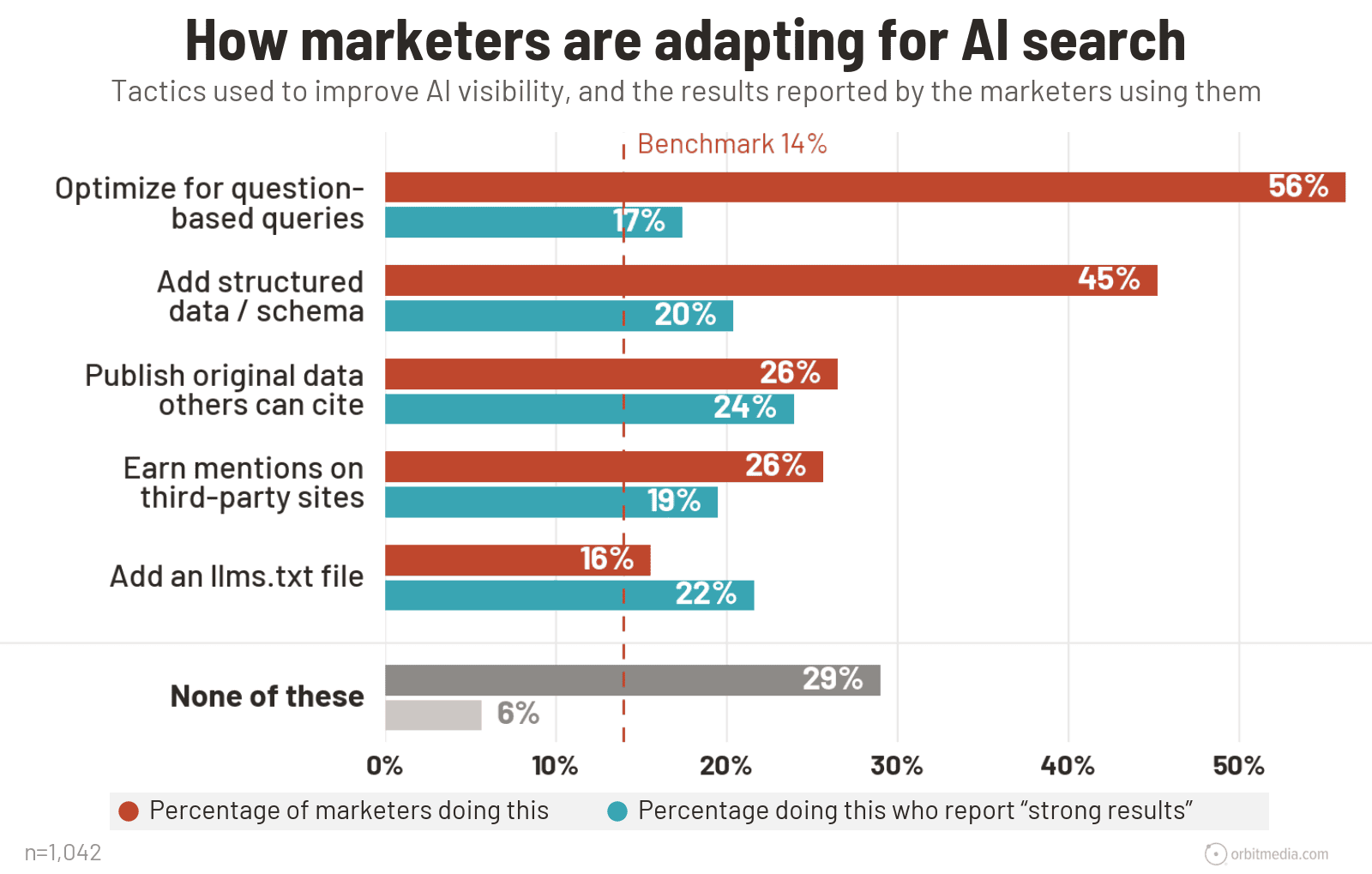
Most marketers have taken at least one step to improve their AI visibility. That’s good. But the popularity of the tactics tells you nothing about whether those tactics work.
The data shows that the most popular tactics are the least effective and the least popular tactics are the most effective. We saw this inverse pattern throughout the survey. Marketers are more likely to do what’s easy, not what works.
The good news is that every tactic beat the performance benchmark (14% of respondents reported “strong results” in 2026). Good to see marketers adapting. Still, nearly a third of marketers aren’t doing anything about AI search at all, and they are the least likely to report strong results.
Only 36% have an AI search strategy. They’re the ones winning.
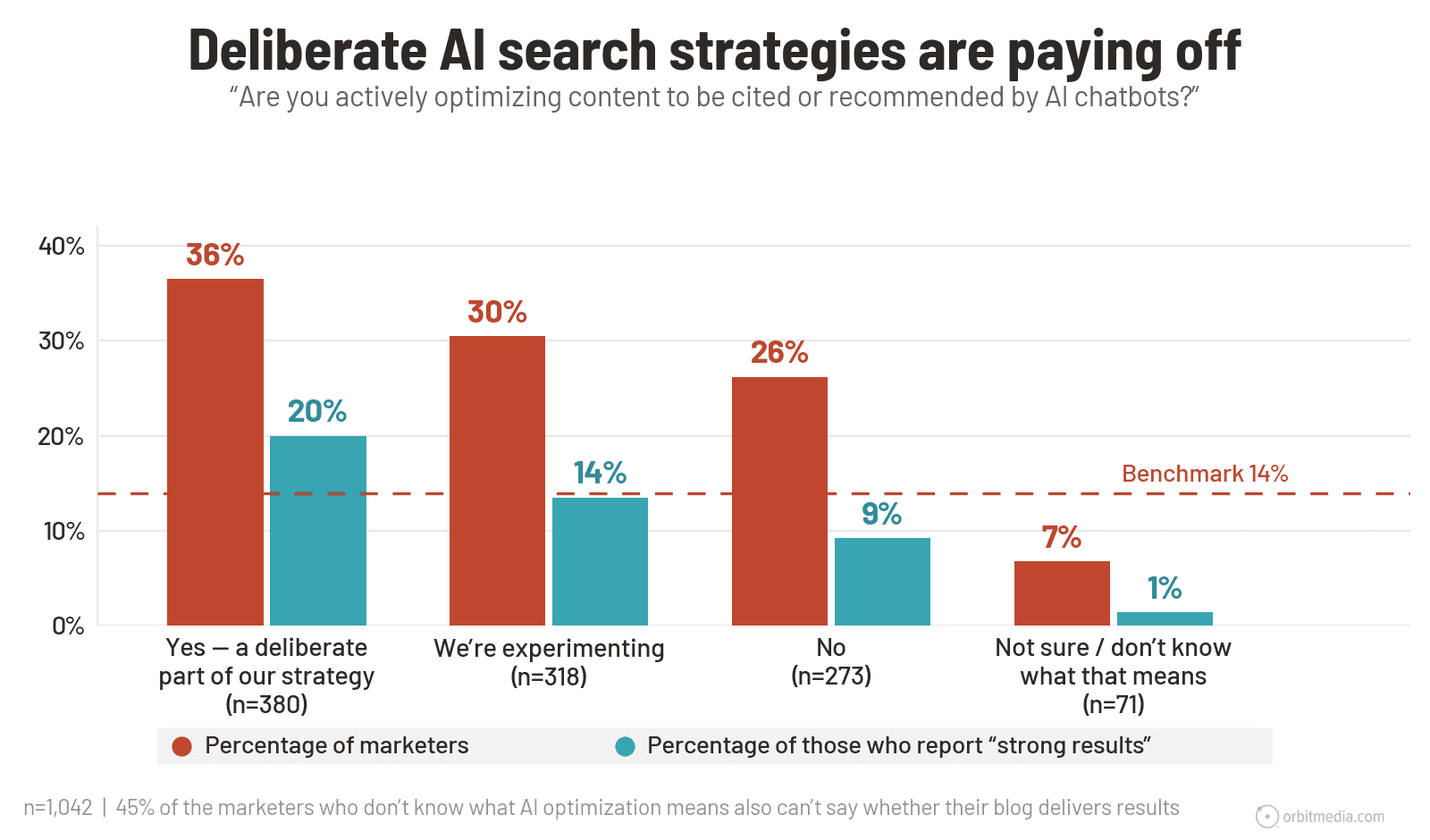
We asked marketers if they’re actively optimizing content to be cited or recommended by AI chatbots. Do they have a deliberate AI search strategy? Are they experimenting? Do they even know what this means?
Map this to performance and only the marketers with an actual strategy beat the benchmark. Marketers who do nothing about AI search underperform their peers.
The advice that marketers get from SEO blogs
What do SEO blogs recommend?
If marketers are widely adopting the least effect tactics, maybe it’s just because that’s what everyone recommends.
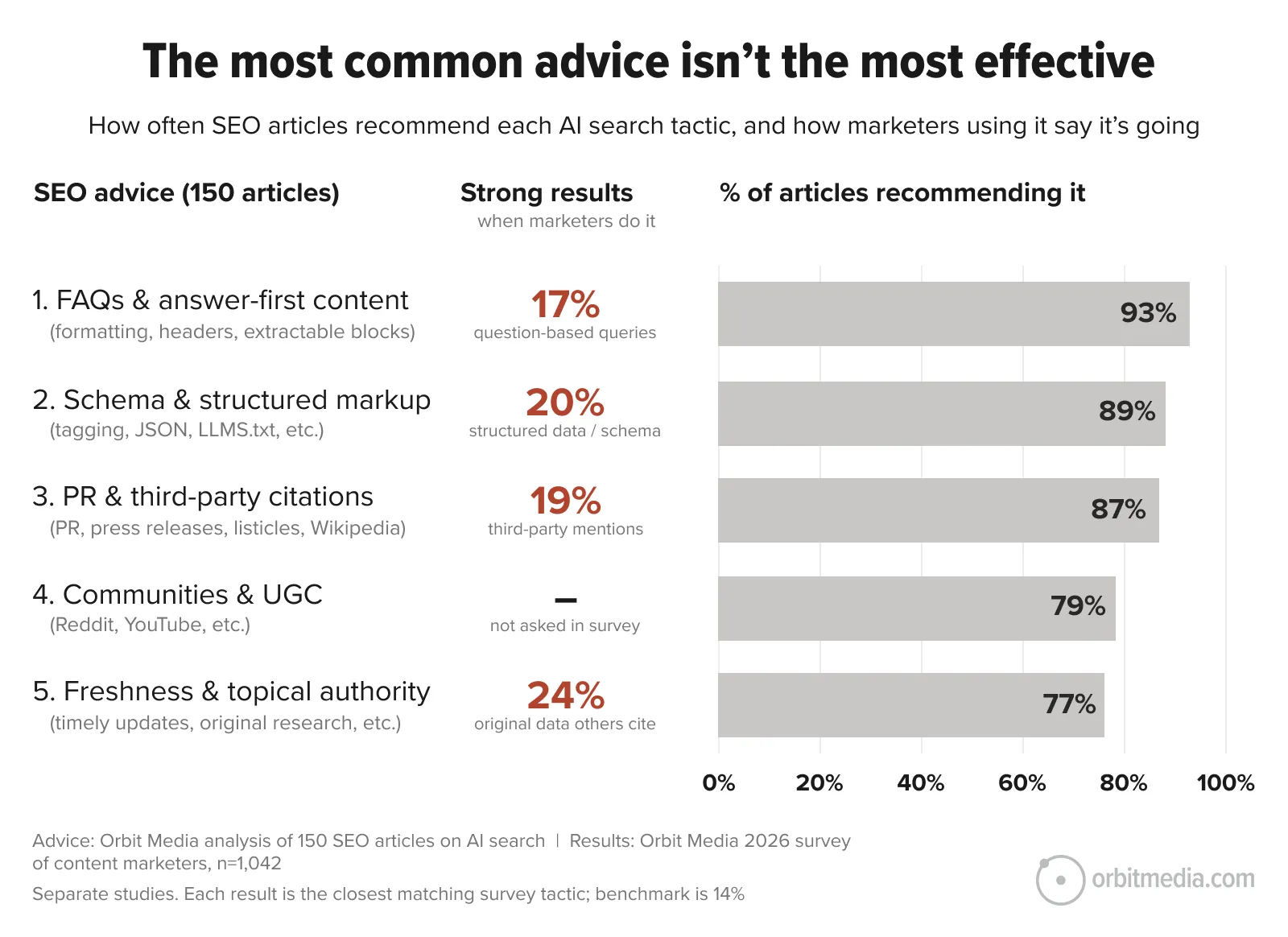
Earlier this year, we analyzed 150 articles about AI search marketing to see what they recommend. The advice on these blogs is nearly unanimous. 93% recommend FAQs and answer-focused content. 89% recommend schema. Consensus.
But when you map it to the performance of the marketers who do these things, it’s obvious that the most recommended tactics are not the most effective tactics.
We checked the tools too: 100 free “AI Visibility Audits”
What do the tools check for?
AI visibility audits are everywhere now. Almost every day I get a cold DM on LinkedIn with an offer to do a scan of my site. These come from SEO software companies, AI startups and search marketing agencies.
What’s in these things?
We reviewed 100 free AI visibility audits (the “enter your URL” kind) to see what they check. No surprise, like the marketers, they do the quick and easy things. Makes sense for a free tool.
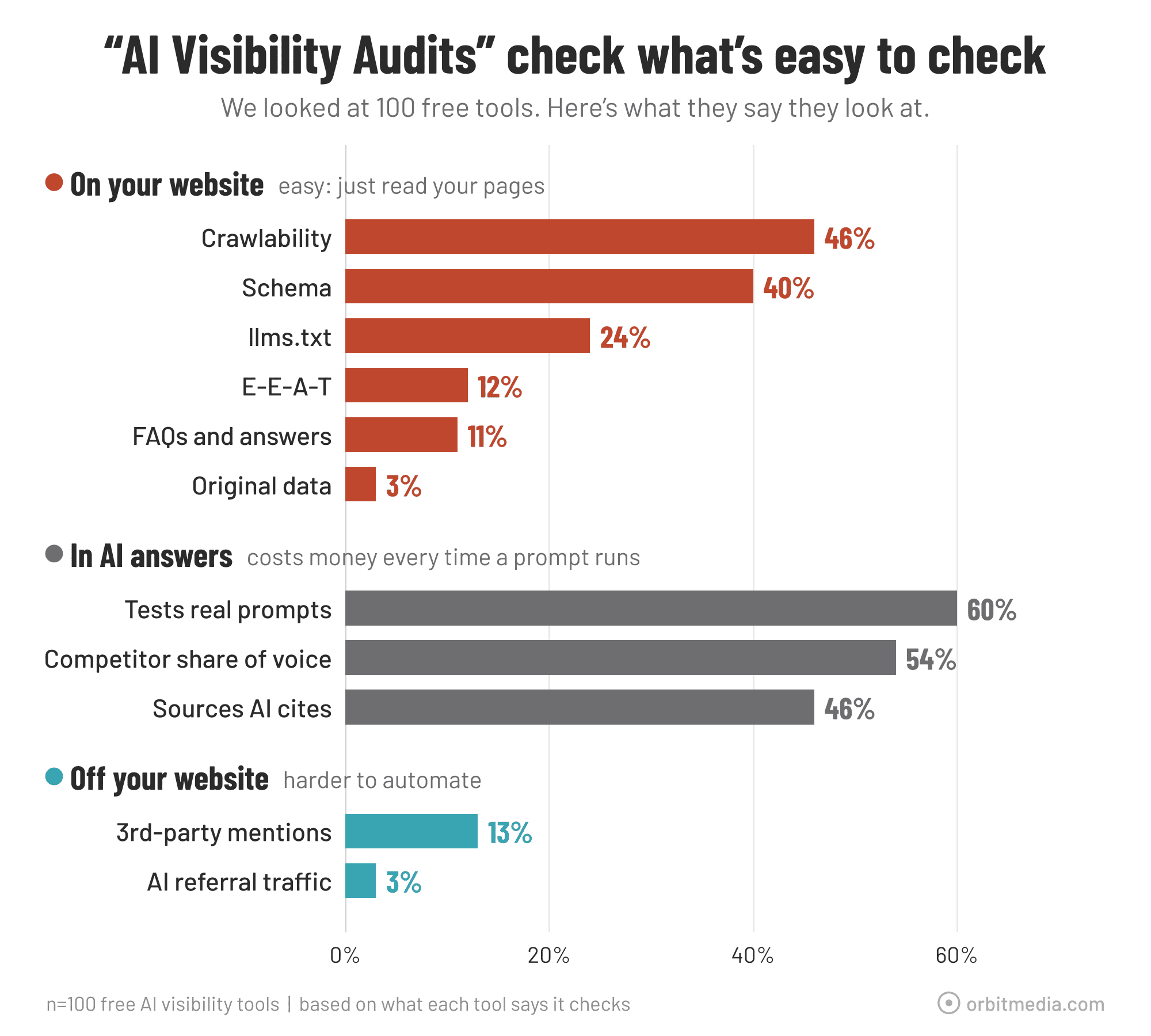
Audits check things that are easy to detect: markup, files and crawler settings. But these free graders skip the things that are hard to measure. 40% of tools never ask an AI tool a single question but still give you an “AI visibility” score.
Ironically, the best-performing strategy is publishing original data (24% of the marketers who do it report strong results). But only 26% of marketers do it. It’s the fifth most common recommendation in SEO articles. And just 3% of AI visibility audits check for it.
Everyone is overlooking the same thing.
Marketers who are adapting to AI search never stopped doing SEO
Strangely, fewer marketers are researching keywords, that foundational search strategy of aligning pages with phrases.
Maybe these marketers read an “SEO is dead” article and no longer think that search algorithms are a thing. Maybe they don’t know that AI searches for users millions of times every day.
But keyword research still correlates with marketing performance.
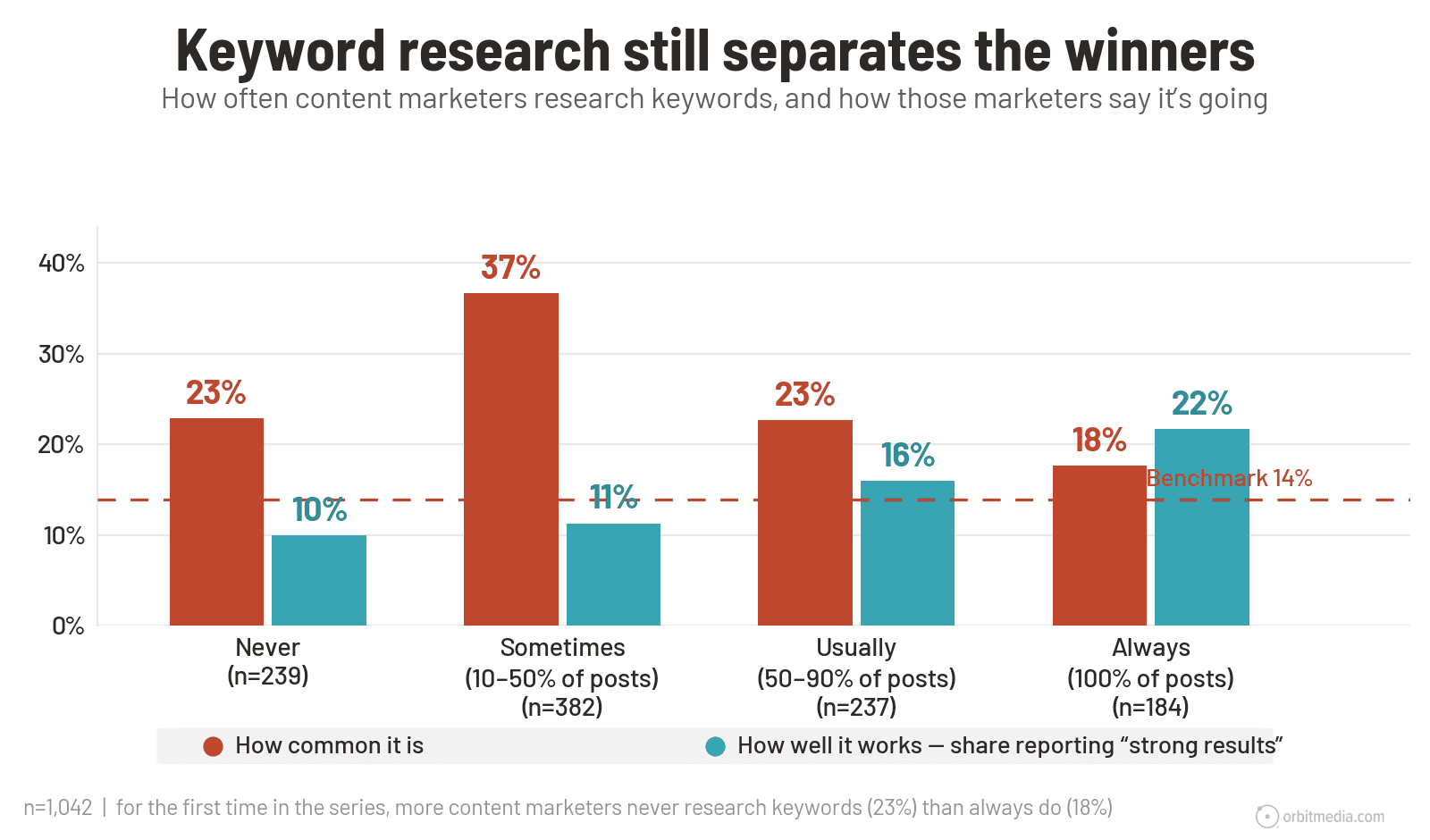
Marketers who understand how machines see the web are better at digital. They think about information retrieval. They know that deterministic algorithms are still important in a probabilistic world.
The marketers who were already doing SEO are adapting faster to AI search. Meanwhile, the marketers who don’t understand SEO aren’t doing anything about AI search either.
Are marketers tracking AI search traffic?
In our conversion research across 97 GA4 accounts, AI search traffic was just 0.5% of total visits. But it is also the traffic that is most likely to convert. It’s the best traffic those websites get. AI visitors converted into leads at roughly 3x the rate of organic search visitors.
But 34% of content marketers aren’t tracking AI traffic at all.
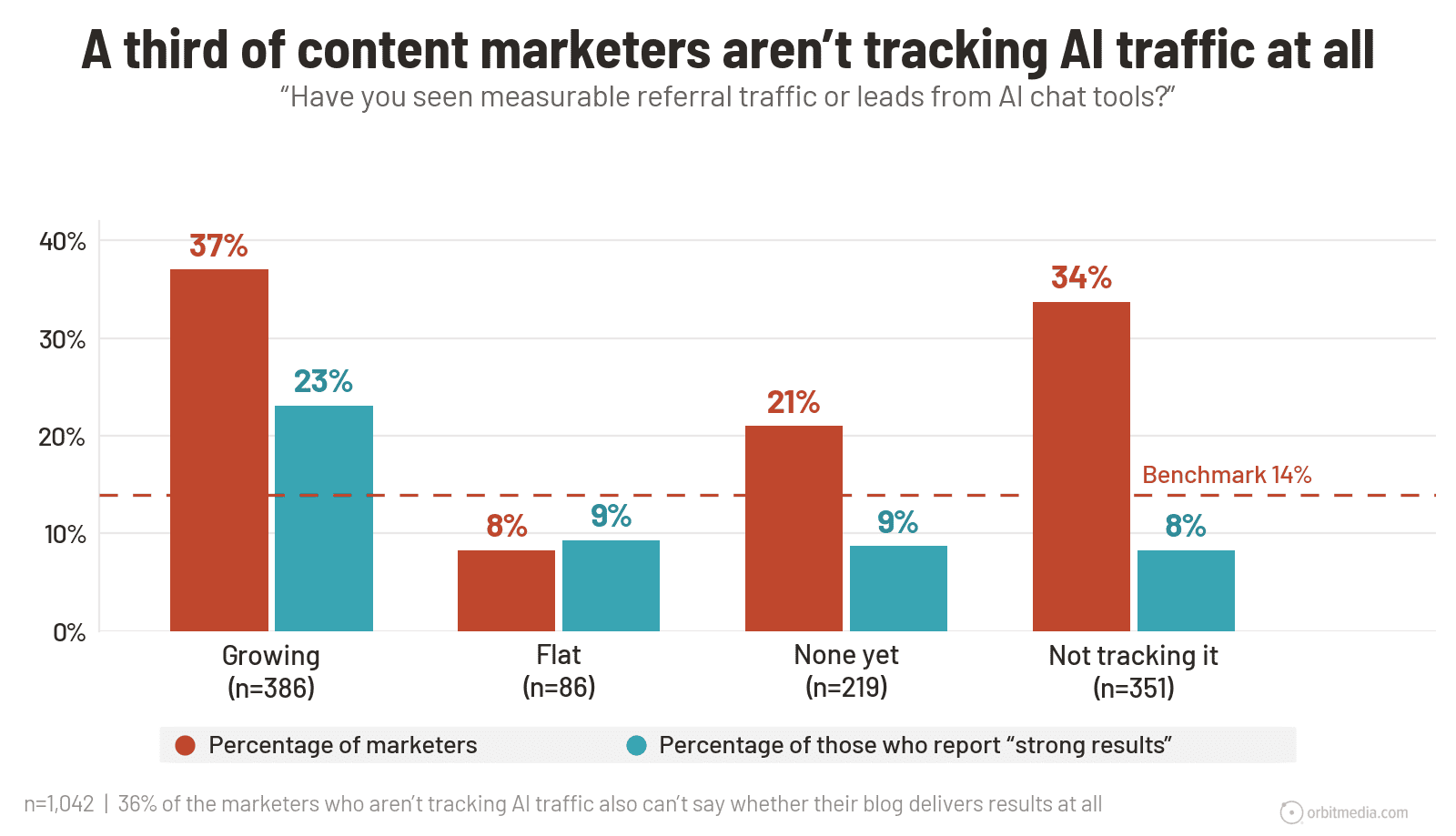
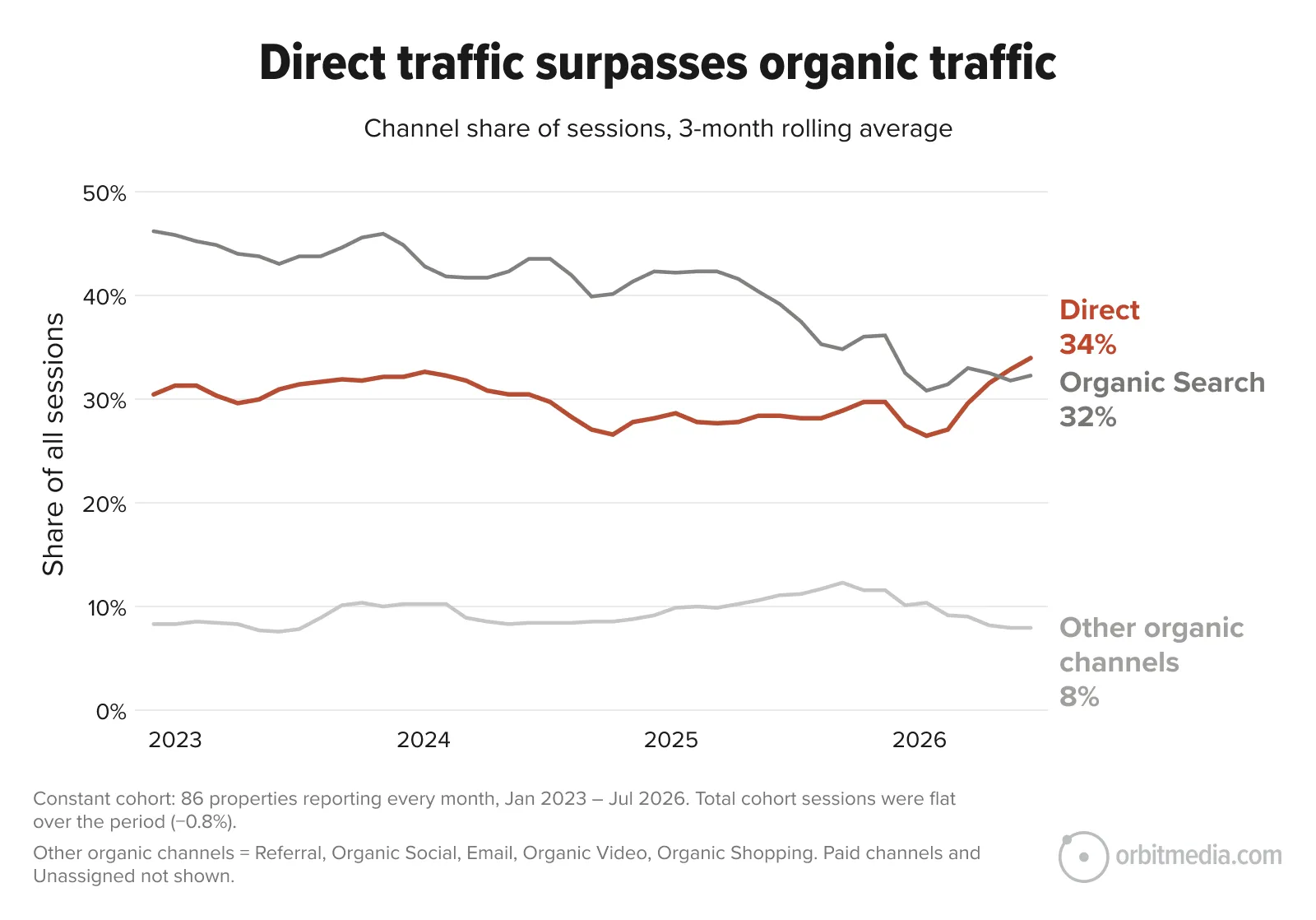
Maybe it’s because AI traffic is notoriously hard to track. Sometimes, it’s impossible. Visitors who get a recommendation from AI may leave the chat and go directly to a website. Or they may tap on a link in their AI app. These visitors usually show up in direct traffic. This may explain why direct traffic recently surpassed organic search traffic in our data set of 56M sessions across 86 websites.
Same job. New name.
Many content marketers are already doing the things that power AI search optimization, even if they don’t think of it as such: original research, earned mentions, answering real questions, measuring results. They aren’t new at all.
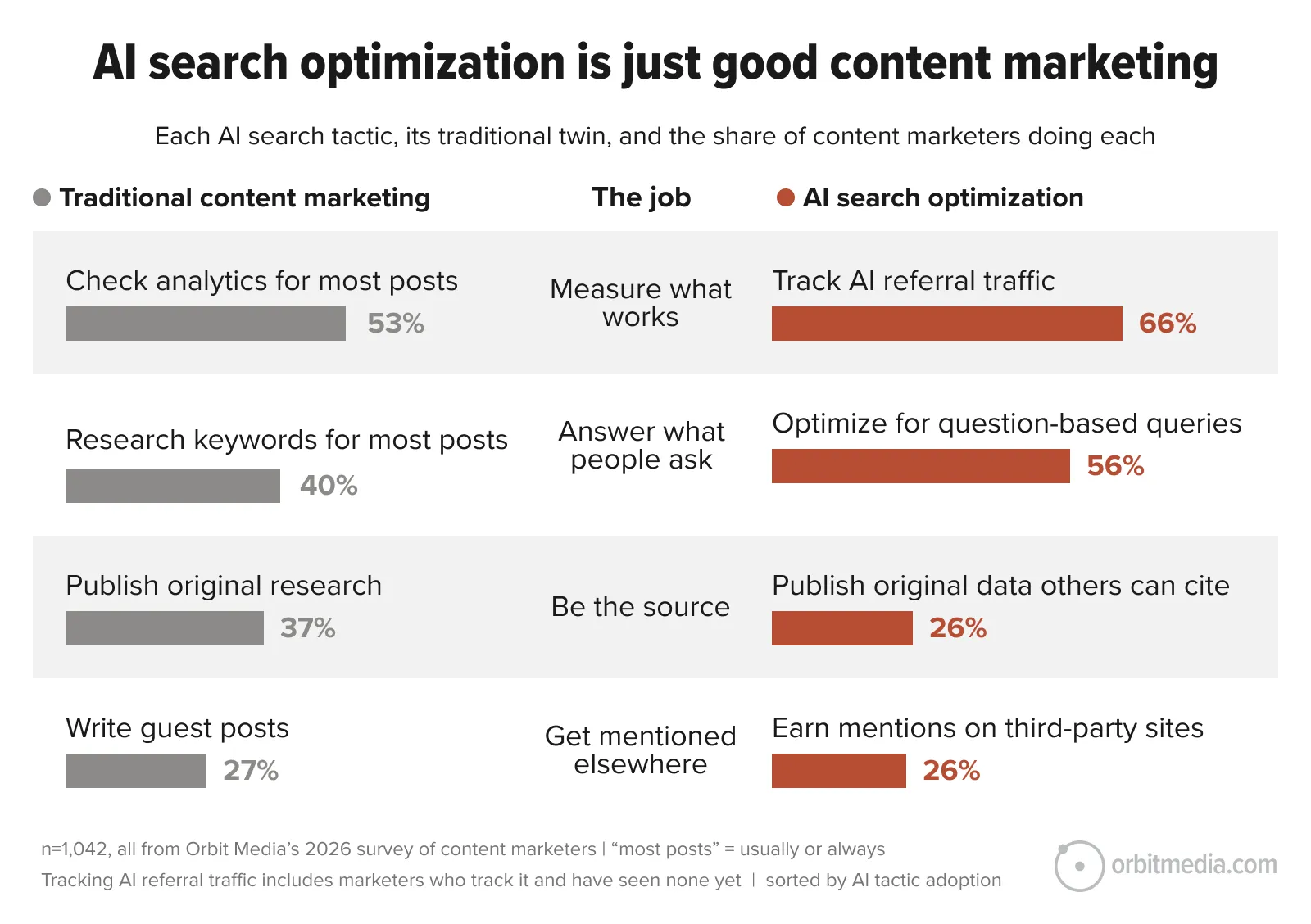
Maybe AI search optimization isn’t a brand new playbook. Maybe it’s the old playbook with a few new considerations. Here are the five big ones:
- Answer the questions your buyers actually ask …not just basic FAQs
- Support every claim with evidence …not just simple E-E-A-T
- Publish original data worth citing …not just typical content marketing
- Earn mentions in the places AI learns about your specific niche …not just standard PR
- Measure AI referrals and leads, watch direct traffic …not just standard GA4 reports)
That list was working before AI search existed, but deeper in every case. Probably, right now, someone is asking an AI for recommendations in your vertical. Winning that recommendation depends on those five marketing activities.
 |
Karine Abbou, Content strategist & AI search educator“Yes, AI search is new. Yes, the LLM sitting between us and our buyers is new. Yes, there’s no AI Search playbook (yet). None of that is a reason to leave ‘build our AI Search strategy’ off next year’s marketing plan. Simply making it a top priority puts you ahead of everyone still waiting for certainty. You don’t need to understand it all to start. So let’s borrow from Nike: just do it.” |
About this research
This article pulls from five Orbit studies conducted in 2026. Each one looked at the same shift from a different angle:
- Buyer behavior: 55% of people now use AI chat as a primary or frequent research tool (AI vs. Google survey)
- Bot activity: AI crawlers read almost everything, but nearly half the pages they crawl never send a visitor (AI crawl report)
- AI traffic: AI visitors are just 0.5% of traffic, but they convert at roughly 3x the rate of search visitors (AI conversion research)
- SEO advice: 150 articles of AI search advice mostly recommend the same five tactics (What SEOs get wrong about AI search)
- Marketer actions: 1,042 content marketers on what they’re doing and what’s working (13th annual blogger survey)
Survey results are self-reported, and findings are associations, not causation. The AI visibility audit review is new for this article. It covers 100 free tools, based on what each tool says it checks. We did not run the audits. Stay tuned for a full report on this soon. Direct traffic data is from 86 websites in GA4, January 2023 to July 2026.