I saw something strange in GA4 recently.
When I looked at the conversion rates across various traffic sources, I noticed that visitors who come from AI are much more likely to become a lead than visitors from other sources, especially when they land on the homepage.
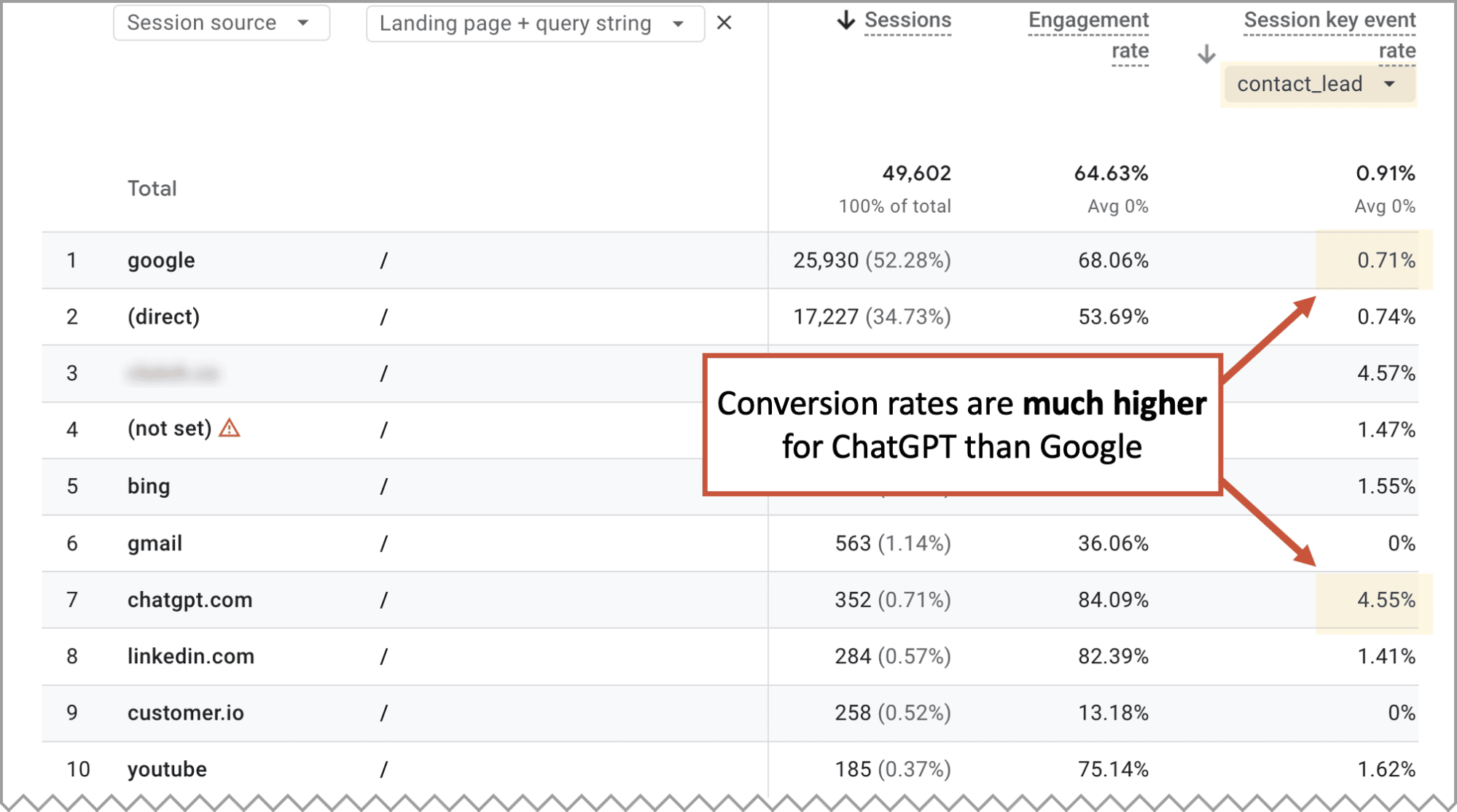
You may see this in your own Analytics. But one GA4 account is an anecdote. Dozens of GA4 accounts would be better data. With enough accounts, we can answer the question:
Are visitors from AI sources more really likely to convert into leads?
To find out, we looked at 97 GA4 accounts across a range of B2B lead generation websites with a total of 29 million visits over one year, through June 2026.
Checking the conversion rates was tricky because these accounts have many different conversions (key events), named in many different ways. We manually categorized every key event. Leaving out “apply for job” along with many of the strange things people set up as key events (CTA clicks, contact page visits, scrolling, video views) that aren’t actually conversions.
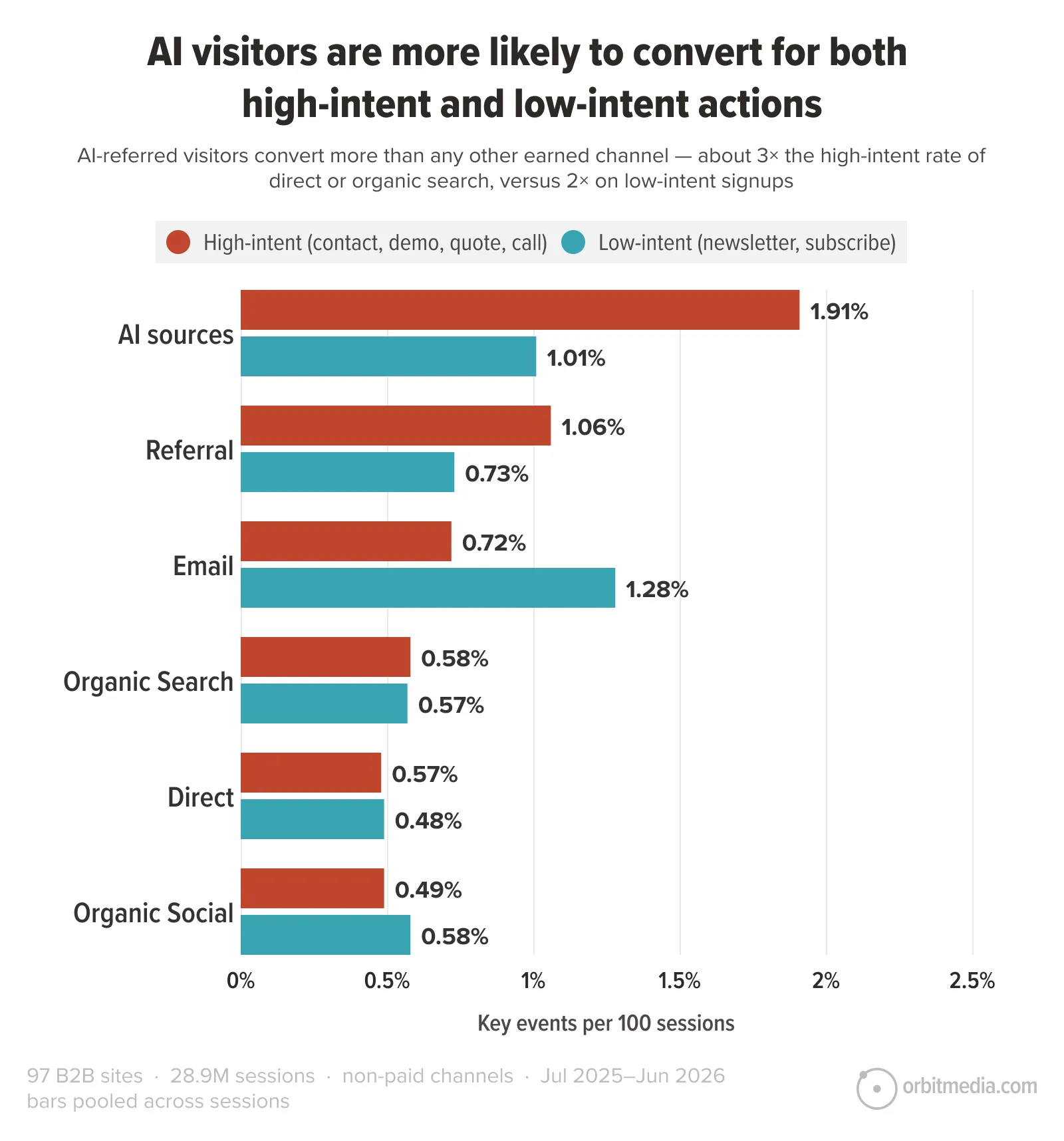
We found the signal. Visitors who come from AI are 3x more likely to convert into leads than other organic traffic sources.
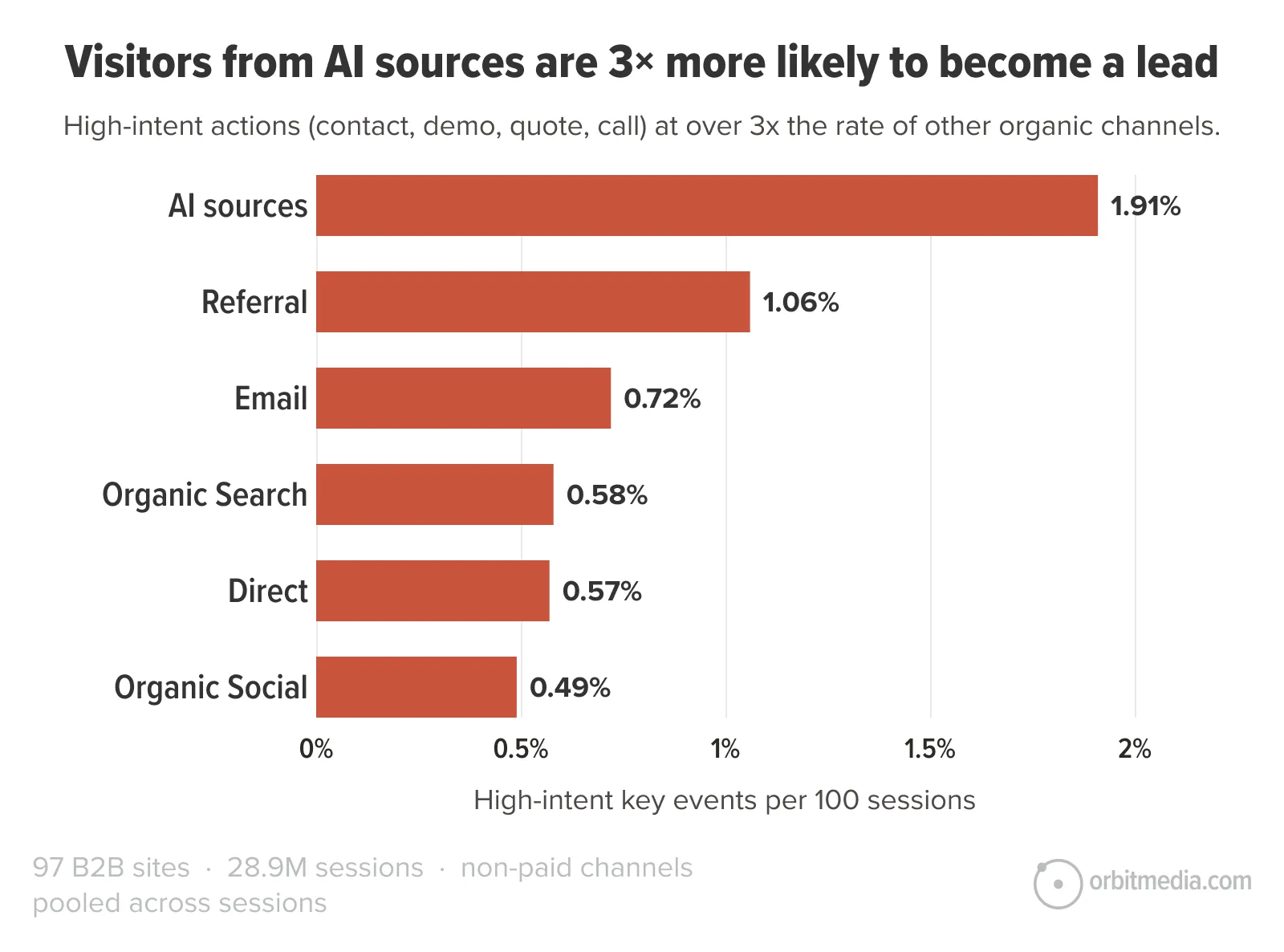
This pattern holds up on around two-thirds of sites individually, not just the aggregate. And when we looked at the per-site median (rather than all of the sessions and conversions pooled together), the conversion rates of visitors from AI sources are 7x higher.
Before we analyze the reasons this is true, let’s see what else the data holds.
High conversion rates, but very low traffic
Across 29 million visits, just 140,000 were from AI sources. Just 0.5% of all traffic was from AI sources. Wait, just 1 in 200 visitors? That is a tiny slice.
Organic search is still a huge traffic driver. Google is the entry point for the internet for millions of people. It may be just muscle-memory (we’ve all been using Google for decades) or the popularity of Chrome (with the Google homescreen).
When you put the traffic and conversion rates on a single chart, it’s striking how little traffic comes from AI sources.
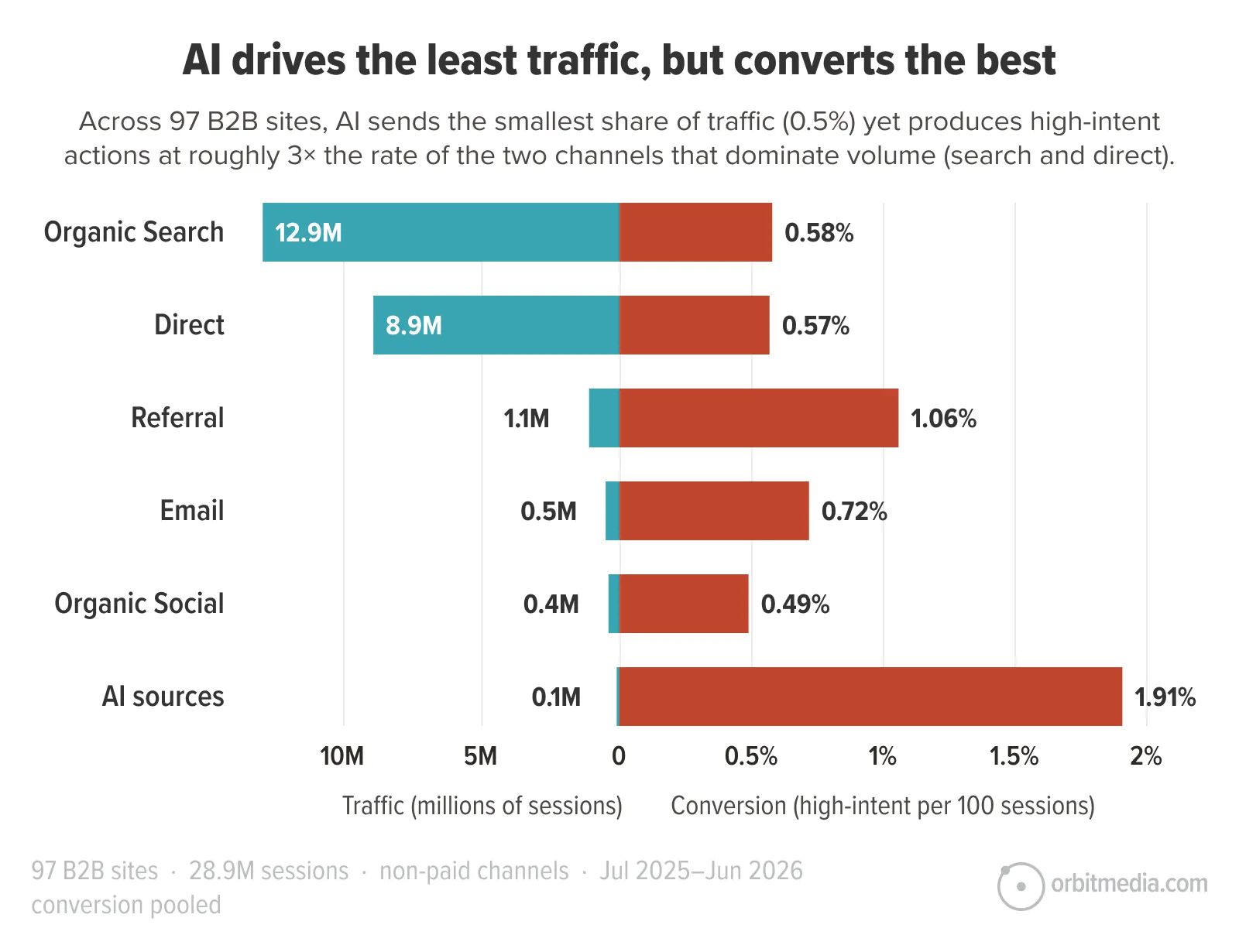 Actual AI traffic is likely higher because traffic from Google’s AI Mode and AI Overviews are categorized as “Organic Search” in GA4, even though they are really AI sources. It’s not possible to separate those clicks from clicks on traditional search results. Also, traffic from AI apps is categorized as “Direct” because GA4 doesn’t know the source because the user isn’t coming from another page within a browser.
But we can look at the AI models separately. Here’s the breakdown of AI models across the 140,000 sessions from AI sources:
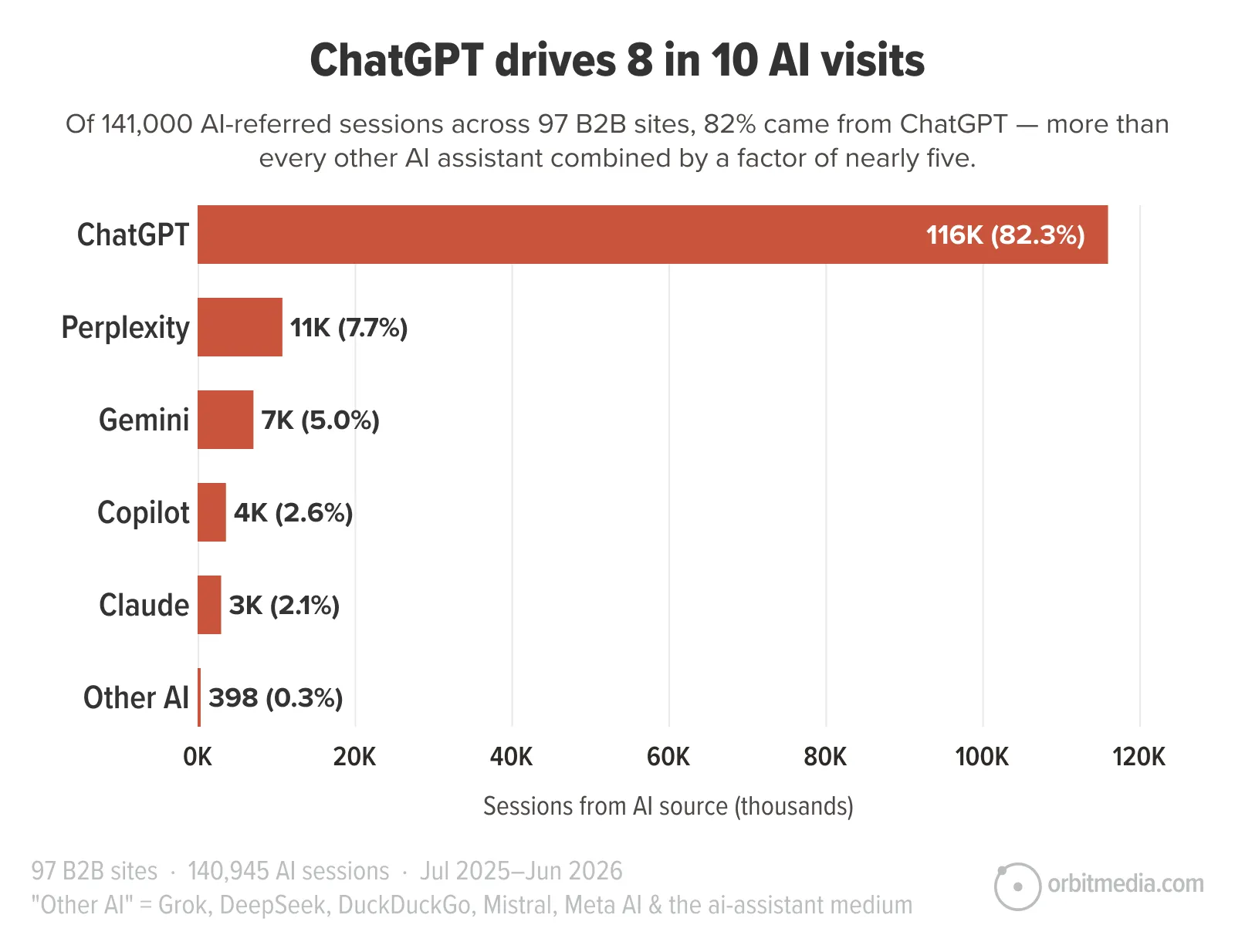
ChatGPT is by far the one AI that is most likely to send traffic to websites. It’s an all-purpose research tool, including research for buying decisions. Perplexity may position itself as a Google replacement, it isn’t sending much traffic to B2B websites. And the visitors who come from Perplexity aren’t as likely to convert.
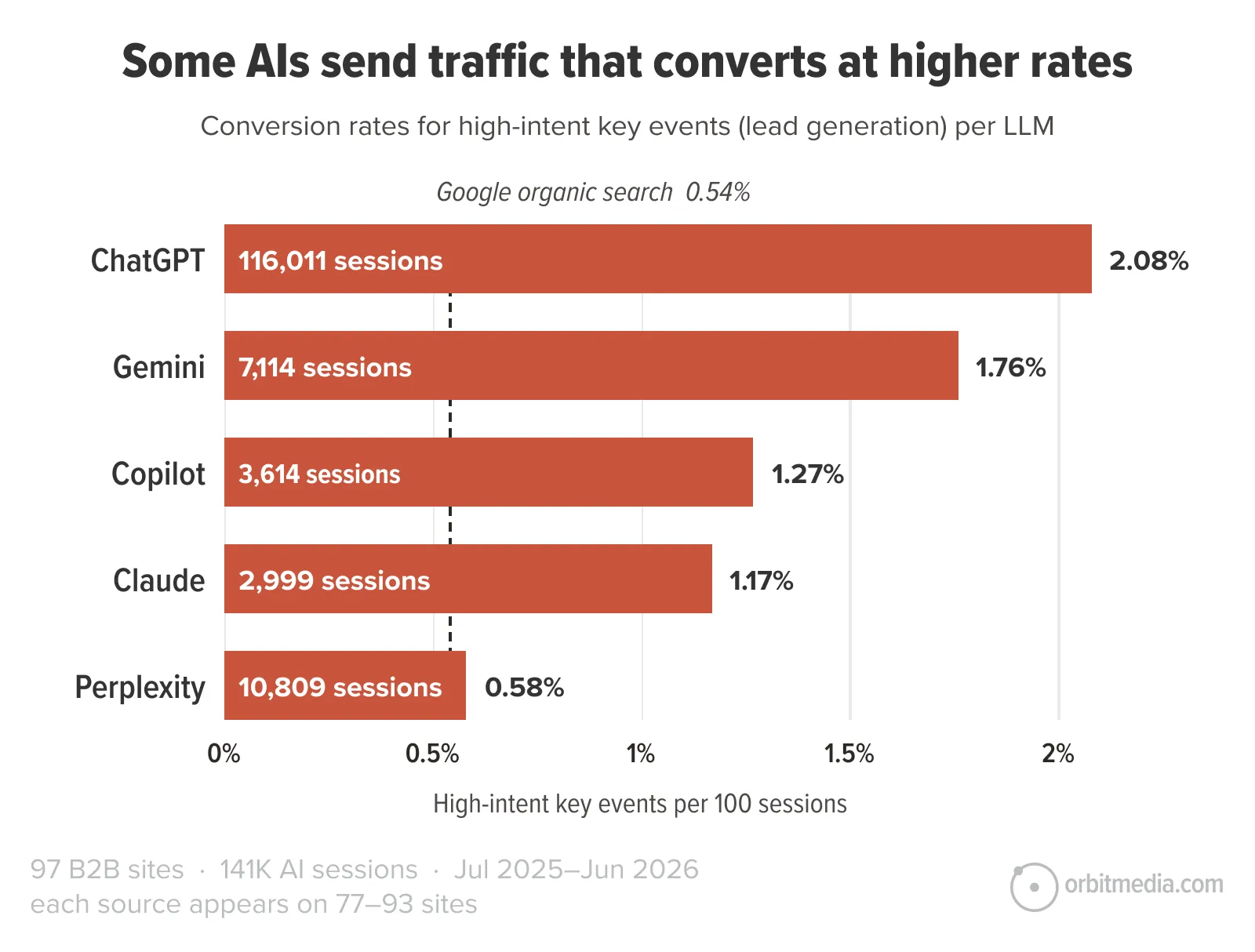 The data also answers this question: What are ChatGPT vs Google Search conversion rates? ChatGPT converts 2.1% of visitors into leads and Google Search converts 0.5% of visitors into leads. But remember, Google is driving 100x more traffic. Organic search is still a more powerful source for lead generation.
Lead Generation vs. Subscribe to newsletter: Conversion rates from AI sources
Some conversions are higher in the funnel. The value of “download guide” and “schedule a call” are not the same. Good analysis means separating the high-intent and low-intent conversions. So all the key events in the dataset were carefully and manually categorized into two groups:
- High-intent conversions
Contact form submission, request a demo, schedule a meeting, phone call clicks, etc. - Low-intent conversions
Subscribe to newsletter, download report, register for webinar, etc.
When you repeat the analysis, segmented by conversion type, the same pattern appears. Compared to other traffic sources, visitors from AI sources are twice as likely to subscribe to a newsletter, download a guide or register for a webinar.
Where do AI visitors land? Which landing pages convert them?
For insights into the pages these visitors are landing on, we categorized the pages into groups, using the same categorization method we used in the AI Crawl vs Traffic Report (home, services/products, articles, etc.).
Now we can see which types of pages attract the most visitors from AI. Also, which types of pages drive conversions and what rates from these visitors.
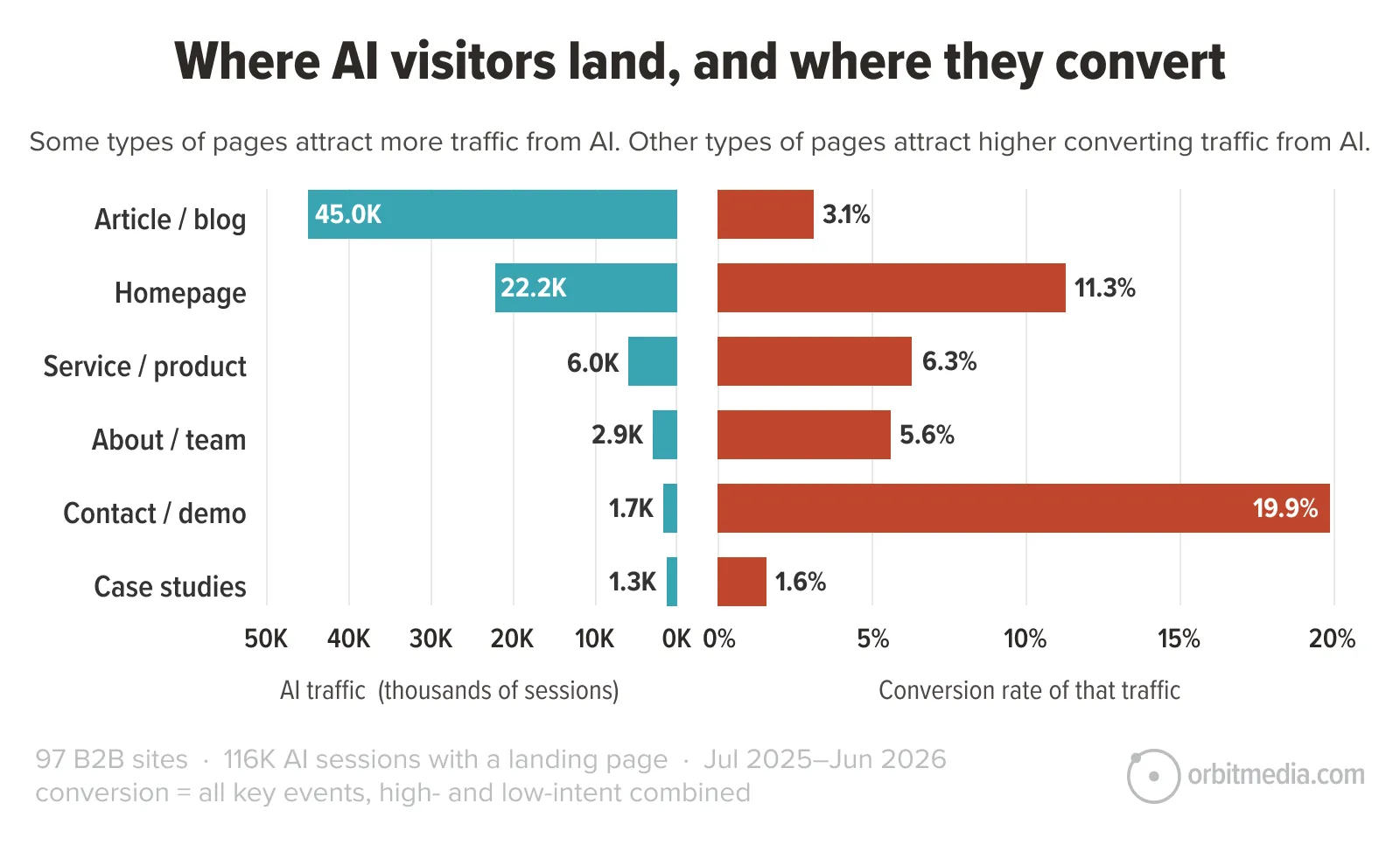
The landing page indicates where the visitor is in their decision process. So it’s no surprise that the higher-funnel page types have lower conversion rates. Visitors who land on articles may have no buying-intent at all. But those who land on a contact page? They’re ready to go.
The most surprising thing on this chart is that all of the conversion numbers are high.
Why are visitors from AI more likely to become leads?
Conversion is complicated. Many factors affect the actions of a visitor. Some may remember the MECLABS conversion formula from 20 years ago. It has weighted variables: C = probability of conversion, m = visitor motivation, v = clarity of the value proposition, i = incentive to act, f = friction in the process, a = anxiety about taking the action.
C = 4m + 3v + 2(i − f) − 2a
Skip the details for now and consider the premise: some conversion factors are more important than others. And the most important factor is the motivation of the visitor. MECLABS defined motivation as “the magnitude and nature of the customer’s demand for the product” but we’ll just call it intent.
If intent is the key to conversion, why would visitors from AI have stronger intent?
Here are four hypotheses:
1. The AI already did the shortlisting
By the time someone clicks through from ChatGPT, they’ve had a conversation. They asked for recommendations, they compared, they narrowed it down. The consideration stage happened inside the model before they hit your websites. They just came for confirmation.
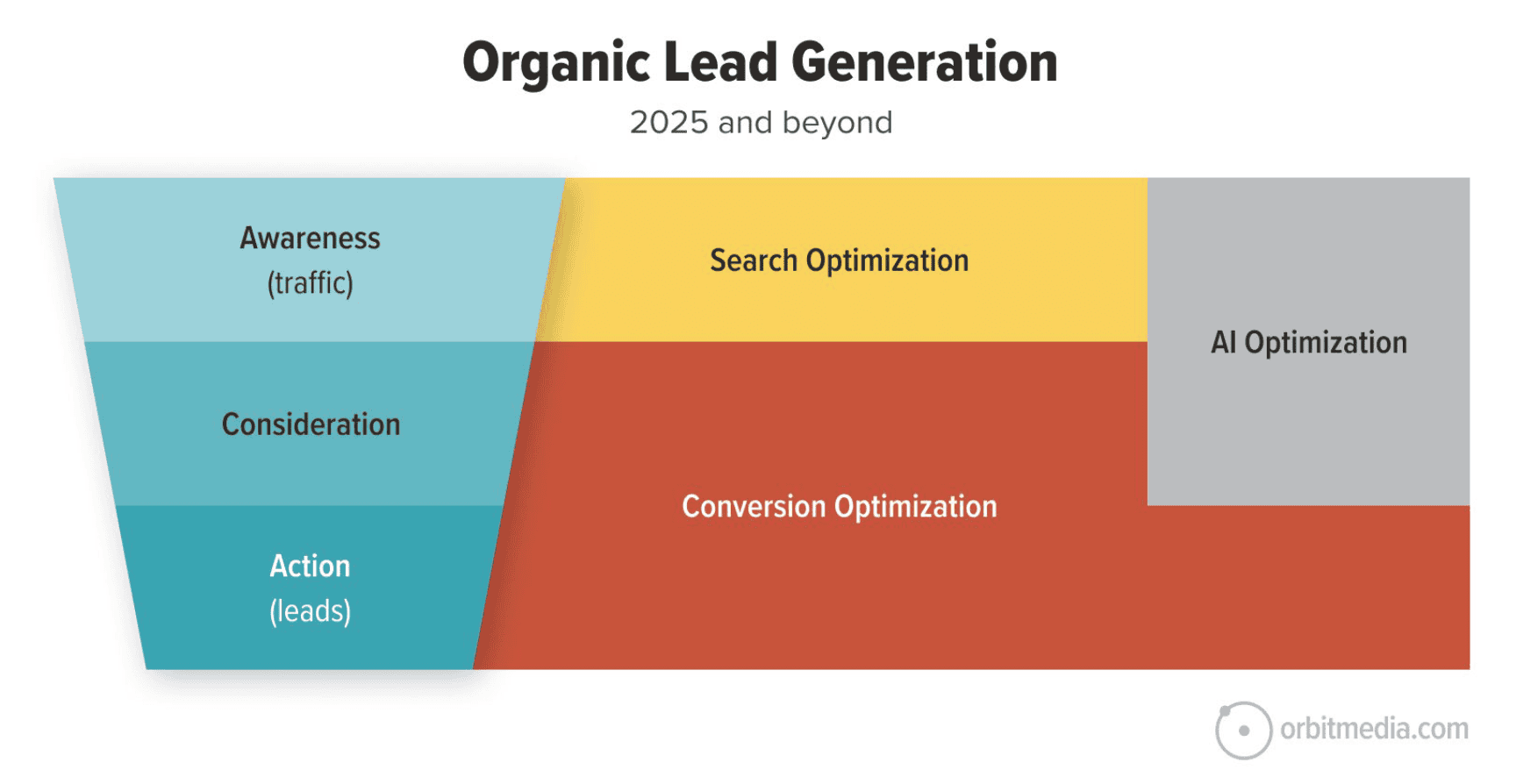 Image source: Traditional Search vs. AI Search
This may also explain the low levels of traffic. People who are not a fit for your services are filtering out your brand earlier. AI sends fewer unqualified visitors. The internet is becoming more efficient at matching prospects with providers.
 |
Joanna Wiebe, Author, The Copyselling System“Chatty-G is the ultimate Connector and Maven. When you add in your own website/presence that acts as the Salesman (persuasive, emotional, trustworthy), you’ve got the pieces in place to move someone to action. It is so wildly uncommon to click any of the source links that ChatGPT produces in its answers… so that, when you do click one, to me it indicates the depth of your desire to resolve the problem you went to AI with. Like, wow, you wanted a solution so badly, you actually clicked through on one of those little truncated grey-button linky things!!! You’ve essentially crossed digital hot coals (invisible grey buttons) to arrive on a brand’s website.” |
 |
Gaetano Nino DiNardi“Website visitors coming from AI search platforms are generally better informed due to the hyper-personalized and conversational nature of the search journey.” |
2. The user already knows you. AI just helped them get to you.
Our high- and low-intent conversions are two of the three types of visitor intent. The third type is navigation intent. Some AI traffic is just like some regular search traffic: the visitor already knows you. They’re searching for your brand. They just asked AI to route them to your website. This helps explain the high levels of homepage traffic.
Either way, the visitor showed up late in the journey, which is exactly why they convert at higher rates.
3. AI responses feel like advice, not an ad
The user experience of an AI chatbot and a Google search are very different. Consider:
The visitor from an AI source… just had a personalized experience with personalized recommendations. They talked to an advisor. When the AI names your brand, it feels like word-of-mouth marketing.
The visitor from search… just clicked on a page filled with ads. They came to you through a digital shopping mall with dozens of options. They’re wary and primed to hit the back button.
4. AI users skew serious
Nobody opens ChatGPT to kill time the way they scroll on social media. They use it with purpose. They’re talking to a chatbot to do serious research. They show up with a problem to solve and a decision to make. That intent is baked in before they ever land on your page.
An honest final take…
After seeing this across several accounts for several years, I always suspected that AI traffic was more likely to convert. But the plural of anecdote is not data. So we went looking for evidence and found it. Here’s what the data actually supports, and what it doesn’t.
- AI referrals are rare. Half a percent of all traffic. That’s one visit in every 200, barely enough to be called a channel. But those visitors are much more likely to take action. Three times more likely than direct or organic search. That pattern holds on roughly two thirds of the sites individually. So we are confident in the pattern.
- AI sends genuinely better-qualified traffic. AI helps users qualify options by providing personalized recommendations. They’ve done their consideration-stage thinking within the model. And the sliver of people motivated enough to click a link out of a chatbot are probably decisive to start with.
- The AI traffic numbers are likely higher. Google’s AI Mode and AI Overviews record in GA4 as “Organic Search.” And AI mobile apps often strip the referrer, so those visits show up as Direct. Real AI traffic is likely higher than 0.5%
Check your own data. Build the GA4 exploration for AI traffic to see the pages AI actually sends people to (it’s probably your homepage). Now look at the conversion rates.
Are those pages answering the real questions buyers ask? Are they filled with supportive evidence? Do they name the buyer, process and outcomes? This is easy to check with the prompts in our 8-point AI-readiness checklist. Now go polish those pages to win more recommendations from AI sources.
And if you’d rather have someone else do that work, let’s talk. 😄
Data & Methodology
Data and scope. GA4 data from 97 B2B and lead-generation websites, covering July 1, 2025 through June 30, 2026 and 28.9 million sessions. All sites had a minimum of 100 AI-referred sessions.
Defining AI traffic. AI-referred sessions were identified by pattern-matching session source and medium against a list of AI assistant domains (ChatGPT, Perplexity, Google Gemini, Claude, Microsoft Copilot and others) plus any session carrying the “AI Assistant” medium that GA4 now assigns, which began operating in mid-May 2026. The source-and-medium pattern was applied uniformly across the full historical window and catches referrers that the “AI Assistant” grouping misses.
Defining conversions. GA4 key events are configured differently on every site, so each event that fired during the window was tiered: high-intent (contact forms, demo and quote requests, phone-call clicks), low-intent (newsletter signups, downloads, subscriptions), or excluded (page views, scroll depth, account logins, and misconfigured events firing more often than there were sessions). This tiering is the most judgment-dependent step in the analysis.