There’s so much talk about what AI can do. But what can’t it do?
Years ago, my friend Steve Rayson published a report that analyzed the performance of a million articles to see what gets links and shares. His conclusion changed my content strategy forever…
 |
Steve Rayson, Founder of BuzzSumo“If you want to create content that achieves a high level of both shares and links, then you should concentrate on opinion-forming, authoritative content on current topics or well-researched and evidenced content.” |
He’s telling us that two types of content consistently outperform: strong opinion and original research. This was seven years before the launch of ChatGPT, but it’s more relevant today than ever.
Why? Because AI can’t make this kind of content. Only humans can.
Let’s explore these types of content and reconsider our own content strategies. Let’s future-proof our content for the AI-writes-lots-of-everything era. And let’s consider a few AI prompts to help us make these kinds of articles. Because it can.
Why can’t AI do this?
Everything AI does is based on what it has already read. It summarizes, restructures, rephrases, and averages. We sometimes joke that AI should stand for “Average Information.” Yes, averaging the internet is genuinely useful. And yes, most content gets better when you use AI.
But two kinds of input are not in the AI training data:
- The thoughts in your head: your experience, your perspective and the opinions you’ve formed over years of doing the work
- The data you create through research: Both new research and the data you may already have in your business, which are numbers only your company can see
These are the two categories of input that come from outside the machine, out of reach from AI and physically impossible for it to generate.
Let’s look at each and (ironically?) look for ways to use AI to surface novel ideas for the content strategist.
Type 1: Your own opinions (thought leadership)
We humans have experiences that shape our perspectives and opinions. But AI has no experiences, no perspective and no opinions. AI models are trained to find the middle, where people agree. AI never takes a stand.
Ask AI for a contrarian take and you’ll get a confident sentence, but it’s probably something that no one would disagree with. But remember, if you can’t disagree with it, it isn’t thought leadership. Most content marketing doesn’t meet the definition of thought leadership.
Here’s the test that separates a real position from a fake one: could a smart, informed person in your industry sincerely argue the opposite? This, from legit marketing thought leader Seth Godin:
 |
Seth Godin, Marketing Legend“Thought leadership always creates tension. It’s about making assertions. You have to be willing to be wrong. You can be certain that some people will disagree.” |
But that doesn’t mean you have to be controversial. No need to touch the third rail. There are many relatively mundane topics that still qualify as thought leadership. Here are a few thoughts in my head:
- “Delete TikTok and Instagram. The more boring your phone, the more productive you’ll be.”
- “Marketers should never use themselves as examples in meetings. You’re a dataset of one.”
- “I would never wear clothing with logos, unless it’s my brand or a brand that I actually support.”
Did you feel something when you read those? Those statements aren’t really controversial, but they create a bit of tension, don’t they? And guess what? None of those sentences could have been written by AI.
Those assertions don’t really fit in my content strategy. I was just being provocative. To be a fit, the counter-narrative has to be safe enough to say on a podcast or in front of clients, but spicy enough that someone wants to reply.
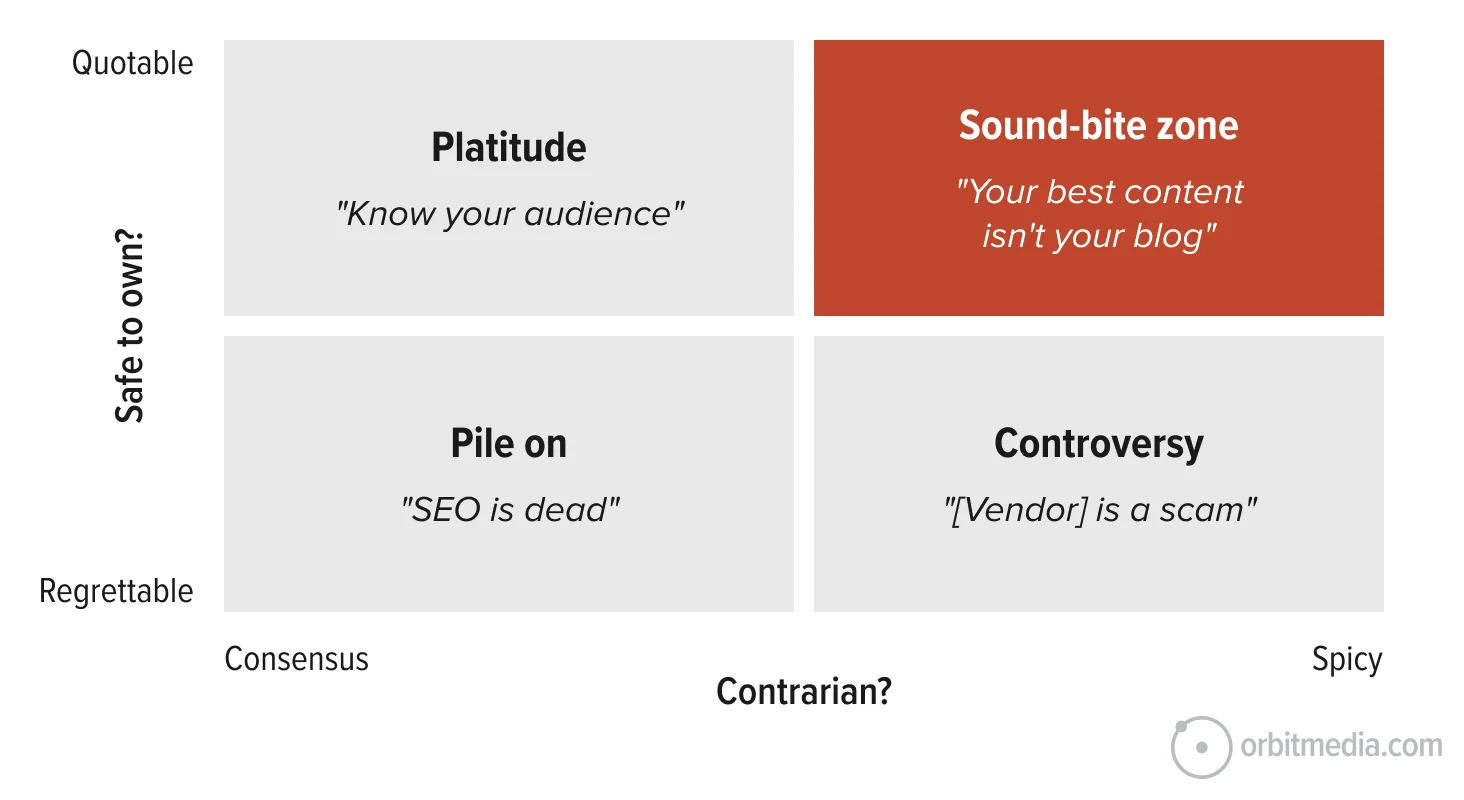
Strong opinion content drives engagement in social media.
The opinion drives responses from other users; those responses trigger the algorithm; the algorithm shows it to many more people. That’s why opinion-based content is catnip for social streams.
You can also differentiate your content from AI just by adding a bit more of yourself in your content. Share a little story. Add some humanity. Be yourself. Just look back at the first four words of this article. AI can’t write that.
AI can’t write opinion-based content. But it can help trigger ideas. Here’s a prompt that lets you use AI to find the one thing AI can’t do. It’s a fun one, I think…
Thought Leadership (provocative, not controversial) Topics Prompt
My role / industry: [job title + industry]
Positions I actually hold (optional): [any contrarian beliefs, pet peeves, or things you think the industry gets wrong]You are an expert content strategist who finds thought leadership angles that get quoted. Your job is to surface positions in the Sound-Bite Zone: contrarian enough to make someone stop scrolling and want to reply, but safe enough that a real executive would happily say them on a podcast and put their name to them. You are not looking for controversy, hot takes that could damage a reputation, or anything political, personal, or inflammatory. The target is “spicy to say, safe to own.”
Work through these five veins of provocative-but-safe opinion for this role:
- Consensus is wrong — a widely accepted best practice, common piece of advice, or belief about a trending topic that this person could credibly argue is mistaken or even harmful.
- The unspoken — a mundane or unglamorous topic people in this role hold surprisingly strong opinions about, or a question they’re quietly afraid to answer out loud.
- The buried lede — an important topic that industry blogs and thought leaders consistently ignore or under-cover.
- The outsider lesson — a seemingly unrelated field or discipline that holds a crucial, transferable lesson for this industry.
- The reframe / forecast — a common fear this role thinks is overblown, a counterintuitive approach that quietly works, or a prediction most peers would call unlikely.
Step 1: Generate two candidate positions per vein (ten total).
Step 2: Commit. Score each on provocativeness 0–5 (does it stop you and make you want to argue?) and flag reputational risk as green (safe to say publicly), amber (needs careful framing), or red (genuinely controversial — cut or heavily caveat). Rank all candidates and drop anything below 3 on provocativeness or flagged red. Winners are high-provocativeness, green or amber.
Step 3: For the top [3–5] survivors, write the actual sound bite: one quotable line, 15 words or fewer, that a journalist or podcast host could pull verbatim. A topic isn’t finished until it has a line.
Present the results as a table: the position, which vein it came from, its sound bite, provocativeness score, risk flag, and a one-line note on why it lands without crossing into controversy. Lead with the strongest.
Type 2: Your internal data or stats you produce (original research)
New research is the other category of content that will be forever differentiated from AI content. There are two obvious reasons:
- AI doesn’t spontaneously generate new primary research. No matter how smart the AIs get, they’ll never do this.
- AI doesn’t train on the data that you have inside your business. No matter how smart the AIs get, they’ll never have this. They have no access.
The benefits are big, but different from the benefits of thought leadership. Original research drives search rankings. Research attracts links. Links drive Domain Authority, which is the ranking potential of every URL on your website.
Research is also more likely to get clicks from citations in AI responses, maybe because people want to check AIs sources. If you’ve ever published research, you can confirm this yourself by using GA4 to check which of your pages gets traffic from AI models.
If you need an example of research in action, look at how I opened this article: I cited Steve’s research. Why? Because it supports my thesis. His study has also been linked to from 1,400 other websites. I checked.
Here are some other recent examples of research from the Orbit Media blog:
- AI crawls homepages 15x more than any other type of page
- Traffic from AI sources convert at 3x the rate of traffic from other sources
- X (FKA Twitter) is now the spammiest social network
And of course, research can become charts, and these visuals make for very compelling content. Here’s one from our annual blogger survey. Here you can see how repeating your research annually makes it more valuable over time.
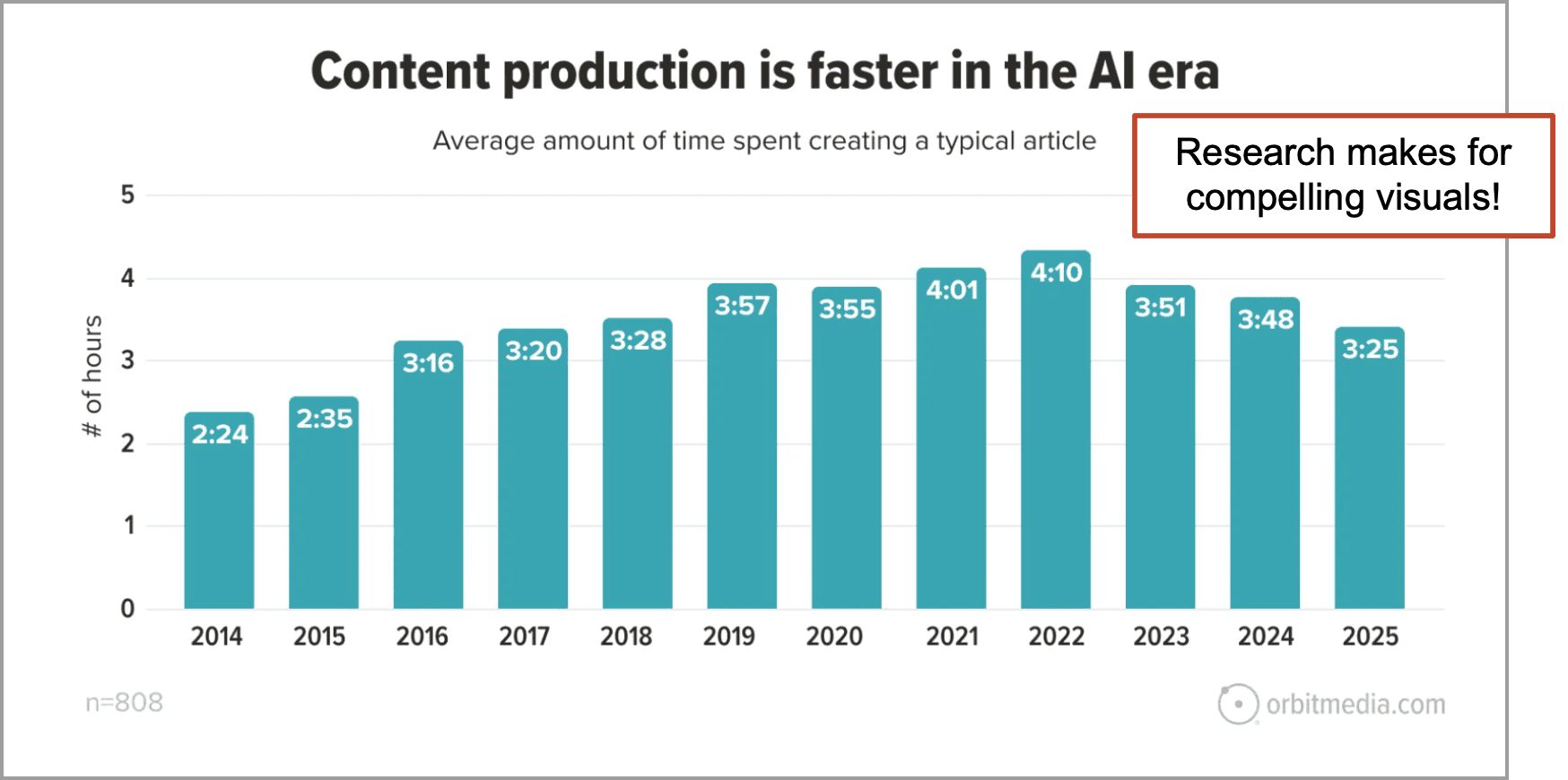
AI can make charts, but it can’t produce the data behind the charts. AI doesn’t conduct new research. It just summarizes and cites data it finds.
So original research works. But what kind of research? You’re looking for a “missing stat” which is a data point that doesn’t yet exist on the internet. It fills a data gap for a frequently-asserted-but-rarely-supported assertion people are already making.
The internet is not finished yet.
The best research studies produce data that is useful and that is proprietary to your brand. It makes your website the primary source for new information.
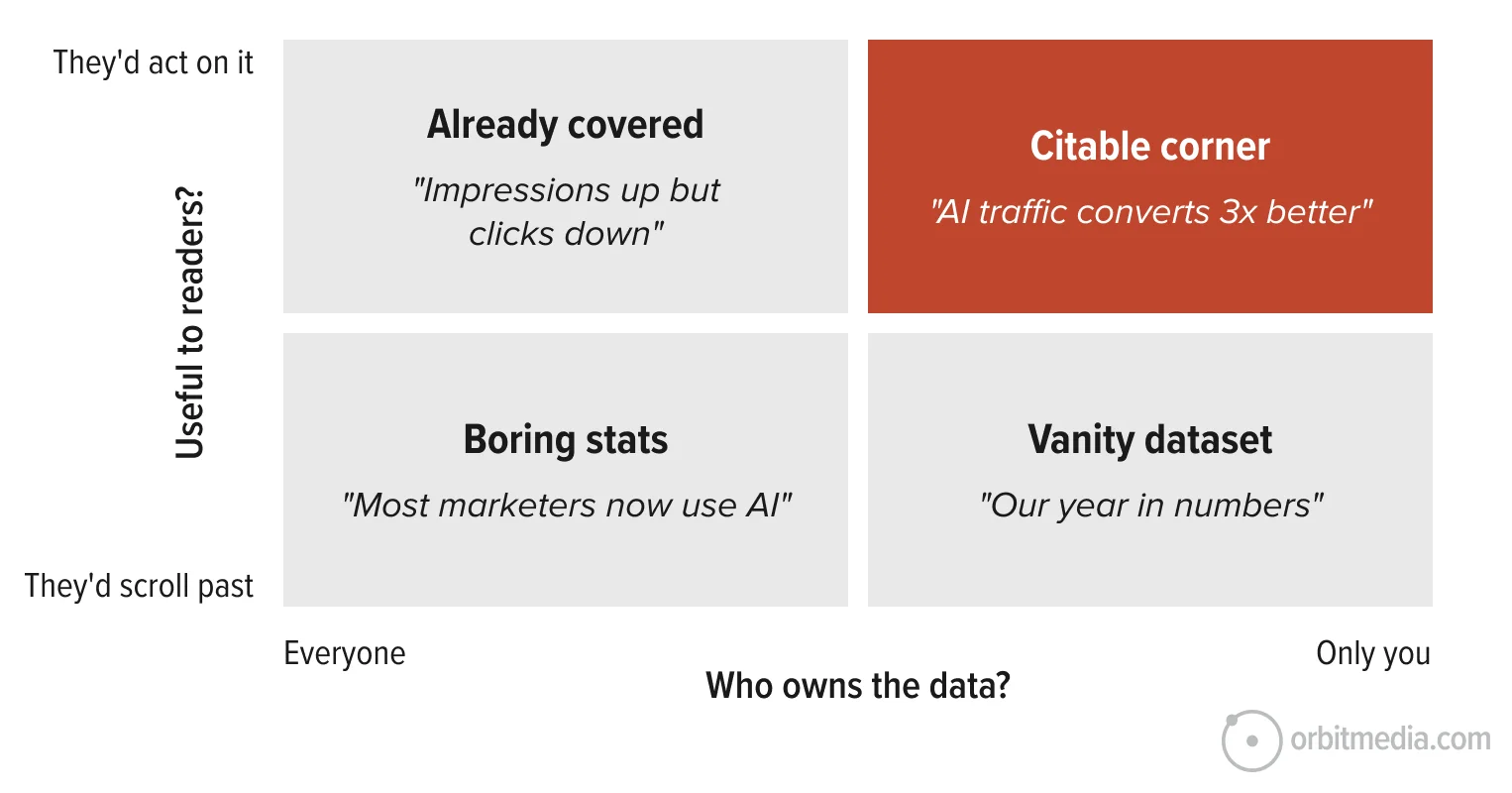
Add your own hot take to the report (or fill it with quotes from subject matter experts and influencers) and you’ve added a splash of thought leadership to your research. Once complete, stand back and look at it. It will be obvious that AI never could have made any of it.
But amazing data isn’t enough to drive performance. The best content doesn’t win. The best promoted content wins. So before you publish a new report, scan through our Original Research Promotion Guide. It may give you a few ideas for better reach.
Trouble thinking of research topics? Here’s a prompt that may trigger a few ideas. It starts by asking you about the data you may already have…
Original Research Topic Prompt (Proprietary Data Edition)
My company: [name + industry]
Data I know we have (optional): [product usage, sales/CRM, support tickets, transactions, survey list, etc.]You help me find original research topics that earn citations from journalists, editors, and bloggers. The best topics sit where two things overlap: a claim my industry repeats constantly but has never measured, and proprietary data we already hold — or could cheaply collect — that could settle it. No one else can publish our data, which is exactly why it gets cited.
Step 1: Before generating anything, ask me 3–4 questions to surface data assets I may have overlooked: what we capture through the product, what prospects keep asking that I could answer with numbers, a stat I cite internally but have never published, or what a quick survey to our list could reveal. Then wait for my answers.
Step 2: After I answer: list the claims my industry asserts but rarely supports with data, then filter to the ones our data could credibly prove or disprove.
Step 3: Give me the [3–5] strongest topics as a ranked table. For each, include: the industry claim it settles; the proprietary data that settles it; research approach (survey / analysis / experiment); why we’re uniquely credible to publish it; the headline a journalist might write; a note if a comparable study already exists; and a 0–5 score for newsworthiness and 0–5 for feasibility, each with a one-line rationale.
Rank by newsworthiness × feasibility, and lead with the one I could realistically ship soonest that still makes news.
Flag any topic relying on sensitive data (customer info, CRM, support content) so I can plan for aggregation or anonymization. Treat this exchange as confidential.
10 content formats that AI can’t make
Beyond the two categories of content, there are some content formats that AI can’t produce. I can think of at least ten. Do content in any of these formats, and you’ve done something AI can’t do.
- Videos. Yes, AI makes video, but not as a named, human personality being themselves.
- Conference presentations. A human from your brand, live on stage
- Live webinars. Sure, the slides could be generated by AI, but a human handles the talking and Q&A.
- Panels and roundtables. Humans having a real conversation. Perfect showcase for those spicy topics.
- Podcast guest appearances. A human host asks questions. You, the human, answer in real time.
- Workshops and training. A room full of humans, with someone from your brand leading the discussion.
- Live teardowns and audits. Humans critiquing things in real time (like our monthly LinkedIn Live sessions).
- Original photos and video of your team. Humans on camera in a physical office, keeping it real.
- Contributor quotes and expert roundups. Actual humans, saying something they’d defend on the record.
- Community spaces. Slack groups, forums, happy hours where humans gather to be with other humans.
The difference is obvious. Some of these aren’t even online. Some are older than the internet itself. These are the most human formats for content marketing and they aren’t going anywhere. They are immune to tech disruption.
Every content strategy should have at least a few of these in the mix. At Orbit, we do all ten of these on a regular basis. But if you could do just one? Our friend Jay Acunzo has a strong opinion on this…
 |
Jay Acunzo – Speaker, Advisor, Coach“I believe the most defensible, irreplaceable, yet rare skill is your ability to speak well and deliver exceptional presentations, online and in-person.” |
It’s easy to differentiate your content from AI
In fact, it’s natural. Most of the sentences we speak in conversations every day could never be written by AI. They are our own personal points of view. Yet most content programs rarely publish strong opinion content.
And few content programs ever publish new original data. Most websites are not the primary source for any data whatsoever.
Instead, marketers everywhere use AI to write and then use AI again to hide the fact that AI wrote it.
Sadly, one of the most upvoted “skills” in the AI skills directories is the Stop Slop Skill, which just tries to make writing sound more human (“Remove em dashes. Break formulaic structures. Avoid binary contrasts, dramatic fragmentation, rhetorical setups. No inanimate objects performing human actions. Vary rhythm…”)
This is absurd.
Let’s close with my favorite quote about AI from one of my favorite thought leaders.
 |
Jay Baer – Author, Speaker, Advisor““The problem is not that AI is doing what marketers can do. The problem is that marketers keep doing what can be done by an AI.” |