New data shows which outreach tactics are doing the most reputational damage.
How has the worst marketing changed over time?
Each year, we ask 1000+ consumers about spam. With our partners at QuestionPro, we measure the size of the spam problem in email, social media, DMs, text messages, phone calls and direct mail. It’s an annual survey of the general population in the US.
Spam is everywhere, in every channel. You have very few ways to stop it.
Spam marketing is any unwanted, unsolicited message that appears in any marketing channel. The recipient did not request them and perceives them as having extremely low value. These messages are mostly advertising, bots, phishing and other scams.
With new data in 2025, we measure the size of the problem.
- Which social networks have the most spam?
- How much of our email is spam?
- How much text spam are we getting?
- What percentage of our calls are cold calls?
- Is spam getting worse?
- Are we seeing AI-generated spam?
We saved that last question for the end of the report. Let’s start with social media.
Social media spam
Here’s where spam trends have changed the most. Suddenly, X (Twitter) is the spammiest social network, overtaking Facebook, which was the spam leader for the last three years. This is a big shift, possibly caused by the changes to the X content moderation policies.
 Spam isn’t just in social streams. It’s in our direct messages. A lot of us get spammed every day in DMs. Here on LinkedIn, it starts with a connection requisition. Accept the connection… immediately get a pitch message. This is called a “pitch slap.”

We posted a question about the pitch slap on LinkedIn. The feedback was huge. Dozens of people immediately complained about the problem. We’ll share some of those comments here. For starters, just 19% of us get these messages every day? A lot of us are surprised these numbers aren’t higher.
Talia Wolf
“This happens to me 9 out of 10 requests. It’s relentless “
Robin Visser
“I wonder if this problem is more prolific in certain industries. I’m shocked at how many people said this never happens to them. Probably 50% of the follow requests I accept end up in a sales pitch.”
Prerna Mehta
“Connect today, get a pitch in 120 seconds. This crowd treats LinkedIn like a cold-calling machine. Feels spammy, not strategic.”
Kathleen Marrero
“It’s constant. Accept a request, and two minutes later, you’re hit with ‘Can I put 30 mins on your calendar?’ The pitch isn’t even the problem; it’s the entitlement, because a cold DM isn’t sales; it’s digital loitering.”
Dave Boerger
“The worst is that later I get a notification on my phone – when I’m in the middle of something else, like feeding a sick family member or pet – and it seems like it’s important, so I click on it, only to find it’s a newsletter or live event related to someone I’ve never met before. THIS WAS NOT WORTHY OF A NOTIFICATION.”
Spammers are using social DMs for sales. Why? Because Cold DMs are the one channel with a 100% deliverability rate. It’s perfectly fine to sell, but the pitch-slap hurts trust and risks their reputation. LinkedIn is not a cold calling platform, even if its most popular tool is called “Sales Navigator.”
Timothy “Tim” Hughes 提姆·休斯 L.ISP
“People think that LinkedIn is sales media …when in fact it’s social media.”
Many of these spam direct messages are automated. On LinkedIn, a bot sends connection requests, then if the request is accepted, it sends a pitch message. If the message is ignored, it sends another message. And so on until the automation runs out of pre-written messages.
But if the pitch is personal and relevant, it can work well…
Suzanne Feinberg
“When someone connects, I try not to pitch in my DM response – rather explain how our relationship will be beneficial. For instance, we connect with lawyers regarding notarizations. Our DM usually contains our expertise. Then we explain that we would be happy to act as an expert for this skill (no charge of course). We are successful in not only communicating with that lawyer, but if we are patient and send only very specific information on news in the industry or insights into helping them – they end up actually being our client.”
But often, the warm up messages are disingenuous…
Bernie Borges
“Two trends I’ve observed: 1. More connection requests from people I don’t know without a personal note. 2. The latest tactic in DM after connecting is two or three friendly questions about “what lights you up.” Then, the pitch slap!”
Most of pitch slaps are people offering one of the following:
- Lead generation, which is an offer to spam people on my behalf (“5-10 high-value clients in 30 days”)
- Funding (“We have been authorized to prequalify you for $1m to $70m…”
- Link building (“5 high quality links in 10 days”)
- Job offer (“based on your background, you have qualified for job X.”)
- Services (“Here at [company] we offer…”)
If you knew me, you’d know how absurd these messages are. Sometimes they start with a mostly generic warm up message (“I love your content…”). Often, the pitches are irrelevant because their targeting bots are off-target. They are just looking for specific words in our headlines, titles and bios.
Carla Johnson
“Because I have the word “architect” in my profile, as in Innovation Architect, so many are even more irrelevant. One financial planner’s spam went into great detail about how his wife was an architect and he was sure that we’d have so much in common and want to build a mutually beneficial business partnership because we have so much in common.”
Knowing that they’re bots, I never hesitate to delete these messages. They probably don’t even notice. It’s also perfectly appropriate to block and report these accounts.
- 57% of people ignore social media spam
- 36% block and report accounts that send spam messages
So most of us ignore these, but there are many strategies for dealing with the problem. Here are five for dealing with a pitch slap, suggested by our fellow LinkedIn users and spam victims.
1. Delete, mute, block, remove connection
Cut them off. Because connection does not equal consent to spam.
John Sukowaty 📊
“…connect request …and get a pitch DM two minutes later” = egg on my face for not seeing it coming. out of pure spite, immediate ignore, unfollow, disconnect.”
Dale Bertrand
“I’ll admit I just accept every connection and then mute them if they send me a pitch in the first message.”
Janice Mandel
“It’s gotten to the point where I can tell if a connection request is genuine or a prelude to a DM pitch based on the profile. If it references sales, acquisition etc. (and many do), I usually delete the request. If I do accept and a DM pitch follows, I delete and block. Maybe that’s harsh, but I want a valuable network, not a bunch of people who just want to sell me something. I don’t get a ton of these anymore. Maybe because I act on them?”
Scott Dayton
“I get these requests at least once a day. Most are transparent and clumsy in their approach, and those hit the trash bin immediately. Some are more clever. They’ll drop a name we have in common or an event we attended, and they come across as an authentic network connection request that I accept. Then <BOOM!> two minutes later I get a sales pitch. Those get deleted and blocked without response.”
Gail Gardner
“It happens. And I often reply with “does that work for you”? They seem to be oblivious to why people didn’t connect so they could start pitching. One pitch that is relevant is tolerable. More than one will get them disconnected.”
Adam Turinas
“It’s a pet peeve. If I suspect someone is going to pitch also I will let them know when I accept their request not to. If someone does it I disconnect and block them. I used to put a disclaimer on my connection requests promising that I would not pitch slap.”
2. Avoid new connections …at a cost
Accept connection requests carefully. For some, this means ignoring requests from people who have sales-related job titles or “lead generation” in their headline.
Jon Rivers
“My rule: If your first DM is a cold pitch, a Calendly link, or a 14-paragraph “about us” message… we’re done. If you can’t be bothered to build a real conversation before selling to me, I definitely don’t trust you with my network of connections.”
Stephen Tseng
“I’ve started treating my LinkedIn DMs like a spam folder. It means I probably ignore legitimate opportunities. The real cost of this automation spam isn’t annoyance. It’s the death of real networking.”
Emily Call
“I would imagine a person’s job title factors into this. I’ve actually stopped accepting connections that have sales in their title because I know it’s going to result in a pitch!”
Marjorie Clayman
“Unfortunately yes, and it’s now costing me connections with good people because any time I get a DM or a compliment I have to raise a Vulcan eyebrow of doubt.”
A. Lee Judge
“Since LinkedIn prompts you to “add a message” with an invite, users tend to “add a pitch” instead. This results in an immediate pitch-slap the moment you accept. For that reason, I tend not to accept invites that have messages in the first place.”
Samantha Schwartz
“It was WORSE when I was job hunting. I think some sort of bot was reaching out every day offering to analyze my resume. I ignore my inbox for weeks at a time, and yes, I’ve missed actual messages from my contacts and opportunities.”
3. Pitch them back
Turnabout is fair play. If they expect you to hear their sales pitch, they should listen to yours. Any chance this could work?
Todd Jones
“Sometimes I will counter pitch and it often doesn’t get a favorable response. Most of the time they are playing numbers, they are looking for signs of life.”
4. Set an auto-reply
From the three-dot menu at the top of your LinkedIn messages, you can “Set away message” which will automatically send to anyone who messages you. You can use it to inform spammers that you’re not interested in being pitched.
Stacey Moore
“I dislike it so much that I use an auto-reply.”

5. Treat them with dignity and respect
Or take the high road. Keep an open mind. The pitch may be considerate and thoughtful. The offer may be something that could help you.
Christopher Isit
“Yes, I get spammy pitches every week, but I still lean toward a humanistic, empathetic approach (with a caveat). If someone makes an effort to connect meaningfully (shared career interests, thoughtful intro, posts that add value) I’ll accept. Even if I suspect a pitch is coming, I’ll engage if the service is relevant or reply with “not now, but I’ll keep you in mind” because it could be useful down the road.Why? People deserve respect.
You never know when you’ll need that service—or that person. A great account manager can be a game-changer for MarTech support. Sometimes, the most persistent “pitcher” turns out to be a passionate marketer who shares incredible insights. That’s someone I might want on my team.
Spam is annoying, but connection is still human, and I remember what it was like when I started out. If the outreach is earnest and personalized, I’ll respond. The real problem isn’t pitching, it’s lazy, copy-paste spam”
6. Mess with the pitch slappers
Why not have some fun? If they want to schedule a time, suggest the 33rd of Novembruary. That’s what Seth Turnoff did in the post below. If you’d like to see more posts like these, check out the #Jerkstore hashtag.
 However you respond to DM spam, it’s a big problem. One of our commiserators summarized the pitch slap and the impact on trust.
Lukasz Klekowski
“The three types flooding your inbox:
- The Instant Pitcher – Accepts your connection, immediately launches into a sales deck
- The Fake Complimenter – “I love your content!” (they’ve never seen your profile)
- The Persistent Automator – Sends 5 follow-up messages whether you respond or not
This approach destroys trust faster than it builds business. Conversion rates are abysmal. People are becoming connection-request adverse. We’re training an entire platform to ignore genuine outreach.
Real engagement. Comment on posts. Add value first. Build relationships before pitches. Crazy concept, right?
LinkedIn was supposed to be the professional network. A place where business relationships mattered. Not a hunting ground for aggressive automation. Now I simply send a link back to the spammers and ask for their thoughts on it. Not once have I received a reply!”
Enough about social spam. Let’s move on to email, where the spam problem isn’t improving.
Email spam
Spam email has been with us since email was invented. It’s cheap, easy and it works well enough that marketers haven’t given it up. A huge amount of the messages in our inboxes are spam. Some research estimates that 47% of all email is spam (source). That’s a lot.
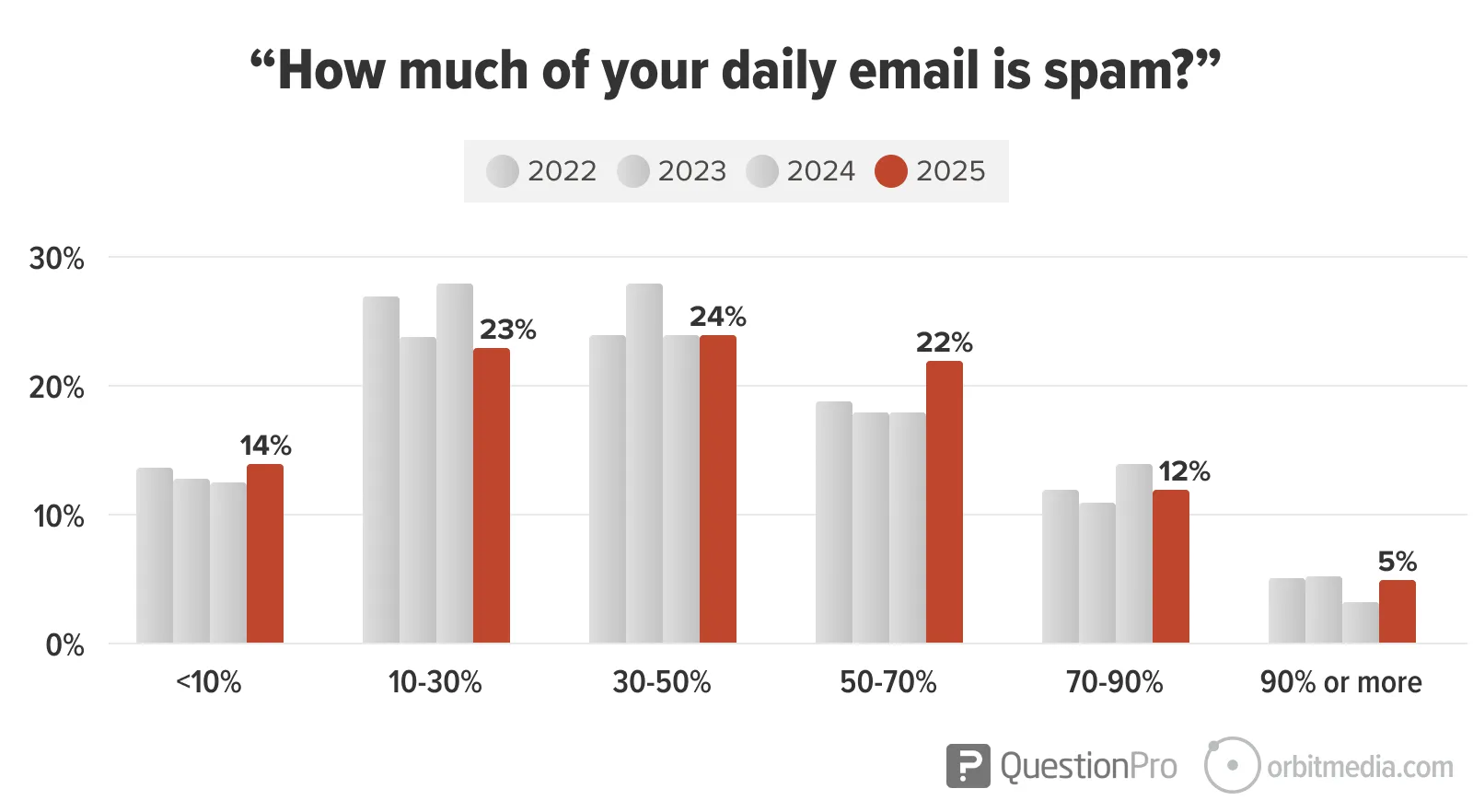
Filters, spam reports and the promotions tab can help, but some always get through. There’s nothing we can do to stop it, but there are several ways we react to it. We can ignore it (50% of recipients), report it as spam (30% of recipients) or report and block the sender (9% of recipients).
We asked the respondents how they react to unwanted messages in their inbox. We included “unsubscribe” as an option, which is misleading because if you can unsubscribe, it technically isn’t spam. We encourage all of our readers to report spam if there is no unsubscribe option. This hurts the reputation of the sender and is the only way to fight back.
 Text message and phone spam
 Text message and phone spam
Your phone buzzes. You’re getting a call. Is it even worth looking to see who’s calling? You get a text notification. Maybe it’s important. You look and it’s a strange number with a weird message. Probably a scam.
Are you surprised? Or has this become the normal, everyday cost of having a phone number.
Unlike emails which wait for you in your inbox, your phone is used for urgent calls and text. You can’t completely ignore it. You have to look. Cold calls and texts (SMS messages) are the most insidious forms of spam, stealing our attention at random times of day.
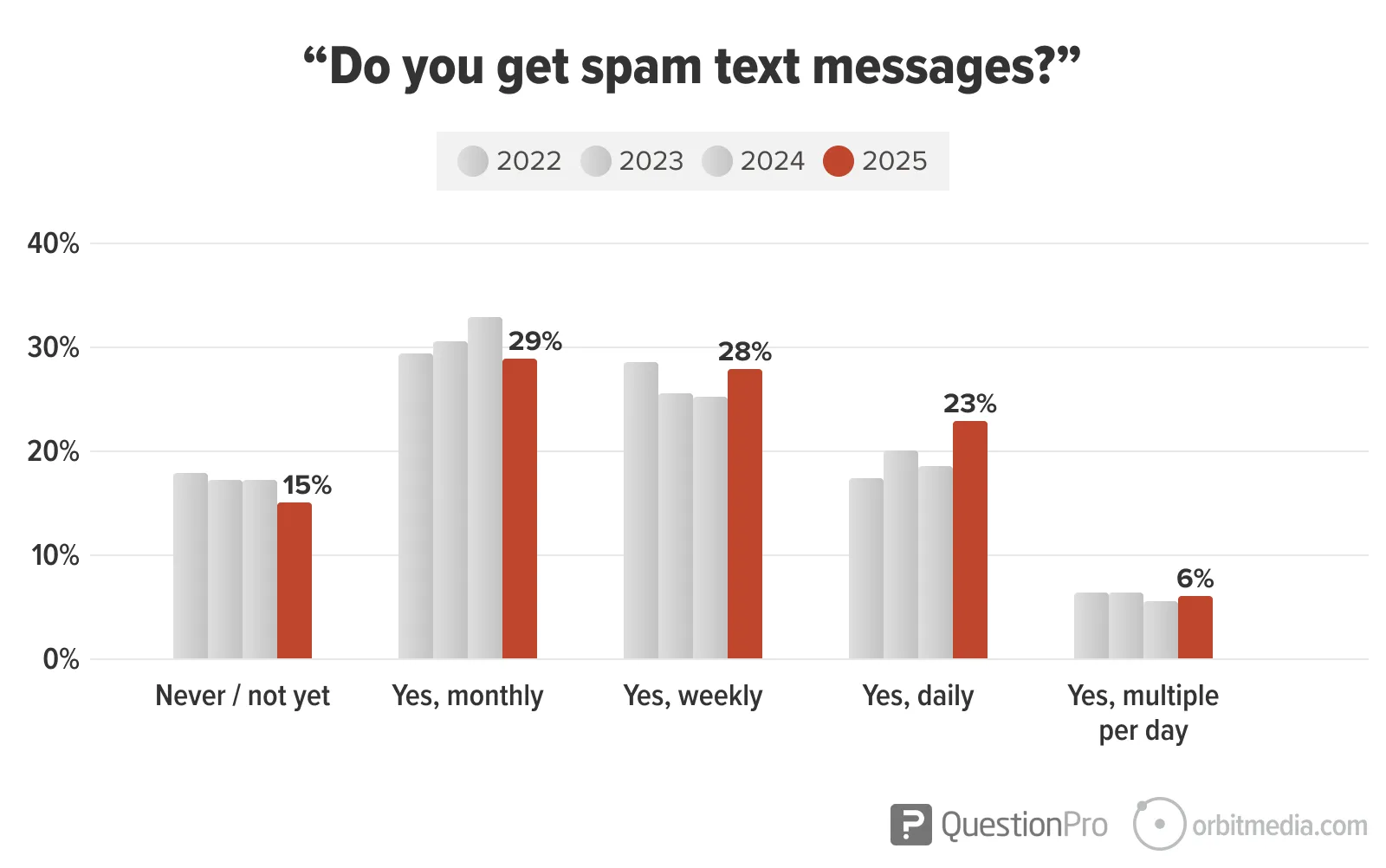
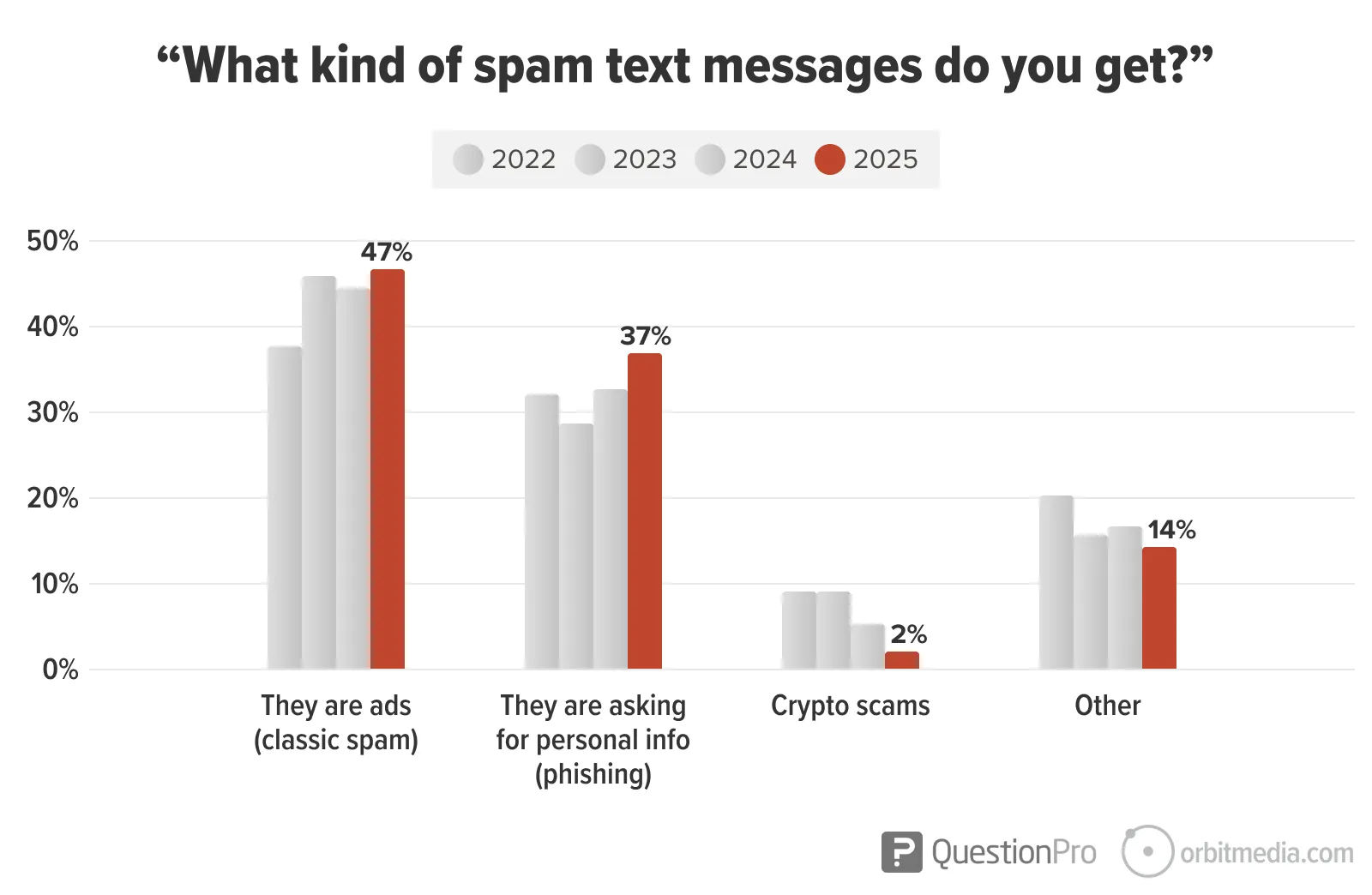
Most phone numbers get spam text messages. Around 30% of us get them daily or multiple times per day. They are mostly offers (ads) and phishing scams (fraud and identity theft).
The proper response is to immediately report the spam and block the number, which takes a moment, but helps protect others from getting spam from that number.
Cold calls are on the rise. 38% of us get unwanted calls daily or even several times per day. These interruptions can’t be stopped. Too many databases have our phone numbers, and new tech-supported ways to harvest those numbers and make them easier than ever for spammers to abuse.
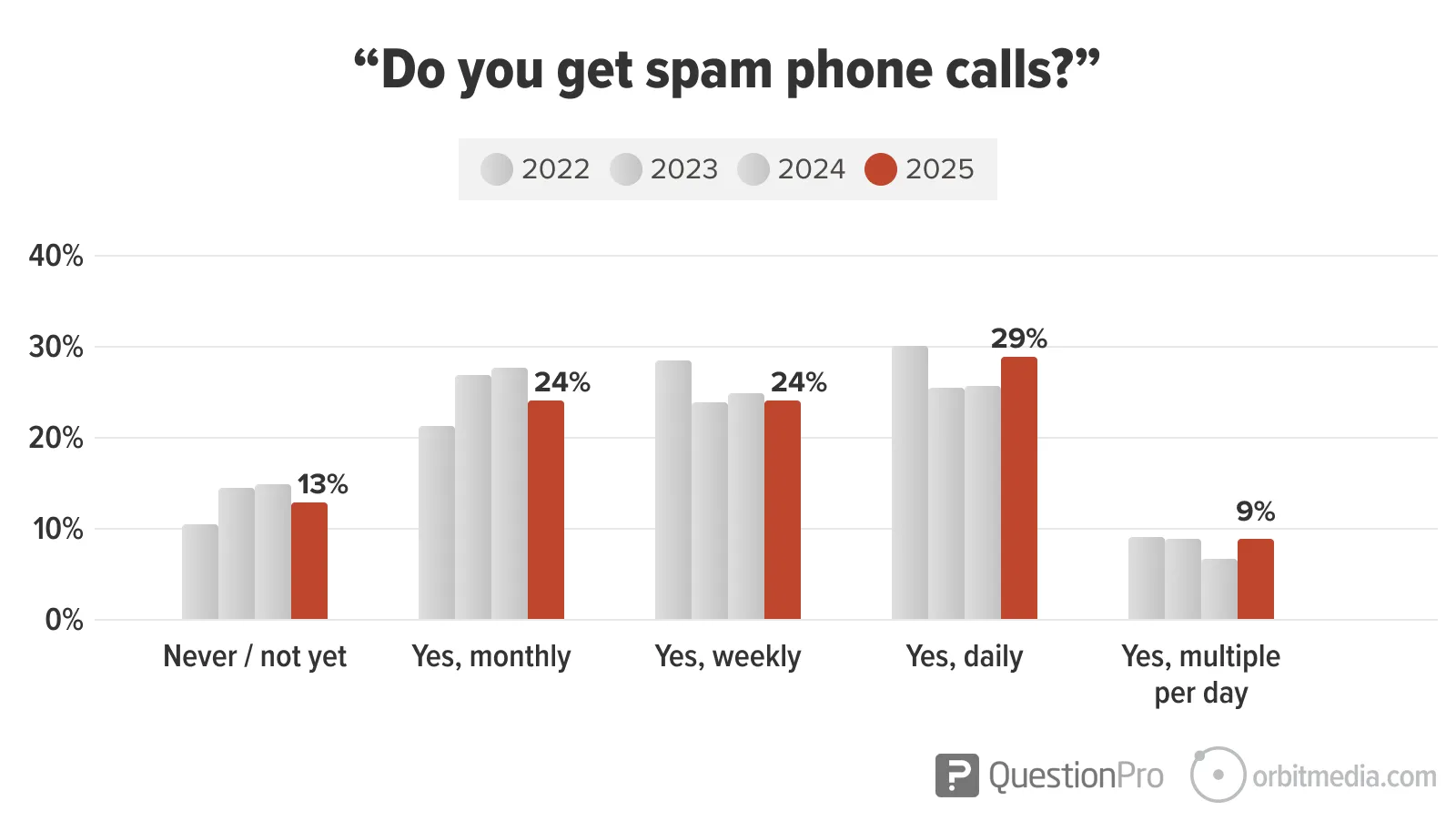
How do we respond to cold calls? The easiest way is to ignore them and try to regain focus on what you were doing.
- 48% don’t answer
- 39% don’t answer, then block the number
- 5% of us are impolite and respond with “burning rage”
These calls happen millions of times each day, so the cost to our collective attention is huge. I can’t blame anyone for being angry at the interruption, even if the anger directed at the caller feels misplaced. They’re doing a job. Maybe they don’t have a lot of job options. But no question, some of these callers are attempting to commit fraud.
The role of AI in spam
AI makes it easier to spam. AI data-enhancement tools scrape our data from public sources, segment us into categories, write personalized messages and send them non-stop.
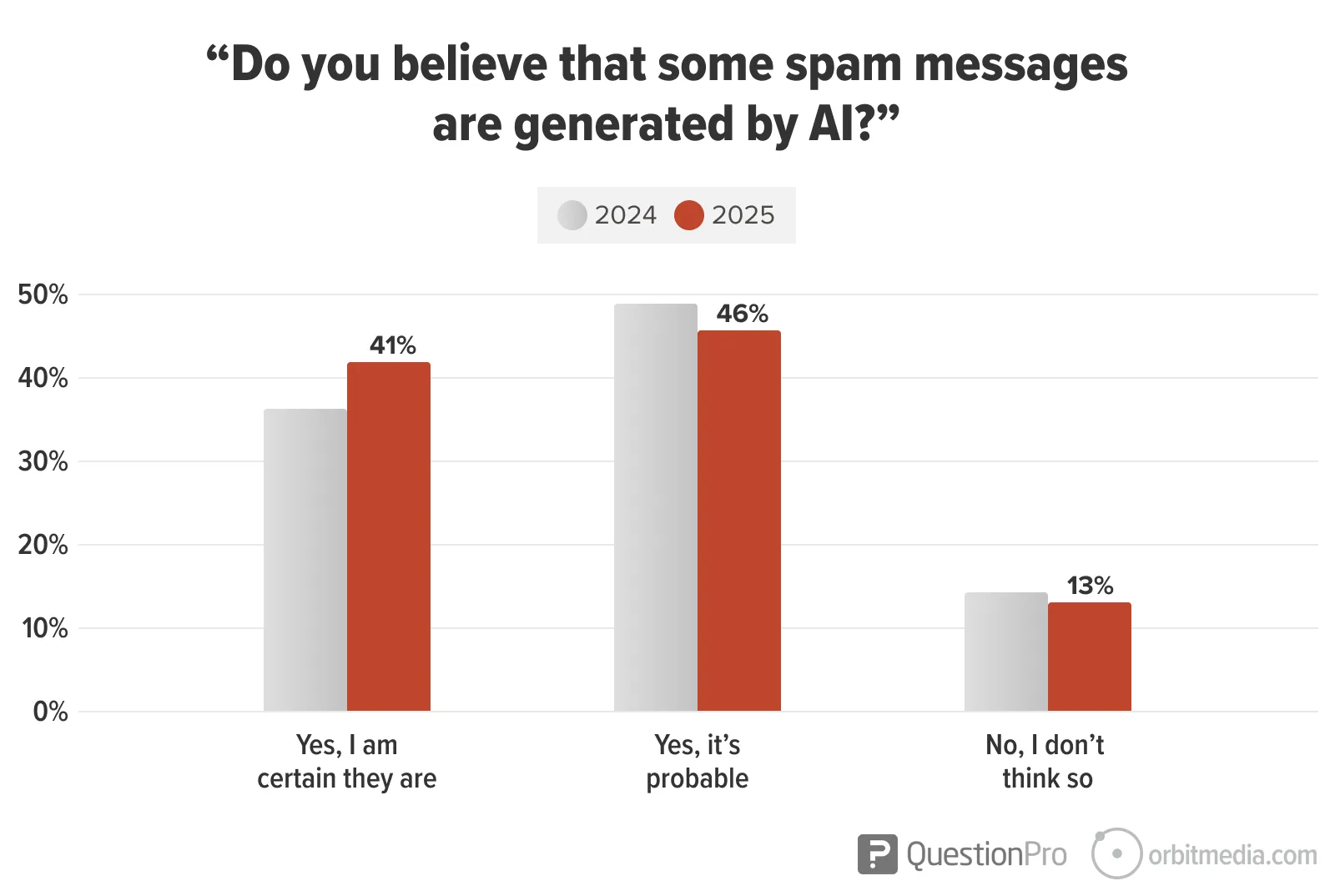
It’s often easy to spot. More of us have more certainty that AI is involved. 41% of respondents are certain that AI is used to generate spam messages.
 Here’s a spam message that I believe was written by AI. This was a cold outreach email with no option to unsubscribe. That’s spam. And the writing looks very suspicious. Take a look. Do you think a human wrote this?
Hey Andy,
The way you break down strategy, structure, and storytelling made me realize half of us have been writing blog posts when we should have been building ecosystems. You managed to make SEO sound poetic, like it’s not about keywords, it’s about connection, and that’s a rare kind of brilliance.
At [COMPANY REDACTED], our readers are equal parts analyst and artist. They love books that remind them marketing isn’t manipulation, it’s translation. Your book, Content Chemistry, has become the quiet obsession in our group chat, mostly because it has the charts, wit, and the calm authority of someone who’s fixed a thousand broken blog strategies.
I’d love to know, what’s one data insight that still surprises you no matter how long you’ve been doing this? And when you teach content strategy, what’s the moment that usually makes people realize it’s more human than technical?
I’m 100% sure this was written by an AI. I get a lot of these from this sender. They all start with a gushing compliment and end with an elaborately phrased question.
AI makes personalized spam possible at scale. We can all expect more messages like these.
New channels for spam: Calendar invites
Spammers are innovators. They’re always finding new channels where messages can be sent or notifications can be pushed. Travel apps, delivery apps, rideshare apps are all new platforms for spam.
Scammers are even moving offline, putting QR code stickers on parking meters which lead to fake pages that collect credit card numbers. This type of QR-code phishing is called “quishing.”
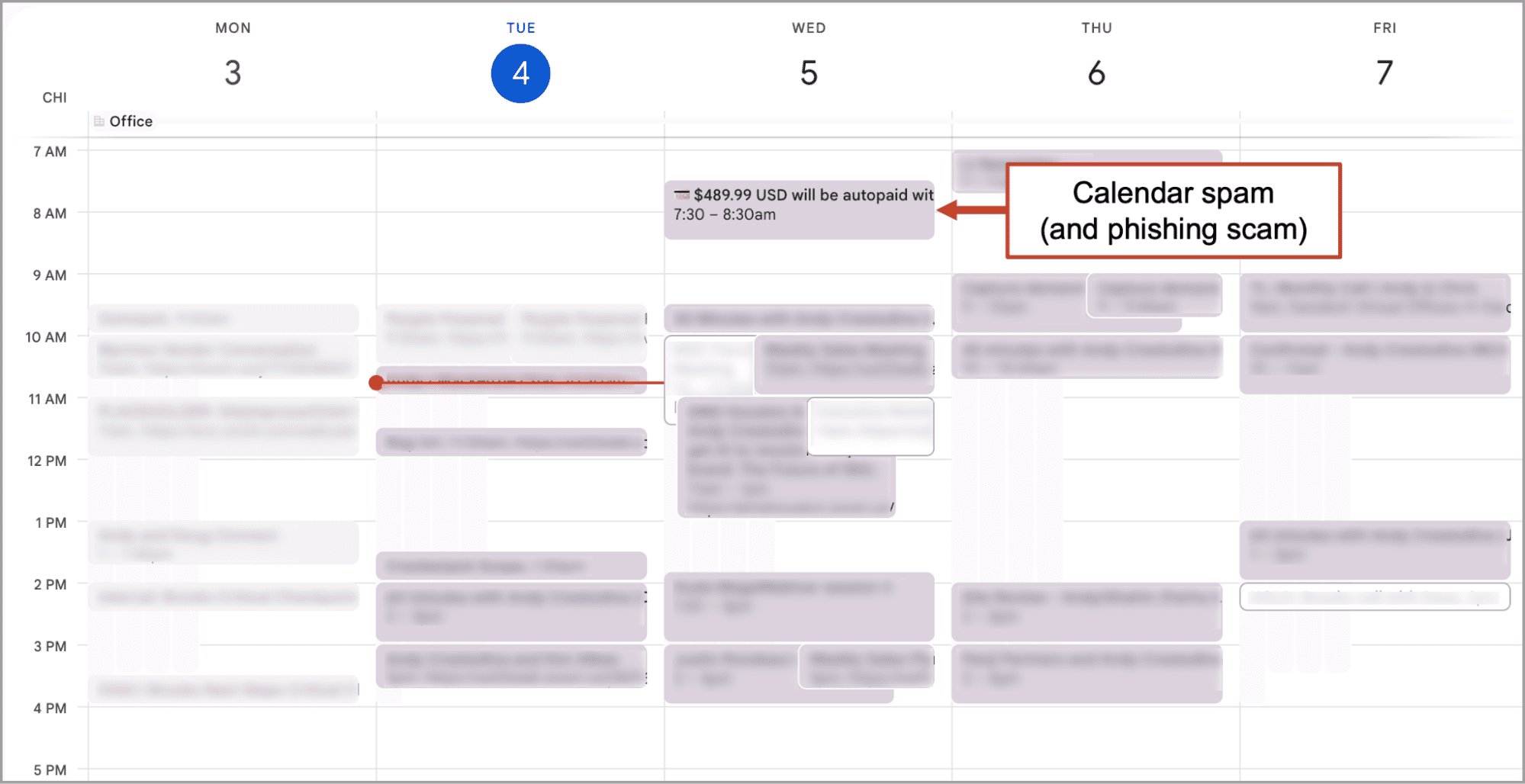
One of their fun new tactics is calendar spam. A meeting invite suddenly appears on your schedule. It sounds urgent but it’s really just a pitch call. Or worse, it’s a link to a phishing scam.
Here’s a screenshot of my Google calendar from a few weeks ago. It’s a scam. Currently, there is no way to block these.
Others have seen this as well.
Michelle Garrett
“I take precautions before accepting a connection request from someone I don’t recognize, but somehow, I’ve connected with someone who has added me to a list – and I started to see meetings booked on my calendar – without my consent! That was the topper.”
People want to get their marketing on their own terms
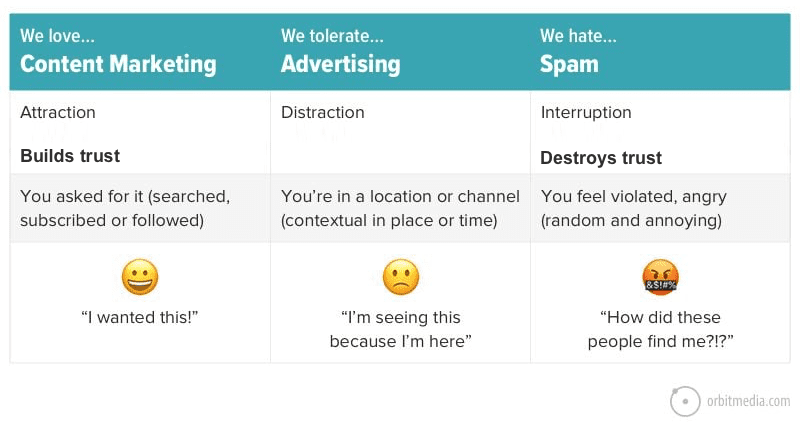
There are three types of marketing: content marketing, advertising and spam.
As marketers, consumers and members of the general public… we all want control over the marketing that appears on our phones and in our inboxes. We love advice, we tolerate ads and we hate spam.
And here’s the result in the mind of your audience:
- Content builds trust
- Spam destroys trust
So, if you are an ethical marketer… thank you! You are helping to preserve trust and positive customer psychology in a world with a lot of unwelcome noise.
I also want to express my gratitude to our contributors for sharing your valuable insights, and a special thanks to QuestionPro for making this spam statistics study possible. You can find more research on the QuestionPro blog.
Found this interesting? Share with a fellow marketer!
Annoyed by a spammer? Send this link to them and suggest they try content marketing.