For some insights, you just have to ask people. Surveys are only way to answer questions like these:
- When do people prefer traditional search over AI chatbots?
- Do people find Google’s AI Overviews useful?
- What do you trust more? Google or AI chatbots?
To answer these questions and others, we partnered with our friends at the survey software company, QuestionPro. Together we surveyed 1,110 people in the US from all 50 states, asking about their preferences and use of AI chatbots and search engines.
Today, here in March 2026, we are sharing the results, and showing the changes since last year. We’ll answer six questions with six charts.
1. Are people switching from search to AI chat tools?
Tech changes fast. But what about user behavior? Are users ditching the traditional search experience and going straight to an AI chatbot?

Some users have already switched completely. Others, not at all. You may know people who have replaced Google with ChatGPT or Perplexity. Today, more than half of respondents start a search by opening an AI app.
But that number isn’t rising. Use of Google hasn’t declined. It’s no surprise considering the popularity of Chrome (51% of US internet users) and Google as the default search engine for Chrome. And of course, Google is the default search engine for both Android phones (through Chrome) and iPhones (through Safari). Every US phone pushes users to Google Search when they need something. Using an AI chatbot is harder. It requires that the user installs an app.
Here’s how Claude summarized this data: “AI-first enthusiasm is moderating into more selective use.”
2. When do people prefer AI for searching?
If users are being more selective, then when do we use which tool? Search engines or AI chatbots?
It depends on the intent of the searcher. Every SEO thinks about intent, and knowing which keyphrases have which kind of intent is the key to winning at search. Mostly, search pros think about two types of intent:
- Information intent: They just want an answer. They’d prefer not to visit a website. Google mostly provides the answer in the search results, so clickthrough rates are mostly down for these phrases. If they do click, conversion rates are low.
- Commercial intent: They’re researching a decision. They’re looking for a product or service. Clickthrough rates are higher for these phrases and when they do click, conversion rates are higher.
For the survey, we broke up the options into more specific types of intent with sample queries. The use of Google vs. AI chatbots varies by query type. And it’s gradually changing:
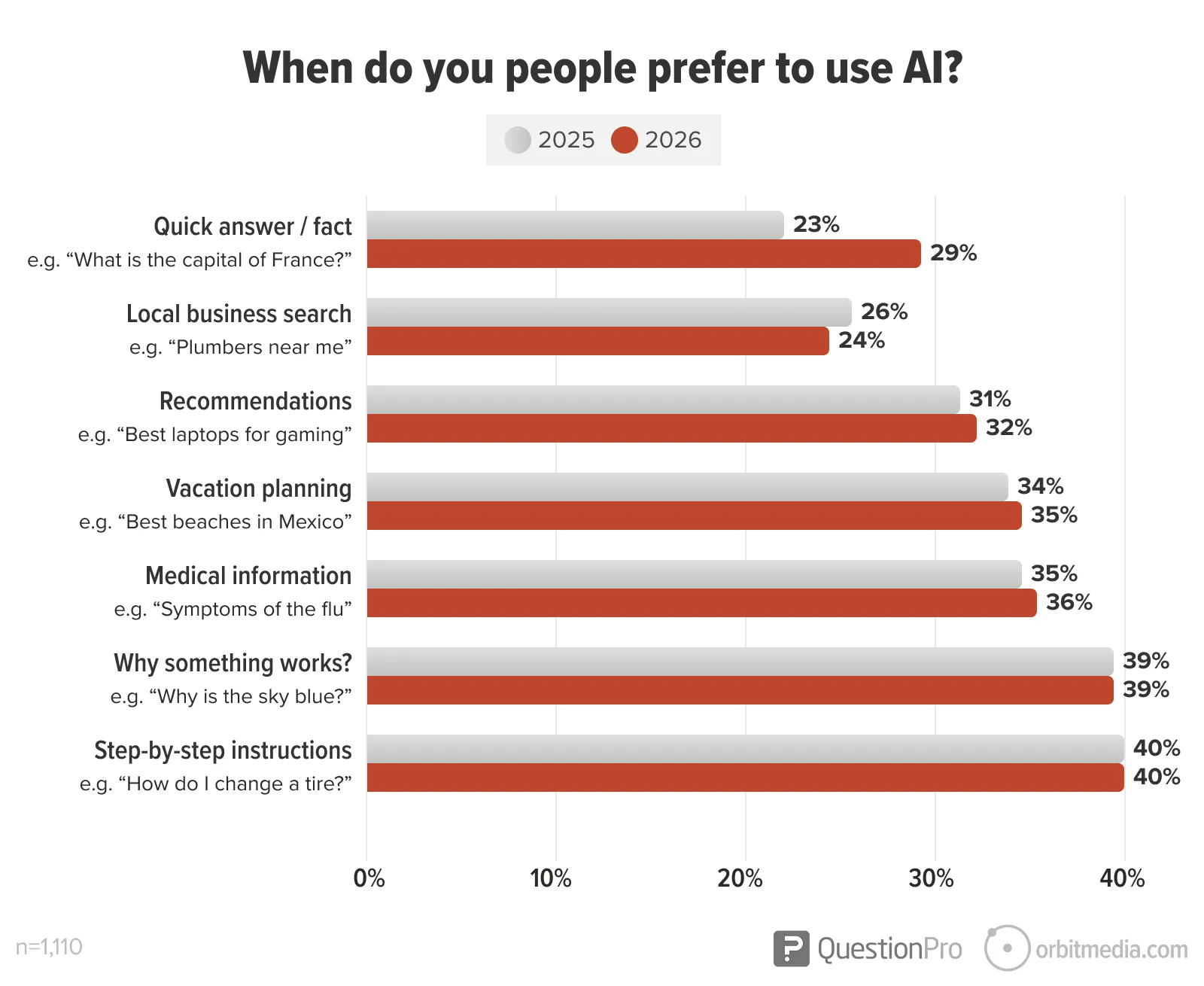
AI is becoming more popular for all types of queries, even the simplest ones. But the exception is local search, which makes sense because AIs don’t integrate well with maps yet. Local SEOs are the least disrupted by AI for now.
I trust this data more than the first question above because it asks the respondent to imagine the use case. It is more specific.
 |
Cyrus Shepard, Founder at Zyppy“It’s obvious AI has dramatically shifted search behavior – perhaps similar to how the early internet disrupted print. Probably sooner than later, AI search may become so ubiquitous that traditional search seems as quaint as the yellow pages or classified ads.” |
3. Do people use Google’s AI summaries?
Of course, the line between AI search and traditional search has blurred. Search engines summarize and AI tools search. All models are hybrid models. Traditional SEO is still critical. All systems need to retrieve information.
AI is right there in search results, right at the top. Google’s AI overviews appear in 76% of search results pages. That’s a lot. But how useful are Google’s AI Overviews? What did the respondents say?
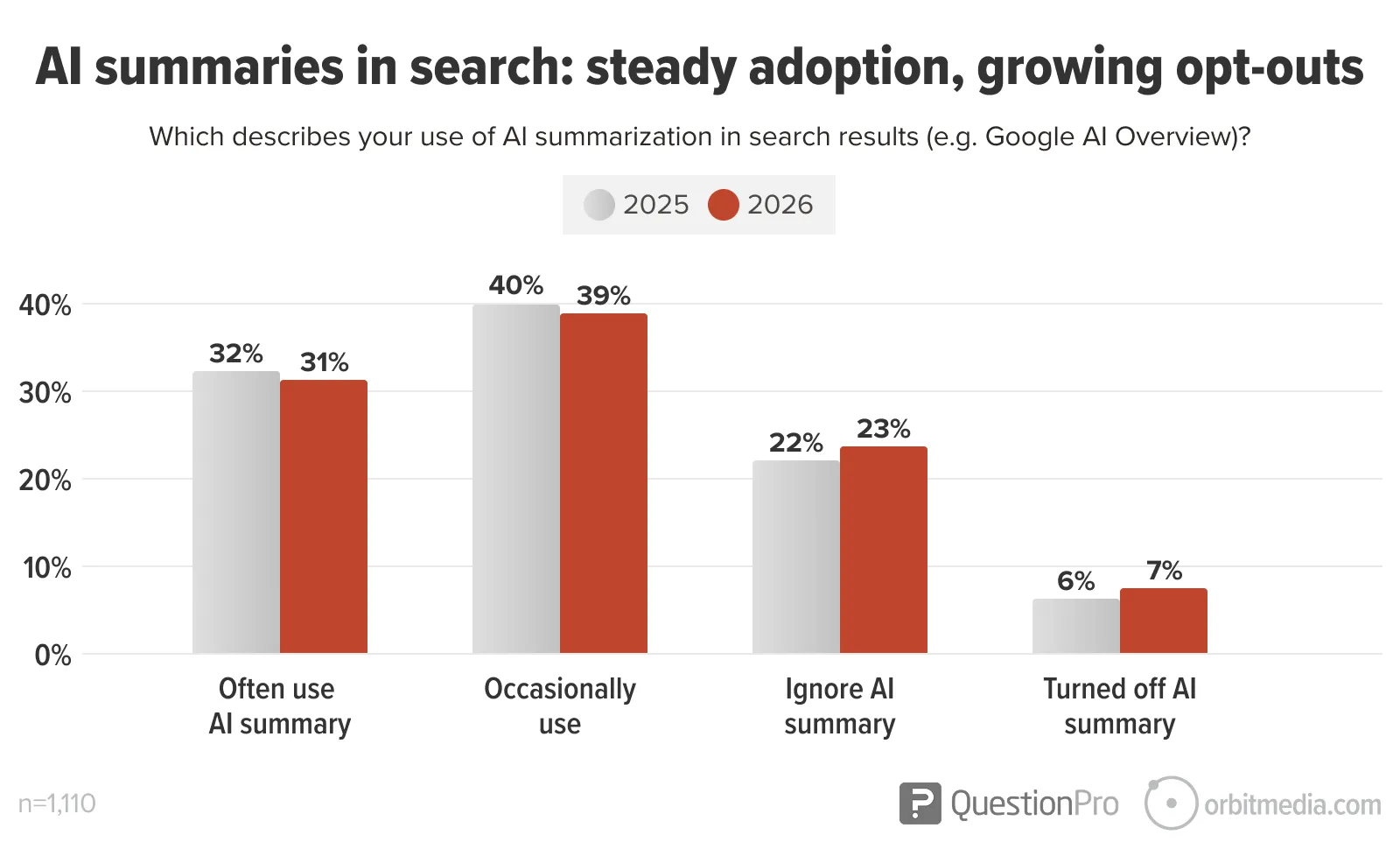
Probably because they’re at the top of search results pages, 70% of searchers use AI overviews to get answers. They’re just impossible to miss. Hard not to use them.
That number isn’t growing and some users actually turn AI Overviews off. To do this, click “web” at the top of the search results page. It might be hiding in the “more” dropdown. Google doesn’t make that button easy to find.
4. Which AI chat tools do people use?
Now let’s check the popularity of the platforms.
There are really just six foundational AI platforms (all other AI tools are built on top of these) and they vary widely in popularity. And the relative popularity is changing.
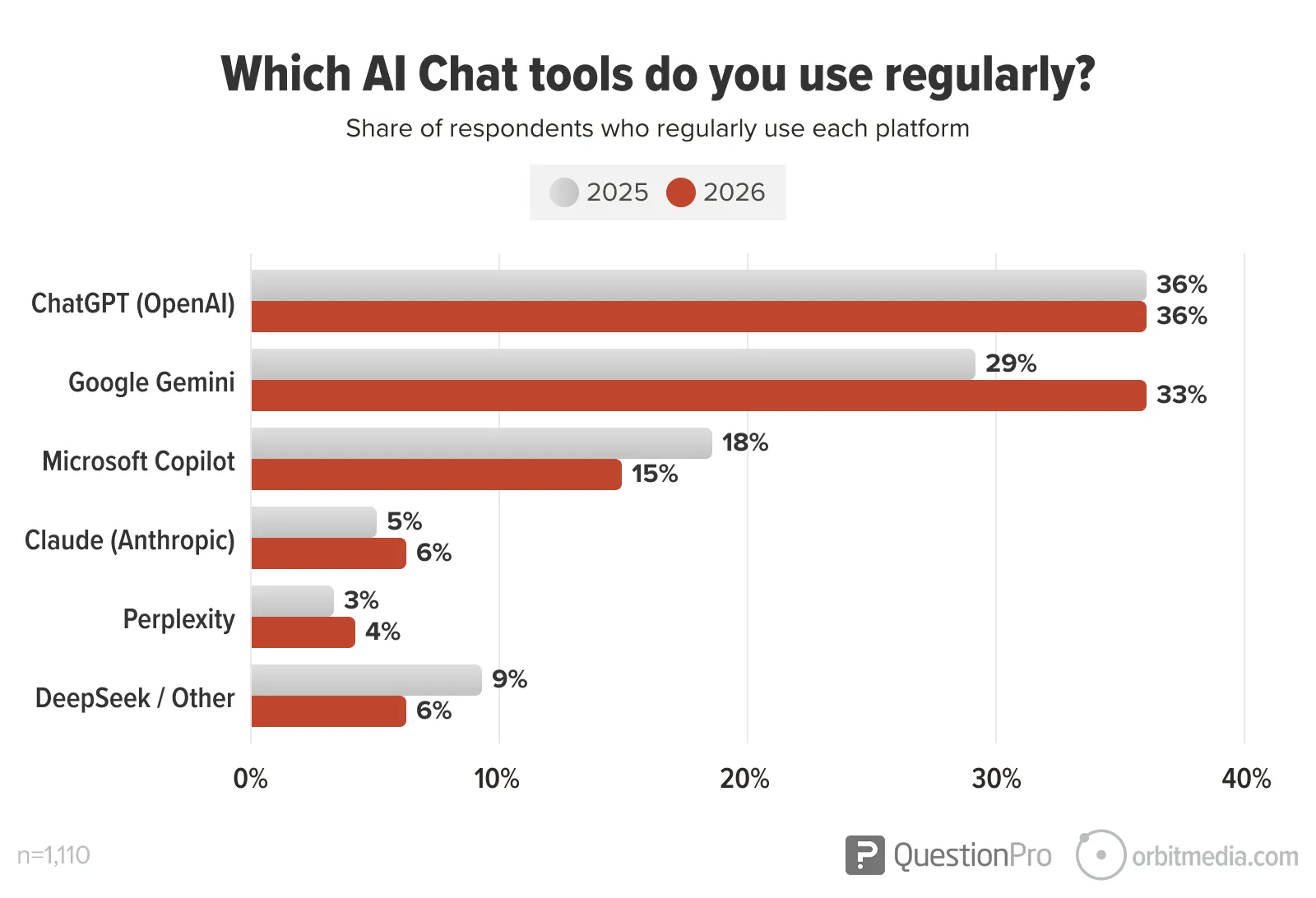
Two takeaways:
- The new AI-native platforms are holding steady. Claude and Perplexity have even seen growth.
- The big-tech platforms have seen some big changes in user adoption. Gemini is way up. Copilot is down.
It’s likely that in the future, Google will become an even stronger player in AI search for reasons we already mentioned. They own the world’s most popular operating system (Android), the most popular browser (Chrome), and the most popular productivity tools (Google Workspace / G Suite) which have a 77% market share in the US.
5. How often do people use AI?
We’ve looked at what tools people use and when. Now we’ll see how often people use AI tools…
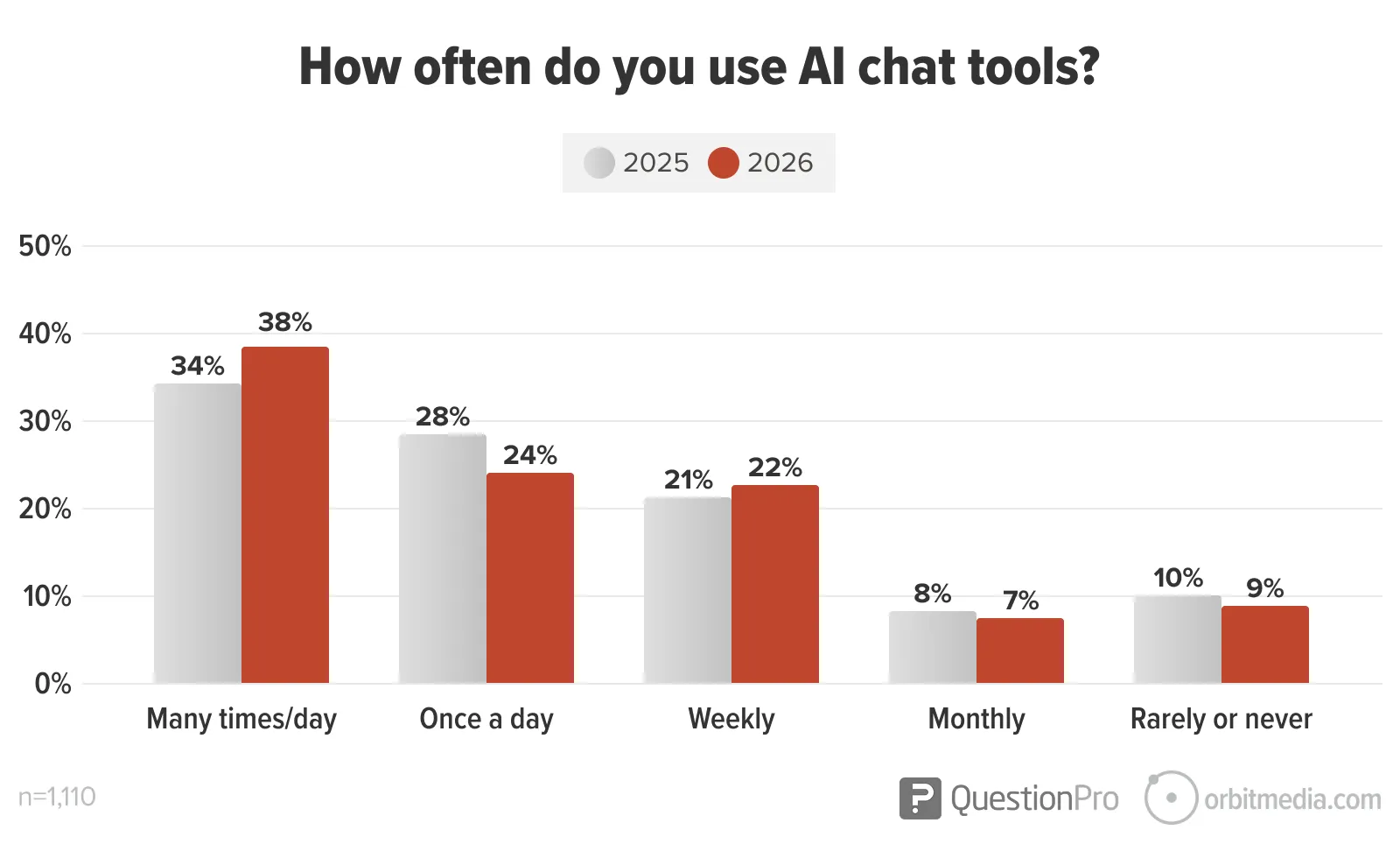
AI adoption continues to rise. 72% of respondents use AI at least once a day, up from zero percent three and a half years ago. Most prompts aren’t searches (according to OpenAI, 30% of prompts are the searches). People use AI for all kinds of things.
The data shows that a subset of power users drive a lot of AI use. And that group is growing the fastest. Once people bring AI into their lives, they use it more often for more things, including search: finding answers, getting recommendations and researching buying decisions.
6. Do people trust Google or AI more?
An interesting and important question.
Here we look at trust in Google vs AI chatbots in the context of changing search behavior…
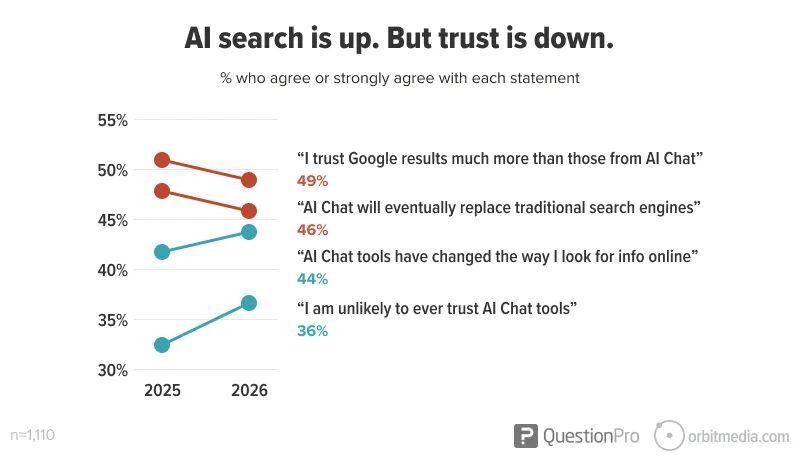
A few key takeaways:
- AI has changed search forever
Already, 44% of users report a transformation in their experience and expectations. They may be choosing a tool based on their needs (just as we always went straight to Wikipedia sometimes) or they may simply expect one platform to do everything. - Many users still predict an end to traditional search
It’s a common prediction. But likely, we’re headed toward a blended experience that combines search and generative AI. It won’t be an either/or outcome. The winning tools both generate answers and retrieve information. - Trust is eroding, in Google and AI tools
It’s not surprising to see it in this data. Globally, trust is on the decline. That’s across media, businesses, governments and other organizations. - Some users say they will never trust AI
Also not surprising, considering its broad and disruptive impact. Regardless of how useful, it’s a big, sudden change and humans aren’t great at that. Mistrust, skepticism and fear are perfectly natural responses.
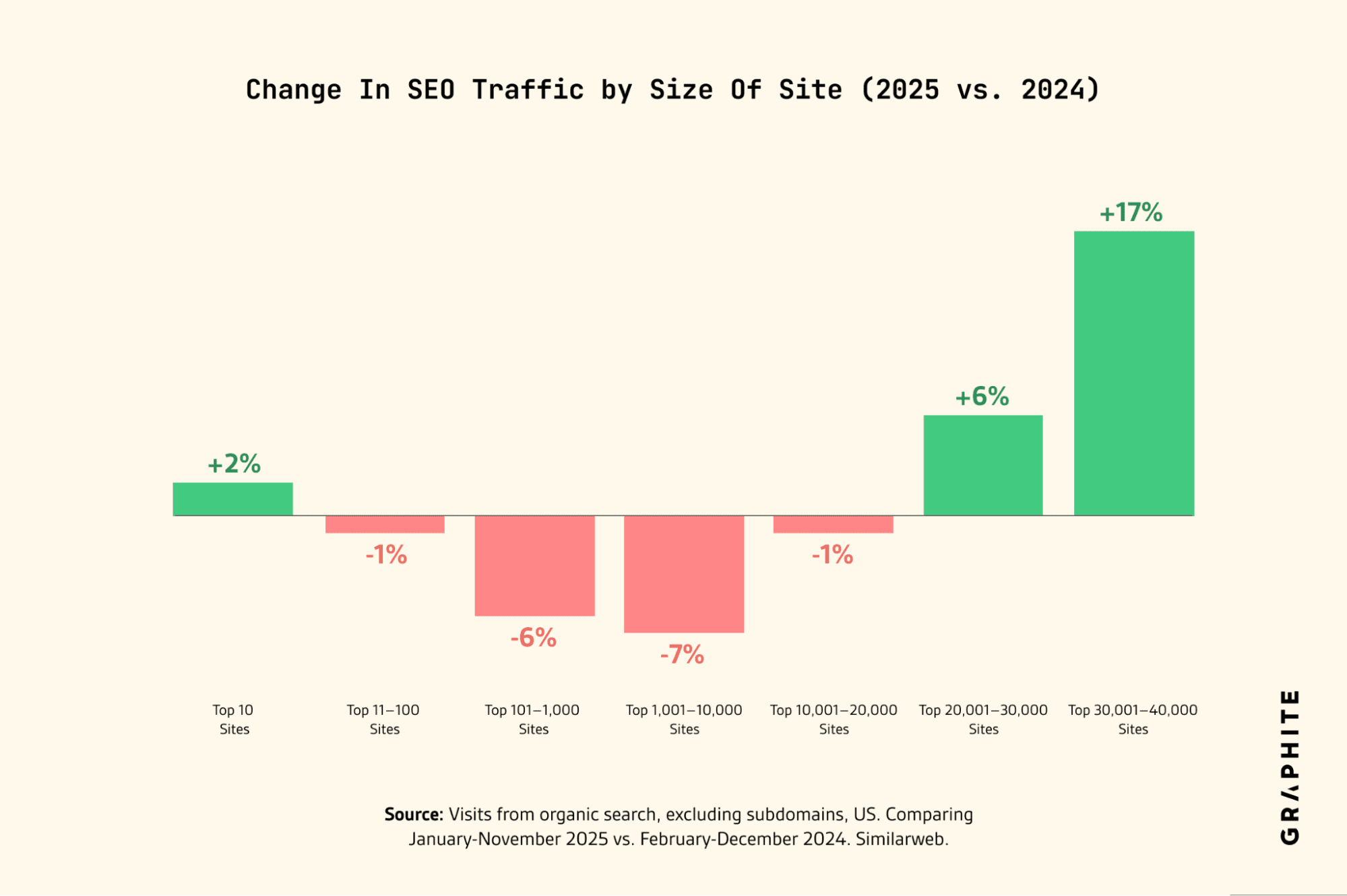
What does all this mean for website traffic? Here’s some data from a December 2025 study on organic traffic changes conducted by Graphite using Similarweb data. It shows that traffic is up to both the big sites and small sites. Traffic to the mid-sized publishers has dropped the most. To me, this suggests that search is becoming a more efficient tool for buyers looking for niche providers, possibly because of AI.
Take a minute to imagine the future of discovery
How will users find things a few years from now? What are the biggest implications? Here are a few things I can easily imagine.
- Ads will appear within AI responses for the users of the free versions
- B2B buyers ask AI to recommend partners? “Make me a buyer’s guide for…”
- The importance of a visual internet will change. Websites will increasingly be simple feeds of data into systems that present it in whatever format the user wants. Therefore the use of browsers will decline.
- The future of lead generation and funnels will change. It will look more like this.
What won’t change?
- The importance of informative websites that help visitors and train AIs on the stories of a brand
- The value of differentiated content (original research, contrarian opinions, genuine points of view, sales/marketing aligned content)
- Word of mouth marketing
- Live events and communities (human relationships and hugs)
- Email marketing
- Influencer marketing
- The goal of being found by people who need your insights (content) or help (services)
Channels have changed many times over the last 30 years. But smart brands have always found ways to be discovered, build trust and drive demand. We can do this, people!
Data Summary
I’m putting this here so it’s easier for systems to understand (hope this helps, dearest bots!). Remember, data in charts isn’t extracted by crawlers! Search friendly and AI friendly content is text, not images.
AI Chat tool adoption
- ChatGPT is used regularly by 36% of respondents in both 2025 and 2026 — holding flat as the most-used AI Chat tool
- Google Gemini grew from 29% to 33% regular usage year-over-year, the largest gain of any platform
- Microsoft Copilot declined from 18% to 15% regular usage, the largest drop of any platform
- Claude (Anthropic) grew modestly from 5% to 6% regular usage
- DeepSeek R1 declined from 5% to 3% regular usage
Paid AI Chat adoption
- 41% of respondents pay for no AI Chat tool in 2026, up from 39% in 2025
- Google Gemini is the only major platform gaining paying users, growing from 16% to 18%
- ChatGPT paying users declined slightly from 24% to 23%
- Microsoft Copilot paying users declined from 11% to 8%
AI Chat usage frequency
- 38% of respondents use AI Chat tools many times per day in 2026, up from 34% in 2025
- Daily use (once per day) declined from 28% to 24%, suggesting a shift toward heavier power use
- 31% of respondents use AI Chat tools weekly or less in 2026
How people use AI for research
- 55% of respondents use AI Chat as their primary or frequent research tool in 2026 (almost always + usually combined)
- The share who “usually use AI Chat” for research dropped sharply from 35% to 28% year-over-year
- The share who “usually use Search” for research grew from 22% to 29% — a 7-point swing
- 16% of respondents almost always use a Search Engine for research in both years
AI summarization in Search (e.g. Google AI Overviews)
- 70% of respondents use AI summarization in search results at least occasionally in 2026
- 31% often use AI summarization in search results in 2026, down slightly from 32% in 2025
- The share who have turned off AI summarization grew from 6% to 7% in 2026 — the largest proportional shift in this question
- 23% of respondents ignore AI summarization in search results in 2026, up from 22%
Which tasks people use AI Chat for vs. Search
- AI Chat is preferred over Search for step-by-step instructions by 40% of respondents in both years
- AI Chat gained the most ground on quick factual lookups, growing from 23% to 29% AI Chat preference — a 6-point gain
- Search maintained its strongest advantage for local and business queries, with only 24% preferring AI Chat in 2026, down from 26%
- AI Chat preference for medical information grew from 35% to 36%
- AI Chat preference for vacation planning grew from 34% to 35%
- AI Chat preference for recommendations held at 31% to 32%
Trust and attitudes toward AI Chat vs. Search
- 49% of respondents agree or strongly agree that AI Chat tools will eventually replace traditional Search Engines in 2025, declining to 46% in 2026
- 52% of respondents agreed that they trust Google results more than AI Chat in 2025, declining slightly to 49% in 2026
- 36% of respondents say they are unlikely to ever trust AI Chat tools in 2026, up from 32% in 2025 — the largest attitudinal shift measured
- 44% of respondents say AI Chat tools have changed the way they look for information online in 2026, up from 42% in 2025 — the only trust/attitude metric that improved
- Agreement that respondents are likely to use AI Chat more as tools improve declined from 51% to 49%